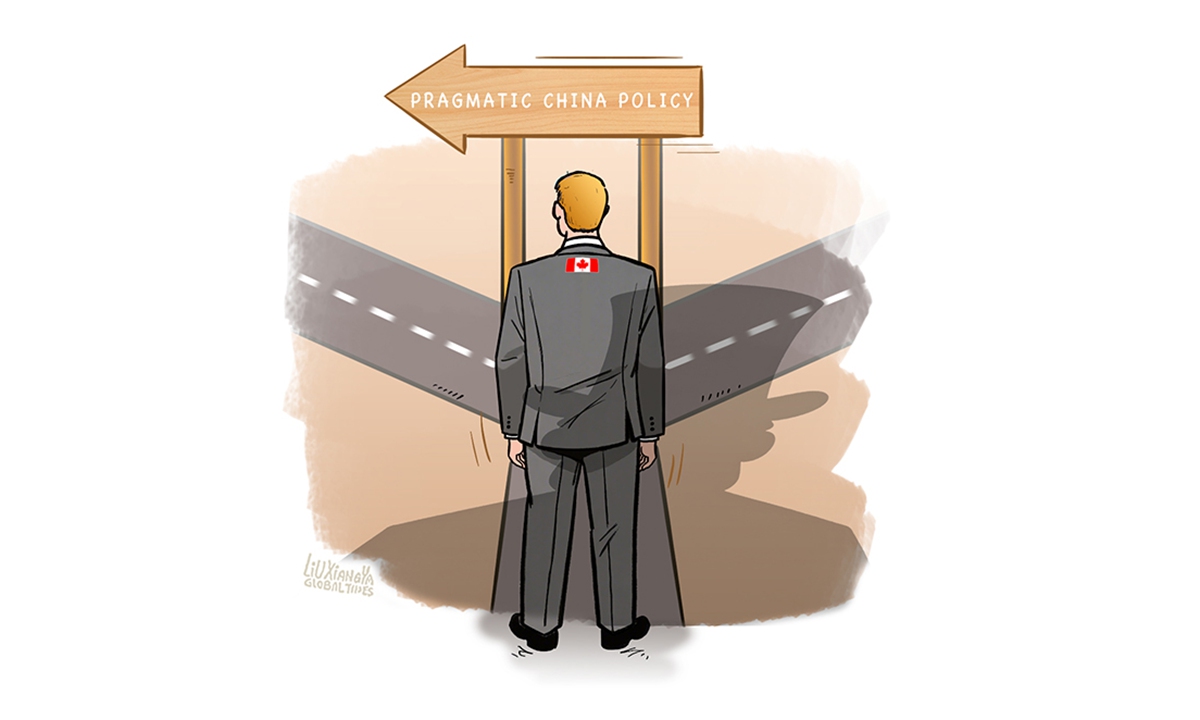
Illustration: Liu Xiangya/GT
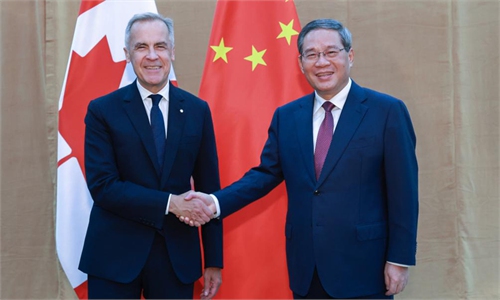
On September 23, Chinese Premier Li Qiang met with Canadian Prime Minister Mark Carney in New York. Carney stated that he had "constructive" trade talks with Li and was anticipating a meeting with Chinese President Xi Jinping as the two nations work to build a new, stable trade relationship, according to Reuters. Back in June, Li and Carney also spoke by phone, agreeing to regularize bilateral channels of communication and discussing trade issues. According to Liu Dan, a research fellow at the Center for Regional Country Studies at Guangdong University of Foreign Studies, "these interactions indicate that the Carney administration is consciously recalibrating its policy tone toward China, proactively seeking to warm relations."
What factors are driving this shift? First, the change in Canadian leadership has brought a more pragmatic orientation. Liu noted, "compared with his predecessor Justin Trudeau, Carney has a solid background in economics. The public expects his administration to focus on the economy and avoid unnecessary political strife. These expectations are also pushing Carney to repair relations with China."
Second, there are increasingly rational domestic voices calling for the Carney administration to reconsider its China policy. Canada's western provinces, such as Manitoba, Saskatchewan, and British Columbia, which have long benefited from trade with China, have repeatedly urged the federal government this year to "normalize ties with China." In September, Saskatchewan Premier Scott Moe led a trade mission to China. These amplified voices from the provinces are growing louder, pressuring Ottawa to rethink its China approach.
At a deeper level, fraying Canada-US relations have spurred Canada to strategically reduce its overreliance on Washington. Last October, in a bid to show loyalty, Canada blindly followed Washington in imposing a 100 percent tariff on the import of Chinese electric vehicles, violating the principles of bilateral free trade and straining China-Canada economic ties. Yet this gesture failed to win it any favor. The US has slapped tariffs on numerous Canadian products, even deriding Canada as "America's 51st state." The humiliation galvanized Canada's public boycotts of US goods and travel, and Canadians have increasingly begun to see the volatility and unreliability of their traditional ally, leading to reflection on the risks of excessive dependence on the US. Blindly following Washington while alienating China - Canada's second largest trading partner - clearly runs counter to Canada's long-term interests and harms its businesses and citizens. As a result, more Canadian politicians are voicing firm calls for "diversifying trade away from the US."
Carney himself also said that the "old relationship with US is over." But the question is whether Canada can truly break free from the US shadow. Can its relationship with China move beyond the policy logic of the US and forge a new, pragmatic path? Liu believes that "Canada is highly dependent on the US in both economic and security matters, and it is unrealistic to completely break free from the influence of the US in its foreign relations."
From China's perspective, it has always regarded Canada as a partner, and is open to promoting relations with Canada. Hopefully, Canada can formulate an independent and rational policy toward China based on its own national interests, rather than blindly following the US. Beijing and Ottawa have great potential for cooperation in complementary fields, such as energy, the green economy and agriculture. On multilateral issues like global governance, they also share a broad consensus. These common interests lay a solid foundation for bringing China-Canada relations back on track.
Listening to rational voices at home and seizing opportunities for pragmatic cooperation is the wise choice for Ottawa. Yet, to what extent Canada's China policy can free itself from US influence remains to be seen. Whether this path can be successfully pursued will test the political wisdom of the Carney administration.
RELATED ARTICLES