From whistles to drones: Roads, mobile internet and tourism transform life for herders in Xinjiang’s Zhaosu
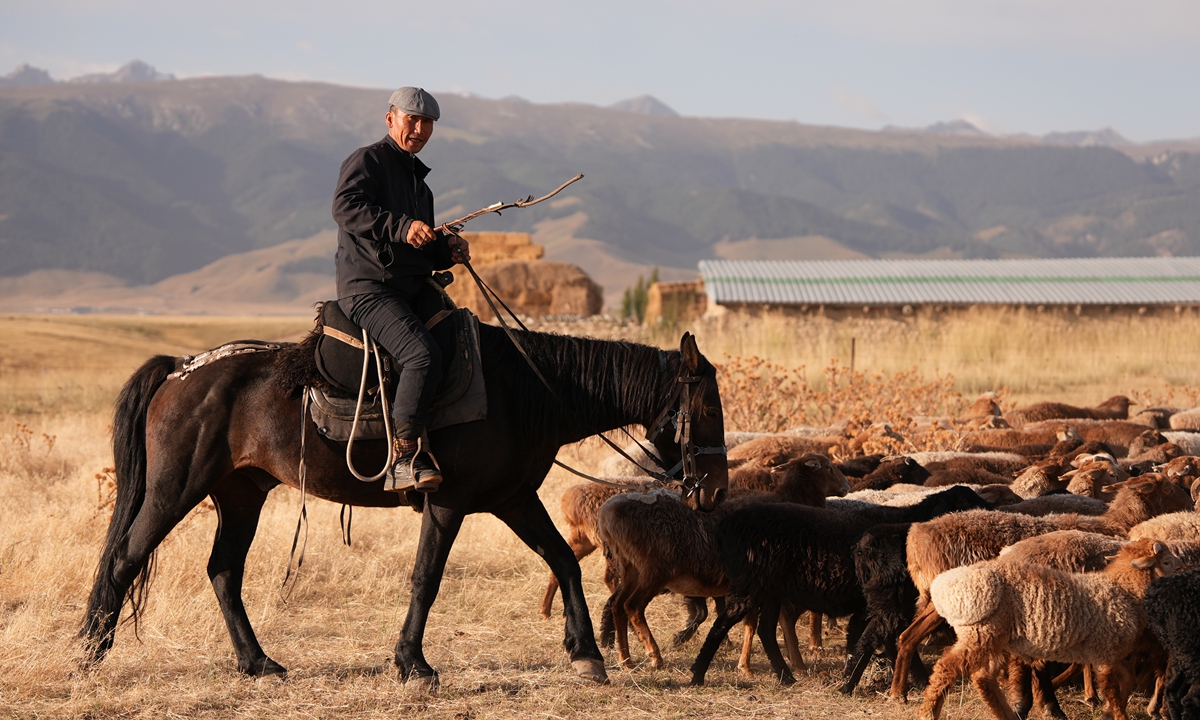
Bahetijiang, A Kazakh herder drives his flock during the seasonal migration, heading toward the winter pasture on September 4, 2025 in Zhaosu county, Ili Kazakh Autonomous Prefecture, Northwest China's Xinjiang Uygur Autonomous Region. Photo: Feng Fan /GT
High in the snowcapped mountains at more than 2,000 meters above sea level, a group of herders on horseback are urging their sheep forward. The rugged paths make it difficult to gather the flock along the planned migration route. Just as the animals threaten to scatter, a buzzing sound comes from above. A drone swoops low across the valley, its engine whirring. Spooked, the sheep turn back toward the designated route, continuing downhill under the guidance of herders stationed on both sides of the trail.
This scene was not staged but witnessed firsthand by Global Times reporters during field reporting in Zhaosu county, Ili Kazakh Autonomous Prefecture, Northwest China's Xinjiang Uygur Autonomous Region. For generations, herders in this borderland area relied only on horsewhips and whistles to drive their flocks. Today, aided by drones, asphalt roads and the mobile internet, they are practicing pastoral traditions in a more scientific, convenient and modern way. The combination of new infrastructure and technology not only reduces livestock losses during the migration but also enables herders to enjoy modern life without giving up their nomadic heritage.
Known in Chinese as zhuanchang, seasonal migration refers to relocating herds between pastures depending on weather and grazing conditions. Herders typically move livestock to higher grasslands in summer, bring them down to autumn pastures before winter, and finally return them to lower plains for the coldest months. The cycle ensures that the animals have sufficient forage while allowing pastures to recover.
Global Times reporters accompanied Kazakh herders on one autumn-to-winter migration. Among them was Nurman, a young Kazakh who returned to his hometown after graduating from university. While coordinating the loading of supplies, including raingear, sleeping bags, veterinary medicine and food, onto their vehicles, Nurman explained how life has changed.
"Now migration is different from the past," he said. "We have cars and can take asphalt roads into the mountains. This road was built specifically to make seasonal migration easier for herders."
Alongside trucks carrying goods, another vehicle transports horses into the deep mountains, where they would still be used to access summer pastures unreachable by road. Yet what once took days on horseback can now be accomplished in just over an hour of riding after disembarking from vehicles.
"In high-altitude areas unsuitable for grazing, herders turn them into summer pastures. In summer, we drive the livestock here. In autumn we move them out and let them stay in autumn pastures. Then in winter, we bring them back again. That's the whole migration process," Nurman explained. "Now, with road access, we no longer need to travel long distances on horseback like before."
Technology changes herding
The spread of new technologies has further transformed pastoral life. With precise weather forecasts, herders can better decide when to move their flocks. Drones allow them to monitor herd positions and even assist in driving animals. Internet coverage along roads and in parts of the mountains enables them to navigate with smartphones.
Global Times reporters observed that during migrations, some herders communicate via WeChat groups to seek help or share updates on their herds. "Some herders set up groups online. When they need to migrate or find herding help, they post in the group. Others may even entrust their sheep to neighbors," Nurman said.
Better infrastructure also means herders no longer need to live a fully nomadic life. Many can now settle in towns or county seats while continuing to manage livestock remotely or with short commutes to pastures. With access to modern housing, logistics and industrial goods, they enjoy a standard of living unimaginable for their grandparents.
At the same time, younger generations are infusing local life with fresh vitality. Nurman, like many other returnees, is combining tradition with entrepreneurship. With a smartphone constantly at hand, he manages accounts on platforms such as RedNote, TikTok and Instagram to promote Zhaosu's unique culture and landscapes. Through these channels, he attracts visitors to experience herding life and pastoral scenery, enabling him to run a small but growing cultural tourism business.
"Sources of income here for herders are actually quite limited," Nurman told the Global Times. "The reason I returned to my hometown was partly to take care of my parents and partly to encourage them [to start businesses]. At the same time, I also hope to inspire local herders to engage in cultural tourism and sell their agricultural products. This way, their income channels will broaden and overall earnings will significantly improve."
Nurman's story is far from unique. Across Zhaosu, and indeed the entire Ili Kazakh Autonomous Prefecture, young people are using cultural tourism to diversify income streams while preserving farming and herding traditions. By tapping into Xinjiang's booming tourism sector, they are finding new employment opportunities and injecting vitality into local communities.
Evolving to services boom
Zhaosu, located on the border and long known for rich grasslands, was once almost entirely dependent on livestock breeding. According to the county government's website, Zhaosu has abundant pastoral resources and is famous for its ecological environment. Yet it is no longer merely a herding county. In 2024, Zhaosu's GDP grew by 6.3 percent year-on-year to 6.93 billion yuan ($974 million). Of this, the service sector contributed 3.39 billion yuan, accounting for 48.9 percent of the total, surpassing the long-dominant farming and herding industries.
This pattern is not unique to Zhaosu. Xinjiang as a whole has seen a tourism boom. Data released by the Xinjiang Uygur Autonomous Region shows that in the first half of 2025, Xinjiang's GDP reached 984.65 billion yuan, up 5.7 percent from the previous year. The services sector contributed 532.99 billion yuan, or about 54 percent of the total. Analysts note that cultural tourism and modern services are becoming major engines of regional growth, complementing traditional industries.
For herders like Nurman, this shift represents both opportunity and responsibility. From the sight of drones buzzing over sheep to herders using smartphones in mountain pastures, Zhaosu offers a vivid illustration of how modernization is transforming Xinjiang's pastoral communities. As Global Times reporters observed on the ground, herders are no longer bound to the old image of wandering nomads who "follow water and grass." Instead, they are carving out a new lifestyle, one that is settled, connected and entrepreneurial, while ensuring that the centuries-old rhythm of seasonal migration continues.
In this transformation, the essence of tradition is not being lost but revitalized. The mountains still echo with the sounds of whistling herders and bleating sheep, but now those echoes are joined by the hum of engines, the ping of smartphone notifications, and the chatter of tourists eager to experience pastoral life.
RELATED ARTICLES