Rare national second-class protected wild plant found at 5,300 meters on Mount Himalayas
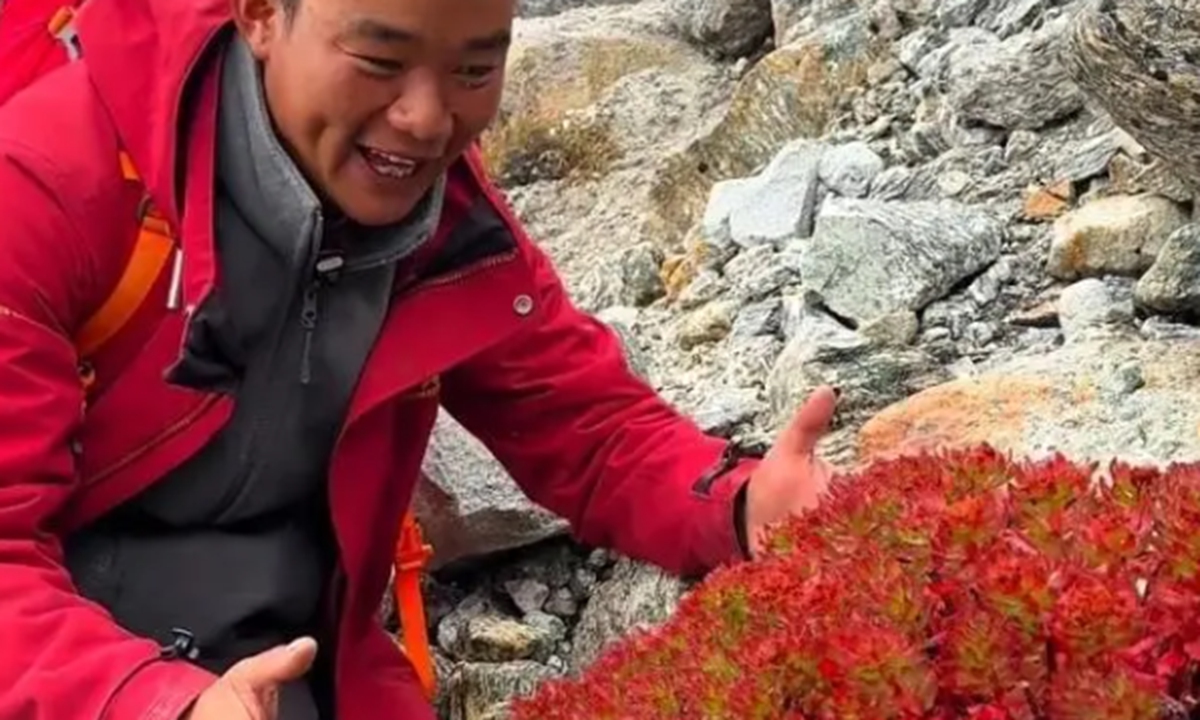
A social media account named "Sherpa Tenzin" posted a video clip saying this on social media Douyin.com, showing a rare, second-class nationally protected plant discovered in the Himalayas. Photo: web
"The world is full of wonders! I saw the nationally protected plant Rhodiola rosea on a snow-capped mountain more than 5,300 meters high—it was incredibly beautiful!" A social media account named "Sherpa Tenzin" posted a video clip saying this on social media Douyin.com, showing a rare, second-class nationally protected plant discovered in the Himalayas, Jimu News reported on Monday.
The video quickly attracted widespread attention. As of the time of reporting, it had garnered over 300,000 likes. It showed clusters of vibrant red Rhodiola rosea growing amid barren rocky crevices, with each cluster covering an area of approximately one square meter.
Sherpa Tenzin said he discovered the Rhodiola rosea on the eastern slope of Mount Qomolangma in Tingri county, Xigaze city, Southwest China's Xizang Autonomous Region, at an altitude above 5,300 meters. He added that although he has lived in the area for many years, it was his first time seeing such a large quantity of Rhodiola rosea at such a high altitude—noting that this variety is rare.
Local forestry and grassland officials said that Rhodiola rosea is not commonly seen in the region and only appears sporadically.
As a traditional Chinese medicinal herb known for boosting vitality and improving blood circulation, Rhodiola rosea is believed to boost blood flow, reduce fatigue, strengthen immunity, and is often used to address physical weakness and alleviate symptoms of altitude sickness such as dizziness and shortness of breath. Primarily growing in high-altitude regions like the Qinghai-Tibet Plateau, it is revered as the "Immortal Herb of the Plateau," according to thel WeChat account of Dongzhimen Hospital at the Beijing University of Chinese Medicine.
Rhodiola rosea has been listed as the national second-class protected wild plant, under China's List of Wild Plants under State Priority Conservation.
RELATED ARTICLES