First full-time Chinese-spoken spokesperson of US State Department appears in media
By Published: Sep 25, 2025 03:45 PM
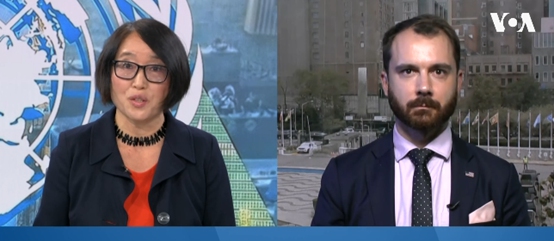
US State Department's first-ever Chinese-language spokesperson Jakob Lengacher(right) talks with a reporter of US official media VOA on September 24, 2025. Photo: screen shot of VOA Chinese
The US State Department's first-ever Chinese-language spokesperson Jakob Lengacher, who has been appointed months ago, appeared in the media as he received interview with US official media VOA, published on Thursday.
The 10-minute video, released on VOA Chinese, featured Lengacher speaking in fluent Chinese as he fielded a series of questions from a reporter.
US State Department has long had foreign language speakers, including Arabic, Hindi and Russian speakers. Previously there was only a part-time Chinese spokesperson, and Lengacher is the first full-time Chinese-language spokesperson for the department, Lengacher said, according to the VOA release in Chinese.
In the interview, Lengacher mentioned US President Donald Trump's speech at United Nations General Assembly (UNGA), US-China relations, and also answered questions about the Gaza conflict and the Russia-Ukraine conflict.
When it comes to US-China relations, the past rhetoric from the US society has been rather complex.
Such as, recently, Air Force Secretary Troy Meink likened today's geopolitical threats to the Sputnik shock of 1957, warning that the United States risks falling behind adversaries, particularly China, unless it accelerates innovation across air and space programs, according to spacenews.
However, it is noteworthy that in this interview with VOA, the Chinese-spoken spokesperson placed significant emphasis on the importance of China-US relations.
This aligns with the relatively positive assessments of China made by some US officials recently.
When asked about the focal points of controversy and areas of significant disagreement in the current US-China relationship and how does the US plan to address these differences, Lengacher cited Secretary of War, Pete Hegseth, saying the US does not seek conflict with China, but there are indeed some areas in the Indo-Pacific region where potential disagreements may arise. However, while we do not seek conflict, the US will actively protect its national interests, VOA said in the report.
The addition of a Chinese-language spokesperson in the US State Department is nonetheless unusual, Lü Xiang, a research fellow at the Chinese Academy of Social Sciences, told the Global Times.
US policy toward China has traditionally been communicated in English, often through media outlets like VOA under a veneer of objectivity. The recent appointment of a Chinese-language spokesperson at the State Department now creates a seamless link between official policy and its presentation by these media channels, Lü said.
"Look at the VOA, together with the Chinese-spoken spokesperson, it's completely a mouthpiece of the US government," he said.
Li Haidong, a professor at the China Foreign Affairs University, told the Global Times that he believes that setting up a full-time Chinese-language spokesperson could mean that the US has recognized the importance of prioritizing its relations with China.
While acknowledging the importance of China-US relations, this spokesperson remains a propagandist for US policy, not a policymaker. The key question is whether American officials will back their rhetoric with concrete actions, Li said.
According to information released on the US Department of State, Lengacher is the first full-time Chinese spokesperson of the Department of State, starting July 9, 2025.
Lengacher is based in Washington, DC, and works in coordination with the Asia-Pacific Media Hub in Bangkok, Thailand. His previous diplomatic assignments include Sao Paulo, Brazil, and Singapore, the US Department of State wrote in his profile.
Prior to joining the State Department, Lengacher spent several years in Harbin, China, as a Fulbright and Boren scholar and worked as a Chinese-language researcher for a nuclear nonproliferation NGO.
He holds an MA in Nonproliferation and Terrorism Studies from the Middlebury Institute of International Studies at Monterey and a BA in Chinese from the University of Massachusetts Amherst. He speaks Mandarin Chinese, Portuguese, and Russian.
RELATED ARTICLES