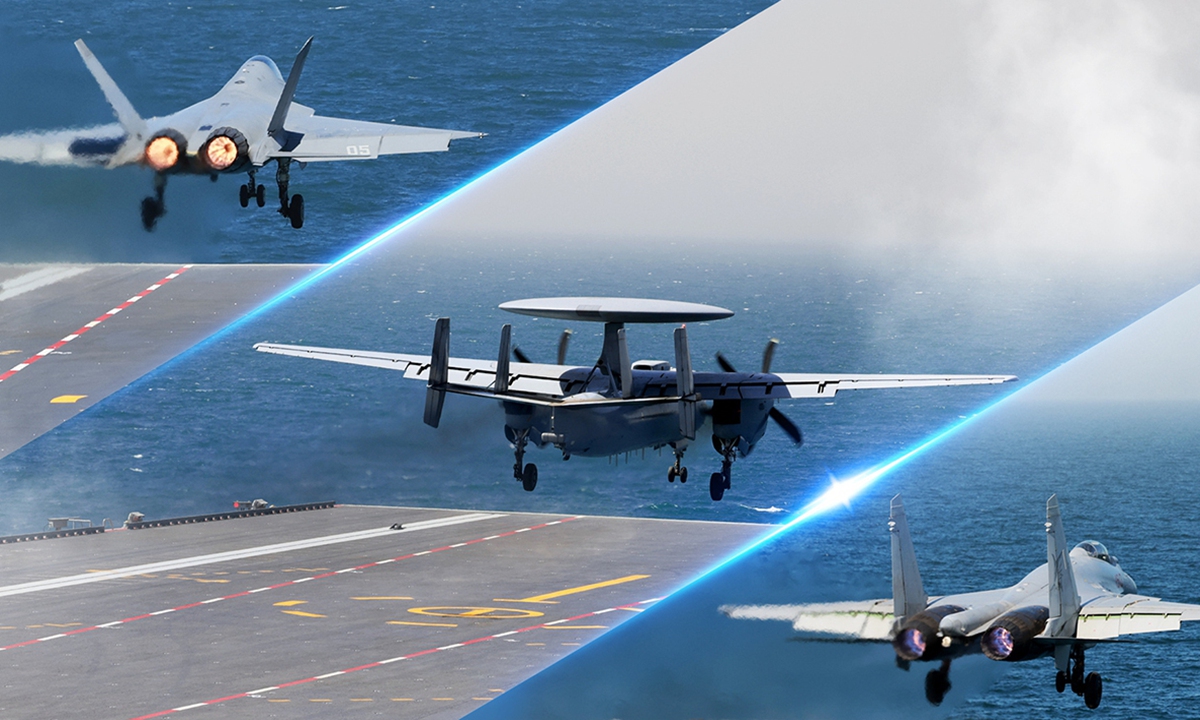
China's first electromagnetic catapult-equipped aircraft carrier, the Fujian, has achieved a breakthrough by hosting the first catapult-assisted takeoff and arrested landing training for the J-15T heavy fighter jet, the J-35 stealth fighter jet, and the KJ-600 early warning aircraft, the Chinese People's Liberation Army (PLA) Navy announced on September 22, 2025. Photo: China Military Bugle
China's third aircraft carrier, the Fujian, has successfully demonstrated its capability to use its electromagnetic catapult, also called EMALS (electromagnetic aircraft launch system), by conducting catapult-assisted launches and landings for three key carrier-based aircraft: the J-35, J-15T and KJ-600.
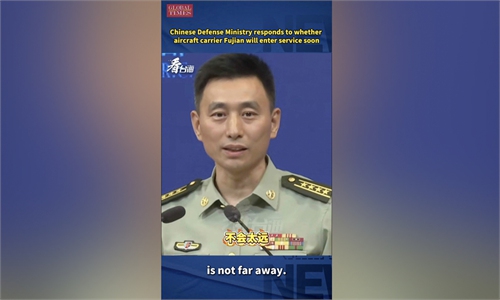
Video footage of their takeoff and landing exercises quickly went viral online. This signals a critical step forward in the development and holistic integration of China's naval combat architecture. This indicates that the Fujian is getting closer to entering active service, with far-reaching significance.
From the perspective of carrier strike group capability, the combination of these three aircraft represents a milestone in China's establishment of a complete carrier-based combat system.
The J-35 is China's domestically developed next-generation stealth fighter, capable of conducting air superiority missions as well as a variety of strikes against ground and naval targets. It forms a key component of both stealth and counter-stealth operations - in other words, it can effectively "punch through" an adversary's air defense radar network. The J-15T fighter jet can serve as a "missile truck," following the J-35 to strike additional long-range targets. The KJ-600 early warning and control aircraft, which offers extended endurance and radar range, is capable of conducting surveillance and detection, command and control, target designation and operational coordination. Dubbed the "sea and air command center," it can comprehensively direct aircraft such as the J-35 and J-15T to execute strikes and maintain vigilance over enemy movements.
The lineup of the J-15T, J-35 and KJ-600 serves as a low-key demonstration that the carrier's air combat system is now fully complete. The essential elements for China's carriers to operate in the open seas are in place. This is a pivotal milestone in the history of Chinese aircraft carriers.
The overall combat and support capabilities of the Fujian carrier strike group have seen a significant leap compared with the earlier Liaoning and Shandong groups. The main reason is the major transformation of the core carrier itself: Transitioning from ski-jump takeoff to electromagnetic catapult launch has brought a qualitative improvement in carrier operational capability.
The Fujian's electromagnetic catapult has been the focus of much discussion in the US media. The EMALS allows carrier aircraft to take off with heavier weapon and fuel loads, as well as accelerate aircraft more smoothly. The US Naval Institute, among others, specifically noted that the Fujian is now the "only other vessel outside the US Navy to be equipped with the advanced aircraft launching system." The USS Gerald R. Ford was the said to be first aircraft carrier to employ EMALS to launch combat jets.
Yet reports claim that the "Ford is the first carrier to feature a catapult system not powered by steam, and issues have plagued EMALS for years," and that it is yet to launch an F-35C Lightning II stealth fighter using EMALS.
On the other hand, it should be noted that the Fujian did not just conduct catapult tests during this recent South China Sea deployment. During previous sea trials, the carrier had already completed multiple catapult and arresting gear landing tests. China maintains strict requirements for carrier sea trials. Success will not be announced based on just one or two tests. The electromagnetic catapult and arresting systems are confirmed only after extensive land- and sea-based testing to ensure their design is sound, reliable and safe.
With the successful deployment of the electromagnetic catapult technology on the Fujian, the Chinese Navy has entered a new era of blue-water operational capability, which will inevitably alter the balance of power in the Western Pacific. The Fujian's electromagnetic catapult not only supports multiple aircraft types, but also significantly extends their time on station in air while fully loaded with fuel and armaments, thereby increasing their flight range.
Previously, the Chinese Navy's operations were largely limited to the "first island chain," now it can project power as far as the "second island chain," decisively breaking through the traditional "near-seas defense" model and steadily accelerating its transition to far-seas defense.
It is foreseeable that the Fujian is drawing ever closer to active service. One can boldly predict that following its South China Sea deployment, the Fujian will most likely enter service, forming China's third aircraft carrier strike group.
Upon the Fujian's commissioning, the formation of a three-carrier fleet comprising the Liaoning, Shandong and Fujian will mark China's formal entry into the era of triple-carrier naval capability. This will not only enable routine carrier readiness training and enhance blue-water operational capabilities but also allow China to effectively safeguard national sovereignty and contribute to regional and global peace and stability.
At that point, the Chinese Navy will be even more confident in protecting maritime rights and conducting far-seas operations.
The author is a Chinese military affairs expert. opinion@globaltimes.com.cn
RELATED ARTICLES