IN-DEPTH / IN-DEPTH
GT investigates: From classrooms to politics – uncovering multifaceted infiltration of illegal religious organization ‘Yiguandao’
A key fight
By Published: Sep 25, 2025 07:07 PM

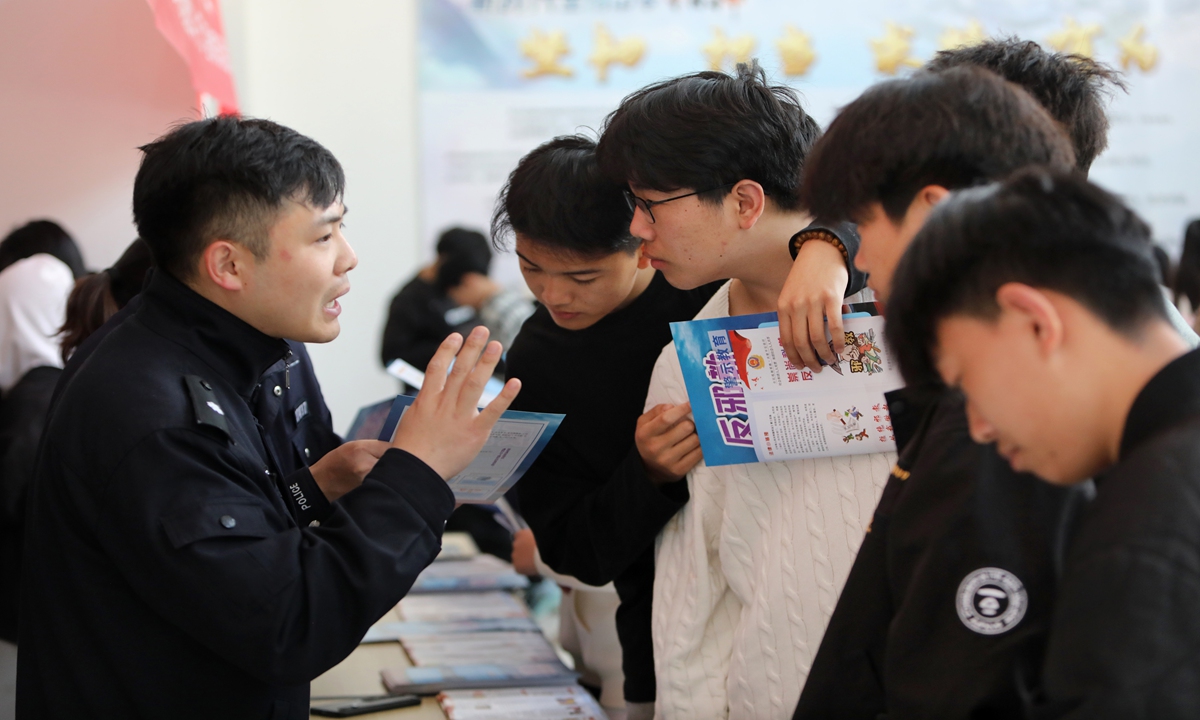
A police officer explains the dangers of cult organizations to students in Lianyungang, East China's Jiangsu Province on April 10, 2025. Photo: VCG
Forcing kindergarten children to kowtow thousands of times in classrooms, preaching under the guise of "studying traditions" in primary schools, or deifying themselves to amass wealth… Recently, multiple cases involving the religious organization Yiguandao have been exposed, drawing widespread societal attention.Yiguandao, or I Kuan-Tao, originated in Qing Dynasty (1644-1911), claiming to be a fusion of Confucianism, Buddhism, and Taoism, and has long operated under the veneer of traditional culture, according to the China Anti-Cult Network, an official website launched in 2017 against the cults under the Ministry of Public Security.
The China Anti-Cult Network underlines that the organization has a notorious history, having repeatedly disrupted social order and even engaged in political activities. Shortly after the founding of the People's Republic of China in 1949, authorities lunched multiple crackdowns on it.
By reviewing the interactions between Taiwan's regional leaders and Yiguandao, as well as the organization's overseas expansion, the Global Times found that the sect has grown significantly on the island of Taiwan, forming ties with political parties and politicians, securing a place in the political ecosystem, and being used as a tool for overseas infiltration to serve specific political agenda.
Yiguandao displays cult-like traits such as doctrinal distortion, leader worship, and extortion, and the recent actions against Yiguandao on activities in the Chinese mainland were both timely and necessary, Yan Kejia, director of the Institute of Religious Studies at the Shanghai Academy of Social Sciences, told the Global Times.
Exposed illegal organization
"Recruiting younger members brings greater 'merit.'"
Recently, police in Anqiu, East China's Shandong Province, cracked a case involving a resurgence of the Yiguandao organization. Over more than two years, the organization recruited over 600 members, including more than 30 minors. Among those implicated was a primary school Chinese teacher accused of luring more than 20 students into joining Yiguandao, according to a report by the news center of Ministry of Public Security on September 8.
In another case in South China's Guangdong Province, members of Yiguandao operated a kindergarten as a sect venue, recruiting teachers and indoctrinating students with distorted teachings. Students were reportedly forced to perform kowtows hundreds of times to statues such as the "Unborn Mother," according to the report.
The main perpetrators and others were found to have violated the law through activities by the sect, breaching provisions of China's Criminal Law and the Public Security Administration Punishment Law. Their sentences ranged from six months to three years of detention, with fines of 6,000 ($845) to 20,000 yuan, said the report.
The China Anti-Cult Network then published detailed articles to state the history of Yiguandao. Founded in 1877 during the Emperor Guangxu era of the Qing Dynasty, Yiguandao venerates the "Eternal Venerable Mother" as the supreme deity. The sect promotes feudal superstitions while deceiving followers to extort money, commit sexual crimes, and even endanger lives.
Yiguandao claimed the world was in the doomsday stage and that only by joining the sect can one be saved and escape the suffering of reincarnation.
During World War II, Yiguandao ringleader collaborated with the Japanese imperialists, collecting military intelligence and aiding in the invasion of China.
Even after the war, Yiguandao disrupted the War of Liberation (1945-1949) and maintained an opposite stance against the newly established People's Republic of China, spreading political rumors and inciting armed rebellion, the China Anti-Cult Network documented.
The Beijing Municipal Government issued a notice on December 19, 1950, banning Yiguandao. The next day, the People's Daily published an editorial titled "Resolutely ban the Yiguandao."
By 1953, the sect's domestic structure was largely dismantled, and its heads fled to the island of Taiwan, according to the China Anti-Cult Network.
Yan told the Global Times that while Yiguandao is currently not officially listed as a cult, its activities display cult-like traits, including distortion of religious doctrines, leader worship, and extortion.
Sects like Yiguanjiao were classified as "Huidaomen" in China, which refers to folk secret societies based on religious heterodoxy, according to a statement published by the Ministry of Public Security in 2021.
"Yiguandao is one of the most large-scale and harmful 'Huidaomen' organizations in modern Chinese history," the China Anti-Cult Network stated in an article titled "Recognizing the harmful nature of the Yiguandao organization" in July.
According to the China Anti-Cult Network, these sects exploit people's fear of the unknown and desire for health and happiness, using intimidation and temptation to control members.
In recent years, "Huidaomen" organizations have used religion or traditional culture as a cover to commit crimes, amass wealth, and commit sexual offenses. Public security authorities nationwide have strengthened crackdowns.
For example, in early 2025, a man in Central China's Henan Province, calling himself the "Kunlun Boy," propagated end-of-world doctrines and claimed that only by following his teachings could adherents "eliminate disasters and cure illnesses," while controlling followers and extorting money, sexually assaulting 10 women and collecting over 5 million yuan. In another case in Shuozhou, North China's Shanxi Province, a Huidaomen sect illegally collected over 72.6 million yuan, claiming that followers must perform rituals at sect-controlled temples to "repay karma."
Zheng Yonghua, a researcher at the Beijing Academy of Social Sciences and author of the book Huidaomen Since Modern Times, explained that sects like "Huidaomen" "appear to combine Confucianism, Buddhism, and Taoism, but in reality, distort all three and incorporate folk myths and feudal customs," according to the China Anti-Cult Network.
Yan said that recent crackdowns on Yiguandao in the Chinese mainland were timely and necessary. The current Yiguandao presence on the mainland is essentially a "revival" of a banned sect; its roots must be clarified and activities strictly stopped.
Families and schools should establish educational and preventive mechanisms, encouraging students to report illegal activities such as "rituals," "ceremonies," or "sermons" outside legal religious settings, he said.
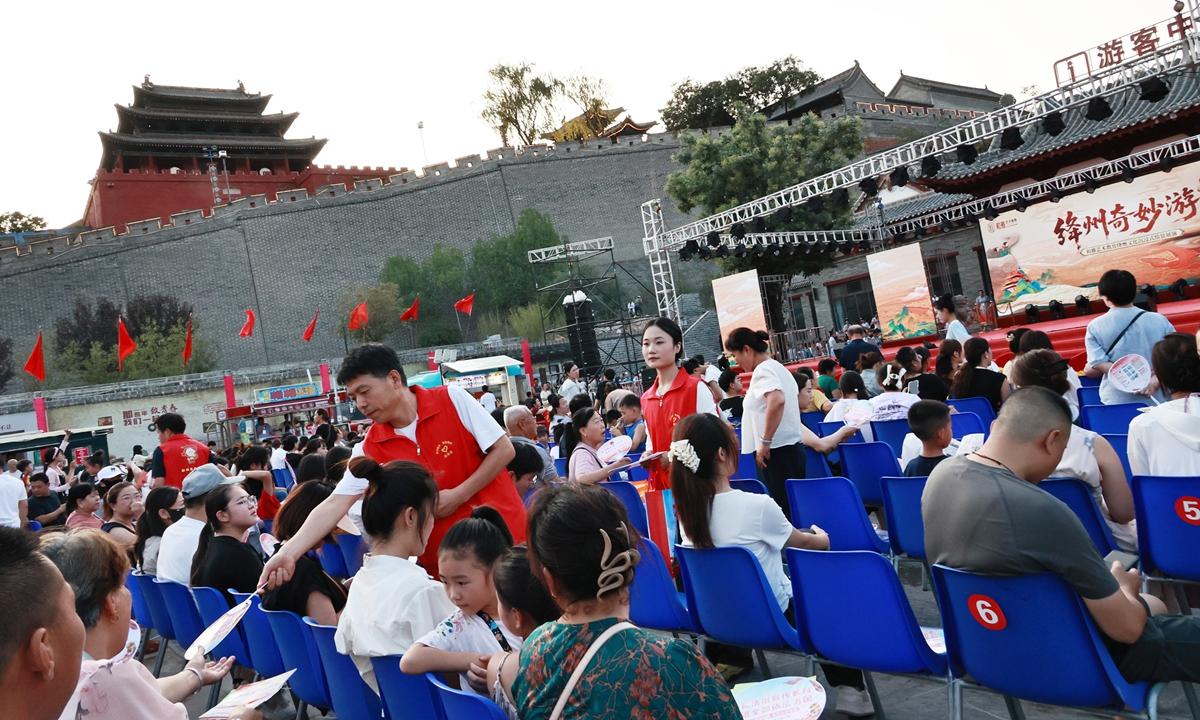
Volunteers from a local justice department distribute legal awareness handbooks and provide consultations, anti-cult education to the public in Yuncheng, Shanxi Province, on July 30, 2025. Photo: IC
Deep roots in Taiwan islandWhile mainland authorities continue to dismantle remnants of Yiguandao, the illegal organization has gradually grown in the island of Taiwan, with a substantial following and an increasingly visible presence in politics.
After its introduction to the island of Taiwan, Yiguandao was banned for many years, but the prohibition failed to stop its activities. By cultivating favor with local authorities and involving itself in local elections, the organization was officially legalized in 1987 in Taiwan, the China Anti-Cult Network said.
According to a US State Department report on religions of the island of Taiwan in 2023, Yiguandao adherents account for roughly 2.2 percent of the island's population, making it the fifth-largest religious group on the island, exceeding the number of Catholics.
In recent years, political figures in the island have repeatedly attended its events to mobilize supporters, while Yiguandao leverages political endorsement to expand its influence, forming a mutually exploitative relationship, the Global Times found.
For instance, in October 2020, the then island's regional leader Tsai Ing-wen and her deputy Lai Ching-te attended the inauguration of a Yiguandao temple. Tsai described Yiguandao as "an important partner for deepening democracy and promoting a harmonious society," according to the website of Taiwan authorities.
In October 2023, the pair also attended the funeral of a senior Yiguandao member and issued a commendation, according to the website.
Academics and the media have also analyzed the "mobilization" relationship between religion and politics on the island of Taiwan. In February 2025, the Taipei Times reported that religion has legitimized political visits to temples, particularly during election periods, highlighting a direct link between religious participation and voter mobilization.
The article included a photo showing Lai, who was already the regional leader, attending a Yiguandao temple and publicly claiming its positive contributions to social harmony and public welfare on October 30, 2024.
The China Anti-Cult Network stated that in recent years, Yiguandao members in the island have entered the Chinese mainland under the pretexts of tourism, to visit relatives, for investment, charity, or academic exchange, engaging in activities described by authorities as infiltration and subversion. There are signs of a resurgence of Yiguandao activity in the Chinese mainland, which warrants heightened vigilance.
In December 2024, the State Council Taiwan Affairs Office confirmed that three "Huidaomen" members from the island were arrested by public security authority in South China's Guangdong Province on charges of "organizing and using a reactionary sect to undermine law enforcement."
The Straits Exchange Foundation of the island said that the detained three were members of Yiguandao from the Taiwan island, Taipei-based CNA reported.
In response to protest from the DPP authorities, Chen Binhua, spokesperson for the State Council Taiwan Affairs Office, stated at a press conference that the arrests were lawful and that the individuals' legal rights were guaranteed. Meanwhile, he asserted that the DPP authorities' political maneuvering could not obscure the fact that these actions interfere with cross-Straits exchanges and cooperation.
A tool for overseas political influence
While Yiguandao expands through organizational networks and political ties, it functions overseas more like a transnational web.
From Southeast Asia to North America, and from South Pacific islands to the Indian subcontinent, Yiguandao frequently held international conferences, established temples and foundations, and extended its influence into local politics, business, and media. These cross-border activities, cloaked in a religious guise, were also reportedly leveraged to serve Taiwan authorities' political agenda, the Global Times found.
In 2024, the Bangkok Post reported that the World Yiguandao Summit was held in Singapore, while in 2025 it moved to Indonesia, extending activities into some of India's poorest regions.
In North America, California hosts the "worldwide headquarter" along with multiple registered temples and foundations, Yiguandao claimed on its website.
An anonymous expert residing long-term in a South Pacific island country told the Global Times that Yiguandao expands its church size through initial training, indoctrination, offering promotions to senior disciples, and cultivating instructors.
Core members carry out local activities under the guise of religion to broaden influence. Senior adherents actively engage with local political and business elites or communities, promoting "Taiwan independence." Some senior managers have infiltrated the upper levels of United Front-linked organizations to gather information on Chinese communities, he said.
The expert said that with increasing China-South Pacific engagement, Yiguandao's activities face some restrictions, but core personnel continue business and religious operations both in China and island nations, enlarging temples. While some operations have shifted from public to behind-the-scenes, activity levels remain high.
Yan stressed that relevant government departments, especially at the grassroots level, should actively assume responsibility for tracking, preventing, and dismantling illegal religious and cult activities. Given the long-term and complex nature of cults, the recent actions against Yiguandao serve as a warning.
RELATED ARTICLES