Fujian’s sea trials outpace expectations, paving way for PLA Navy’s three-carrier era: official media
By Feng Fan, and Liang Rui Published: Sep 27, 2025 08:12 PM

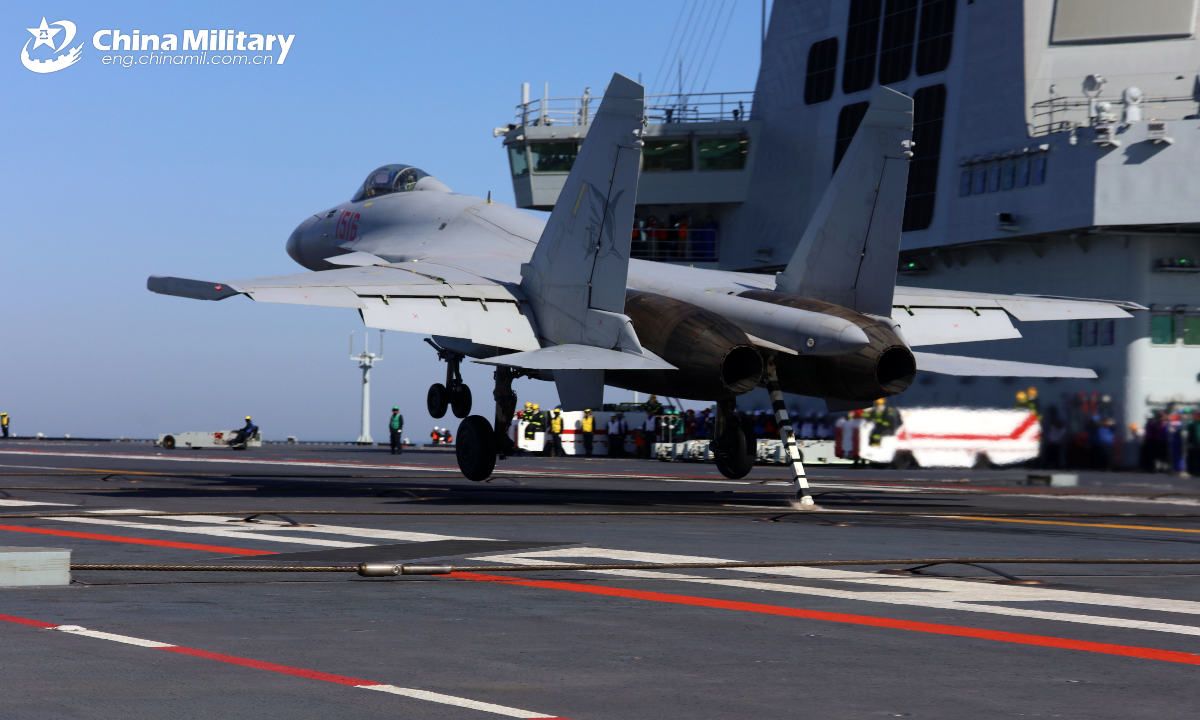
A J-15T heavy fighter jet lands on China's first electromagnetic catapult-equipped aircraft carrier, the Fujian (Hull 18). Three types of aircraft recently completed their inaugural electromagnetic catapult-assisted takeoff and arrested landing trainings on the aircraft carrier.(eng.chinamil.com.cn/Photo by Ju Zhenhua)
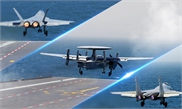
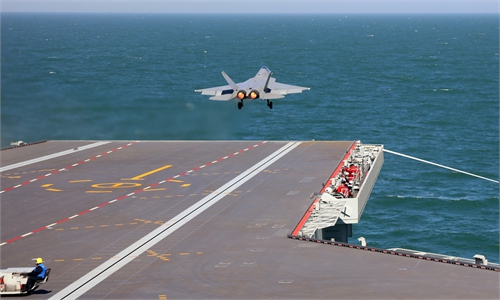
Chinese aircraft carrier Fujian has completed multiple sea trials since its maiden sailing in May 2024 and announced the successful completion of a key electromagnetic catapult test in September 2025, putting the carrier's progress "well ahead of schedule," CCTV News reported on Saturday.The carrier's trials have included the first successful electromagnetic catapult-assisted takeoff and arrested landing trainings for three types of carrier-based aircraft — the J-15T, J-35 and KJ-600 early warning aircraft — marking China's first achievement of electromagnetic catapult launches and arrested recoveries for multiple advanced aircraft types on a single carrier, CCTV reported, quoting the Chinese People's Liberation Army (PLA) Navy's announcement on September 22.
CCTV said Fujian — China's first domestically designed and built electromagnetic catapult-equipped carrier — was launched on June 17, 2022. With a full-load displacement of more than 80,000 tonnes, the ship features a flat, continuous flight deck and is fitted with electromagnetic catapults and arresting gear, making it the world's first conventionally powered carrier to adopt electromagnetic catapult technology.
The vessel completed an eight-day initial sea trial on May 8, 2024, during which its propulsion, power and other systems underwent a series of tests and "achieved the expected results," CCTV added.
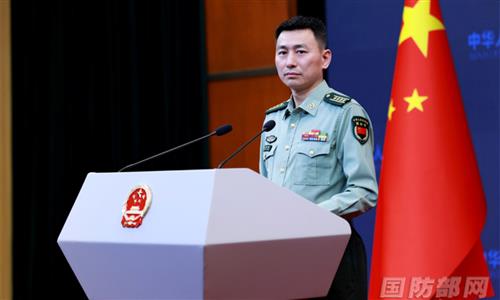
On September 12, the navy said Fujian transited the Taiwan Straits en route to the South China Sea to carry out scientific testing and training missions, according to a statement by Senior Captain Leng Guowei, a spokesperson for the PLA Navy. 10 days later, the navy publicly confirmed the multi-type catapult test successes that signal the carrier's electromagnetic takeoff and arrest systems have met operational requirements.
Chinese expert expressed optimism about Fujian's remaining trial and commissioning timeline. Based on the current sea trials and training situation, the Fujian could become combat ready in a year or so, Wang Ya'nan, chief editor of Beijing-based Aerospace Knowledge magazine, told the Global Times.
Wang added that he expects the Fujian to conduct more intensive training exercises after it is commissioned in to the PLA Navy later this year.
CCTV military observer Wei Dongxu said Fujian — working in concert with the Liaoning and Shandong carriers — could form a two-carrier task-force model that expands the PLAN's blue-water escort and defensive capabilities.
Wei pointed out that, while the Shandong and Liaoning currently lack carrier-based fixed-wing early-warning aircraft, the presence of the KJ-600 aboard Fujian could enable coordinated carrier-air wing operations across the three-carrier force, improving situational awareness and providing mutual backup in demanding flight-deck or combat conditions.
Wei told CCTV that one practical benefit would be handling contingencies during operations: if one carrier were temporarily unable to recover its air wing for any reason, "the other carrier can act as a temporary sea-based airfield, allowing aircraft from Carrier A to land on Carrier B." Such redundancy, he said, would strengthen the fleet's resilience to unforeseen disruptions.
Looking further ahead, Wei predicted the emergence of a new family of intelligent carrier-based unmanned aerial vehicles. "First would be loyal wingmen for strike roles — unmanned combat aircraft that could operate in concert with the J-15T and J-35 — and second would be support types for tasks such as electronic warfare and aerial refuelling," he said.
Wei added that Fujian, or future larger and more modern carriers, may ultimately host an integrated force of manned and unmanned carrier aircraft that together form a novel carrier combat system.
RELATED ARTICLES