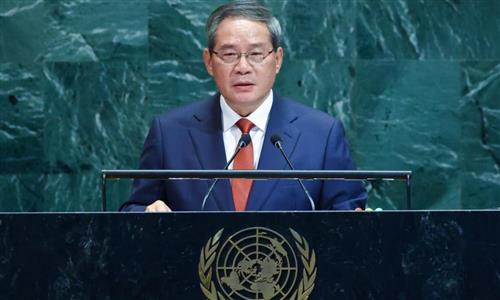
China champions multilateralism at UN, calls for joint actions for world peace, development
Nation always a responsible participant in addressing global challenges: Premier
By Published: Sep 27, 2025 09:55 PM
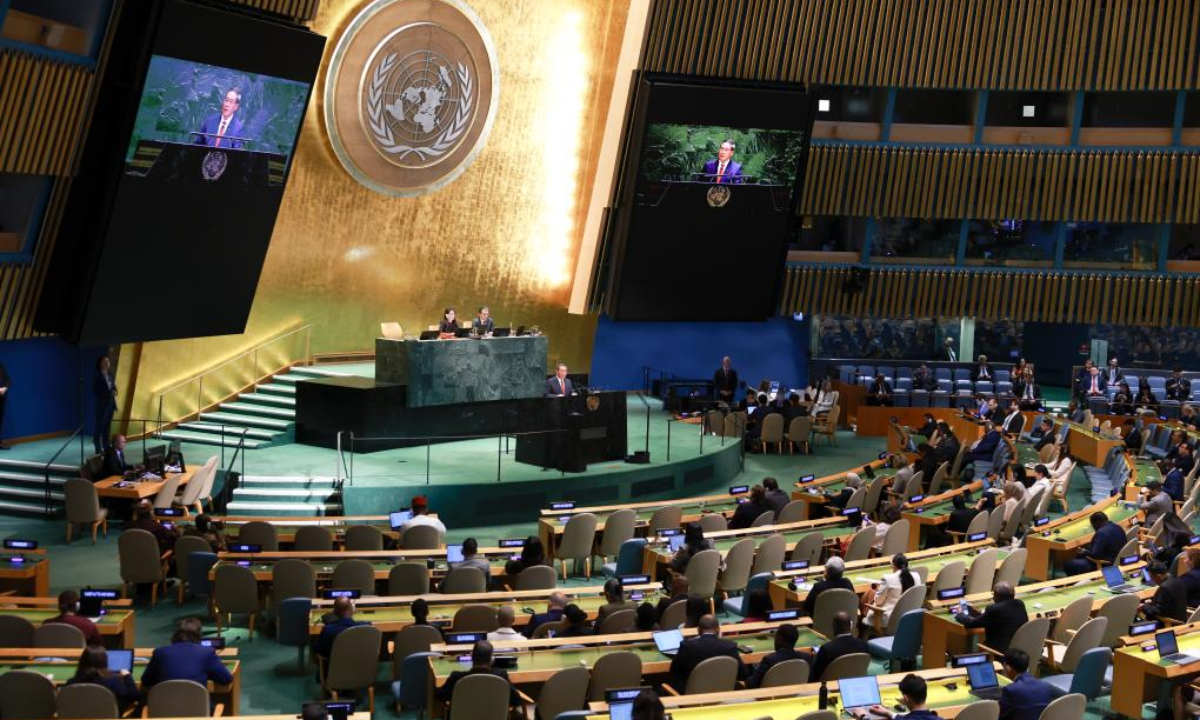
Chinese Premier Li Qiang delivers a speech at the general debate of the 80th session of the UN General Assembly at the UN headquarters in New York, Sept. 26, 2025. (Xinhua/Ding Haitao)
China's role as a defender of multilateralism and a proponent of a fair and inclusive international order was highlighted at the UN stage on Friday local time, amid global challenges and shifting geopolitical dynamics.
In his speech delivered at the 80th session of the UN General Assembly, Chinese Premier Li Qiang pledged China's readiness to work with all parties to take coordinated and effective actions to solve more practical problems and promote world peace and development, the Xinhua News Agency reported.
He said that China will also always be an important promoter of global common development, an active practitioner of exchanges and mutual learning among civilizations, and a responsible participant in addressing global challenges, according to Xinhua.
Analysts said China is not only a participant but also a de facto leading force in fostering global cooperation and addressing pressing issues such as climate change, economic stagnation, and regional conflicts. By advocating for true multilateralism and supporting reforms to enhance the UN's efficiency and inclusivity, China seeks to rectify inequities in the global system and promote a more just and orderly world.
Defender of multilateralism
During his speech, the Chinese Premier stressed that the UN was an important outcome of the victory of the World Anti-Fascist War, and was born out of a deep reflection on the scourge of two world wars, adding that the UN was created upon the ideal of a world free of war.
He described the UN as the world's most universal, representative, and authoritative intergovernmental organization, and said it plays an irreplaceable, key role in global governance.
"History keeps reminding us that when might dictates right, the world risks division and regression… Only when all countries, big or small, are treated as equals and true multilateralism is practiced, can the rights and interests of all parties be better protected," Li said.
The Chinese Premier said that China has all along acted as a staunch defender of world peace and security. Noting the fact that China is the second largest contributor to the UN peacekeeping budget and the largest provider of peacekeepers among the permanent members of the Security Council, Li said China has been working actively to promote peace talks on hotspot issues such as the Ukraine crisis and the Palestinian-Israeli conflict.
"China stands ready to work with all members to uphold the standing and authority of the UN, safeguard the purposes and principles of the UN Charter, support UN reforms to improve its efficiency and capacity to fulfill its mandate, and advocate a greater representation and voice for developing countries," Premier Li said.
According to Wang Youming, Director of the Institute of Developing Countries at the China Institute of International Studies, the current international order is marked by disorder, imbalance, and dysfunction.
Certain Western powers, driven by exceptionalism, unilateralism, and a "nation-first" approach, particularly on critical global issues, have disregarded international moral standards and repeatedly exercised veto power, significantly eroding the UN's functionality and authority, the expert said.
Against this backdrop, China's call to strengthen an international order with the United Nations at its core is both timely and essential, Wang added.
According to the Chinese Premier, China will also work with the UN to set up a China-UN Global South-South Development Facility and provide it with $10 million in budgetary support. China will also partner with the United Nations Development Programme to establish a global center for sustainable development in Shanghai to accelerate the implementation of the UN 2030 Agenda for Sustainable Development.
The calls by the Chinese side were echoed by multiple countries at the UN stage, with world leaders and diplomats voicing strong support for improving global governance and upholding multilateralism.
According to Xinhua, Pakistani Prime Minister Shehbaz Sharif told the UNGA on Friday that "Multilateralism is no more an option. It is the need of the hour." He said he "admires" the China-proposed Global Governance Initiative, which "offers a comprehensive framework for a more just, fair and inclusive development."
Venezuelan Foreign Minister Yvan Gil echoed the call, stressing that his country supports the need for balance, justice and equality. Gil also voiced support for the initiatives put forward by China to build a community with a shared future for humanity, per Xinhua.
Li Haidong, a professor at the China Foreign Affairs University, told the Global Times on Saturday that as some Western nations increasingly withdraw from multilateral bodies, China assumes an indispensable and constructive role in enhancing the United Nations' centrality in global development.
Without China's pivotal contributions, the world—both now and in the future—risks descending into greater fragmentation, with efforts to rebuild global governance and the international order mired in deeper chaos and disarray, the expert stated.
Steadfast commitment
The Chinese Premier, according to an official release from the Chinese Foreign Ministry, also outlined China's specific efforts and achievements in promoting multilateralism and reinvigorating cooperation amid sluggish global growth.
According to Premier Li, China has consistently opened its doors wider to the world. It has lowered its overall tariff level to 7.3 percent and remained the world's second largest importer for 16 consecutive years.
An active player in international cooperation on sci-tech innovation, China has encouraged the sharing of cutting-edge technologies, such as 5G and AI, and engaged in joint efforts to foster new drivers of economic growth. China has also advanced high-quality Belt and Road cooperation with over 150 countries, said the Chinese premier.
Committed to green and low-carbon development, China has established the world's largest and fastest-growing renewable energy system, and built the most extensive and complete new energy industrial chain. China is dedicated to deepening cooperation with other countries in areas such as cybersecurity, biosecurity and outer space. China has proposed the Global Al Governance Initiative and advocated the establishment of a World AI Cooperation Organization.
"A major cause of the current global economic doldrums is the rise in unilateral and protectionist measures, such as tariff hikes and erection of walls and barriers. Ultimately, everyone will be worse off," Premier Li said, "We should collaborate more closely to identify and expand convergence of interests, promote universally beneficial and inclusive economic globalization, and help each other succeed by moving forward in the same direction."
The Chinese Premier announced that over the next five years, China will carry out 50 development cooperation programs in the field of culture and civilization for fellow developing countries and host 200 thematic training and seminar programs, contributing its part to inter-civilizational dialogue and the progress of civilizations.
He added that this time during the 80th session, China will present to the UN the lunar soil samples collected by Chang'e-6 from the far side of the moon.
"China stands as a leading force in reinforcing and elevating the UN's central role within the international system, while also serving as an exemplary model of action," Li Haidong said, "Through a series of practical and impactful actions, China consistently translates its commitments into reality."
At the Shanghai Cooperation Organization Tianjin Summit earlier in September, China proposed the Global Governance Initiative, following the establishment of the International Organization for Mediation in Hong Kong together in May.
Some US media viewed China's proactive moves as a way to counter US global influence. The WSJ said in a report that Beijing "has sought to take advantage of Washington's inattention at the UN to put its mark on global affairs." The New York Times said Beijing was trying to shore up its image on the global stage and "contrast it with the disruptive policies of the Trump administration."
Li Haidong said that China's contributions and role in global governance are not at all based on weakening the influence of the US. Instead, China's vision is centered on fostering the collective progress of humanity, transcending the narrow and shortsighted narrative of US-China competition claimed by some in the US.
Far from seeking to overturn the existing international order, China aims to collaborate with all nations, including developed countries, to reform and refine the current order and systems, promoting a more just and orderly global order, Wang said.
Li Yu contributed to the story
RELATED ARTICLES