China's J-35 stealth fighter jet has RCS smaller than a human palm: official media
By and Liang Rui Published: Sep 28, 2025 01:11 PM

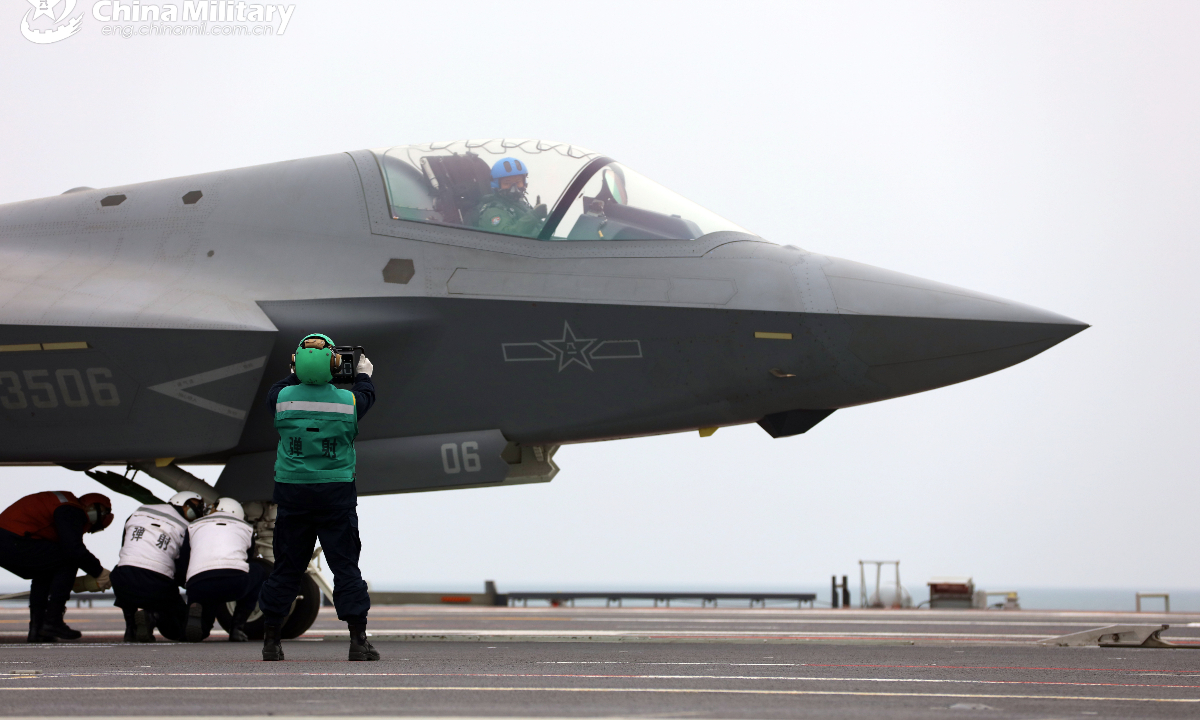
A J-35 stealth fighter jet is ready to take off from China's first electromagnetic catapult-equipped aircraft carrier, the Fujian (Hull 18). Three types of aircraft recently completed their inaugural electromagnetic catapult-assisted takeoff and arrested landing trainings on the aircraft carrier.(eng.chinamil.com.cn/Photo by Ju Zhenhua)
The radar cross section (RCS) of China's J-35 series fighter jet is smaller than a human palm, thanks to its special fuselage design and metamaterial technologies exclusive to China, official media revealed on Sunday. An expert said this indicates the J-35's world-class stealth capability, giving the Chinese warplane a significant advantage.
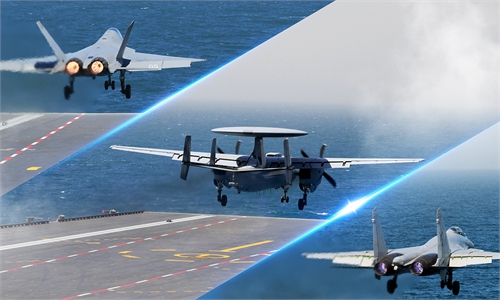
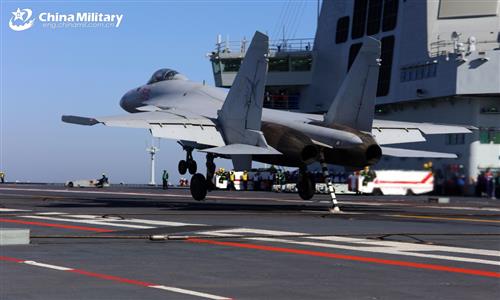
The details on the J-35 series' stealth capability were provided in an in-depth report by China Central Television (CCTV) News on Sunday. The report followed the announcement by the Chinese People's Liberation Army (PLA) Navy on September 22 that China's first electromagnetic catapult-equipped aircraft carrier, the Fujian, had achieved a breakthrough by hosting the first catapult-assisted takeoff and arrested landing training for the J-15T heavy fighter jet, the J-35 stealth fighter jet, and the KJ-600 early warning aircraft.
Wang Ya'nan, chief editor of Beijing-based Aerospace Knowledge magazine, told the Global Times on Sunday that an RCS the size of a human palm, or roughly that of a sparrow, should be considered very small for an aircraft. It means that the J-35's stealth capability is at a world-class level.
Such a small RCS can enable the J-35 to remain undetected until it is very close to its target, giving it more advantages and opportunities in combating, Wang Ya'nan said.
CCTV News also introduced another key performance parameter of the J-35. The report revealed that the maximum takeoff weight of the J-35 is close to 30 tons and is powered by two medium-thrust engines completely independently developed by China.
Wang Ya'nan said that while the J-35 is a medium-sized fighter jet, a maximum takeoff weight of nearly 30 tons means that it is almost a heavy fighter jet. Thanks to the electromagnetic catapult technology, the J-35 can take off fully loaded with munitions and fuel, giving it a longer range and endurance and stronger fire power.
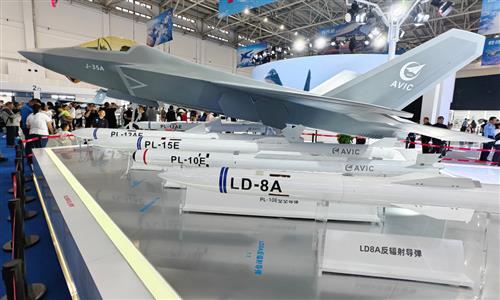
The CCTV News report noted that the J-35 is the carrier-based version of the J-35A, China's independently developed new-generation multirole stealth fighter jet. When the J-35A made its debut at Airshow China 2024, it was announced that the J-35 series has multiple variants, including versions for the navy and the air force.
Wang Yongqing, the chief designer of multiple types of aircraft as well as the chief expert of the Shenyang Aircraft Design and Research Institute of the state-owned Aviation Industry Corporation of China (AVIC), told the Global Times in an exclusive interview in June that this concept has core advantages, including the realization of high efficiency in resource utilization.
"Many of our research achievements can be applied across different variants, such as sensors, onboard equipment, and avionics systems. This development model has significantly reduced both the costs and time required for fighter jet development," Wang Yongqing said.
Under this concept, the J-35 series fighter jets could be built and kept at a large number, and this will correspondingly reduce future maintenance costs and improve logistical efficiency of the equipment, according to the top designer.
RELATED ARTICLES