Illustration: Liu Rui/GT
Editor's Note:
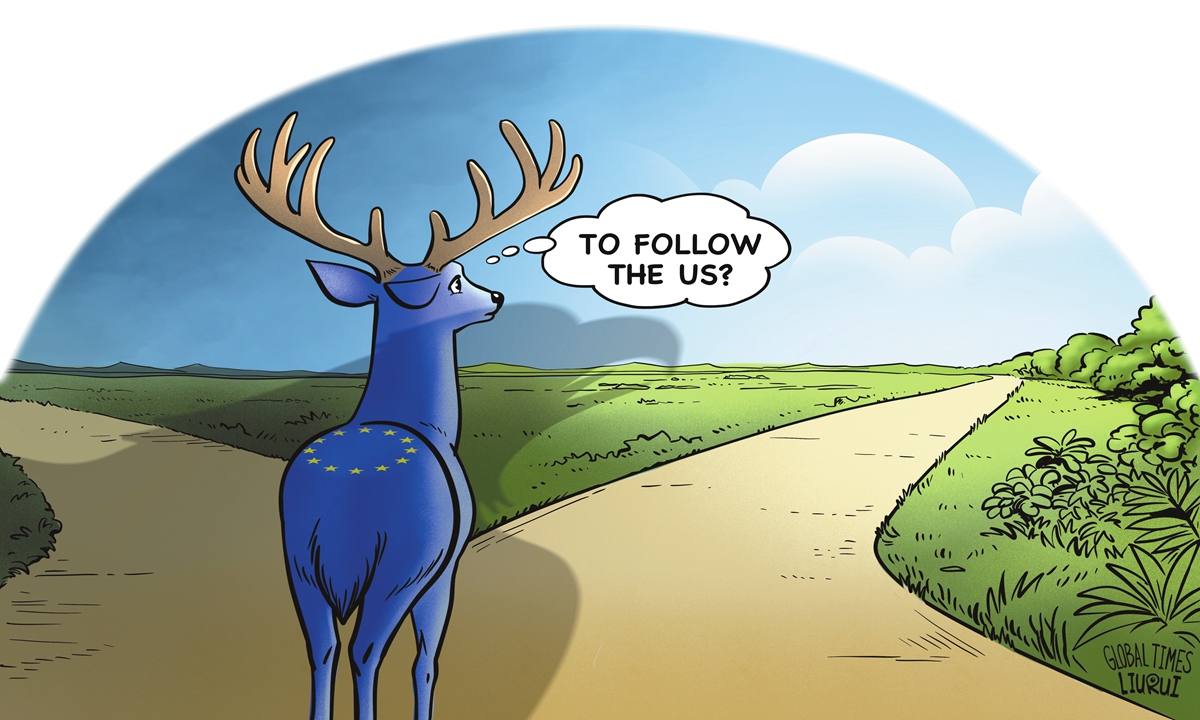
For some time now, the EU has endured mounting pressure from the US - first being urged to sever its purchases of Russian oil and then facing demands for heightened tariffs on China and India. Some European scholars have characterized this as "a strategy to deflect and to distract and to sort of park the ball over to the Europeans and say, 'Well, you go first.'" This raises questions: To what extent can Europe still place trust in the US on matters pertaining to China? And under the weight of tariff threats, will European leaders yield to US' implicit "You jump, I jump" gambit? The Global Times invited three foreign scholars to share their insights on the issues.
Pierre Picquart, an expert in geopolitics and human geography from the University of Paris-VIII
Trade tensions between Washington and Beijing, against the backdrop of technological rivalries and the war in Ukraine, place the EU in a singular position.
Under tariff, security and political pressure, the EU is being urged by Washington to stop buying Russian energy and to adopt a tougher stance against China - with tariffs rising up to as high as 100 percent.
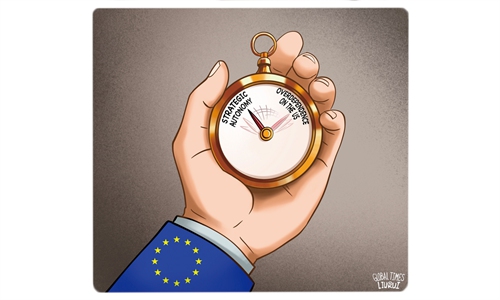
Behind these demands lies a central question: Can Europe still define itself as a mere circumstantial ally, or must it carve out its own path between security dependence and strategic autonomy?
Systematically yielding to Washington's tariff demands entails considerable risks. China and the EU are each other's second-largest trading partners, with economic complementarity being a key feature of their cooperation.
A sudden rupture would impose an immediate cost and undermine the competitiveness of European industries. Beyond the numbers, it must be recalled that China is a major country, bearer of a millennial history and its own vision of development, contributing decisively to global economic and political balances.
For Europe, the stakes go beyond simply managing commercial interdependence: It must acknowledge and assume China's pivotal role - and, beyond it, that of other emerging powers - destined to weigh increasingly on global governance.
Europe therefore faces a dilemma: Preserve its security alliance with the US or defend its economic interests by maintaining a constructive dialogue with China. France has long advocated for "European strategic autonomy," affirming that a strong Europe must defend its values and interests without limiting itself to the role of a follower.
This does not mean, however, systematically opposing Washington and Beijing. The great global challenges - climate, energy transition, food security, regulation of artificial intelligence - require cooperation among the three major poles.
In addition, other players, notably the expanded BRICS countries, are playing a growing role in shaping the global market architecture, reminding us that international governance can no longer be conceived solely on a Western scale. The example of energy illustrates this complementarity: Chinese solar technologies, European industrial innovations, and American financial power can together create a unique synergy.
Europe is at a moment of choice. It can remain in Washington's shadow - at the risk of losing its economic weight - or chart its own course by embracing its interdependencies with Beijing and other emerging powers. In a world where blocs confront each other, the EU can exist only by ceasing to be a follower and becoming a force of initiative. The credibility of its political project is at stake here and now.
Jorge I. Aguadero Casado, a Spanish writer
"The oldest and strongest emotion of mankind is fear" (H.P. Lovecraft) seems an appropriate sentence for the EU: It doesn't believe in itself, has indigestion from liberal democracy, needs money and feels orphaned by its "American friend."
We're facing atavistic emotions. Among them, trust. Can we trust Washington? This partner has punished us severely for its own disagreements with Russia and China. What reason do we have to believe it will respect us in the future?
European nations have mortgaged themselves beyond their means in their defense of Ukraine, and the US is taking advantage of the humanitarian disaster to use us as satellite countries, under the threat of tariffs. Washington prohibits us from buying Russian oil, knowing that the Arab world will not increase its production to supply us, as this would mean the end of their good relations with Russia, so American oil would benefit from our shortages. Is the US pressure motivated by humanitarian reasons? Only they know.
However, The US' words and actions have not matched. In Europe, US hesitation to impose new sanctions on Russia is surprising, despite the repeated insistence of European authorities that the US should increase them to force Moscow to end the war. Furthermore, the American snubs, [as they have been] negotiating on their own with Moscow since January.
In turn, Washington "suggests" we impose tariffs of 50 percent to 100 percent on China, amid heightened tensions between the US and the Asian giant. We live in strange times, where China advocates free markets and the US is protectionist. Where would Europe stand if it accepted Washington's proposal? What if, faced with an obedient Europe that had destroyed its bridges with China, the US made decisions that would harm us?
Faced with tariff pressure, how will we react? The US is imposing increasingly strict conditions on us, demanding that they be met before the US increases pressure on Russia. I don't think Europe will raise its tone toward China beyond some cosmetic statements. Would we really be capable of turning against Russia and China at the same time? How would we back up such an economically suicidal move? Do we print euros like there's no tomorrow?
Einar Tangen, a senior fellow at the Center for International Governance Innovation based in Canada
Washington's latest tariff blitz isn't just about trade - It's about power. With 50 percent tariffs slapped on India and Brazil, 30 percent on South Africa, and escalating pressure on Russia and China, the US is targeting BRICS as a bloc. This isn't random. It's a strategic attempt to fracture emerging alliances that threaten American dominance. And Europe, already under pressure to toe Washington's line on Russia and China, is being drawn into a cynical game of economic divide and conquer.
The irony is sharp. Europe, with its colonial past, once mastered this tactic. Now, it's on the receiving end. The US is demanding that the EU cut off Russian energy and impose sweeping tariffs on Chinese goods. In return, Washington dangles the promise of tougher sanctions on Moscow - If Europe complies. Meanwhile, reports of US backchannel talks with Russia have left European leaders feeling sidelined and exposed.
But the real danger lies in how Washington is trying to pit Europe against BRICS. By selectively targeting BRICS countries with punitive tariffs while pressuring Europe to align, the US is attempting to prevent the formation of a broader counterweight to its influence. It's a classic wedge strategy: isolate, pressure, and dominate.
This is precisely why Europe and BRICS must respond together. Such cooperation would signal the end of unilateral bullying and the beginning of a multipolar economic order.
On China, the divergence is even starker. Trump's push for 50 percent to 100 percent tariffs on Chinese imports has met resistance in Brussels. China remains the EU's second-largest trading partner, and European economies, especially Germany's, are deeply intertwined with Chinese supply chains. A full-scale trade war would be self-destructive.
The path forward is clear. Europe and BRICS must stop playing defense and start shaping the rules. Strategic autonomy isn't just a slogan - It's survival. Divide and conquer works only when the targets stay divided. It's time to break the cycle.
Europe must wake up. Strategic autonomy is no longer a luxury - It's a necessity. The continent must reassess its alliances, diversify its economic dependencies, and prepare for a world where US leadership is neither stable nor guaranteed.
Until then, European leaders risk looking like deer in the headlights - frozen, vulnerable, and dangerously exposed.
RELATED ARTICLES