Al, drones, monitoring stations enhance protection, disaster prevention in Yarlung Zangbo River in Xizang
By Published: Sep 28, 2025 06:50 PM

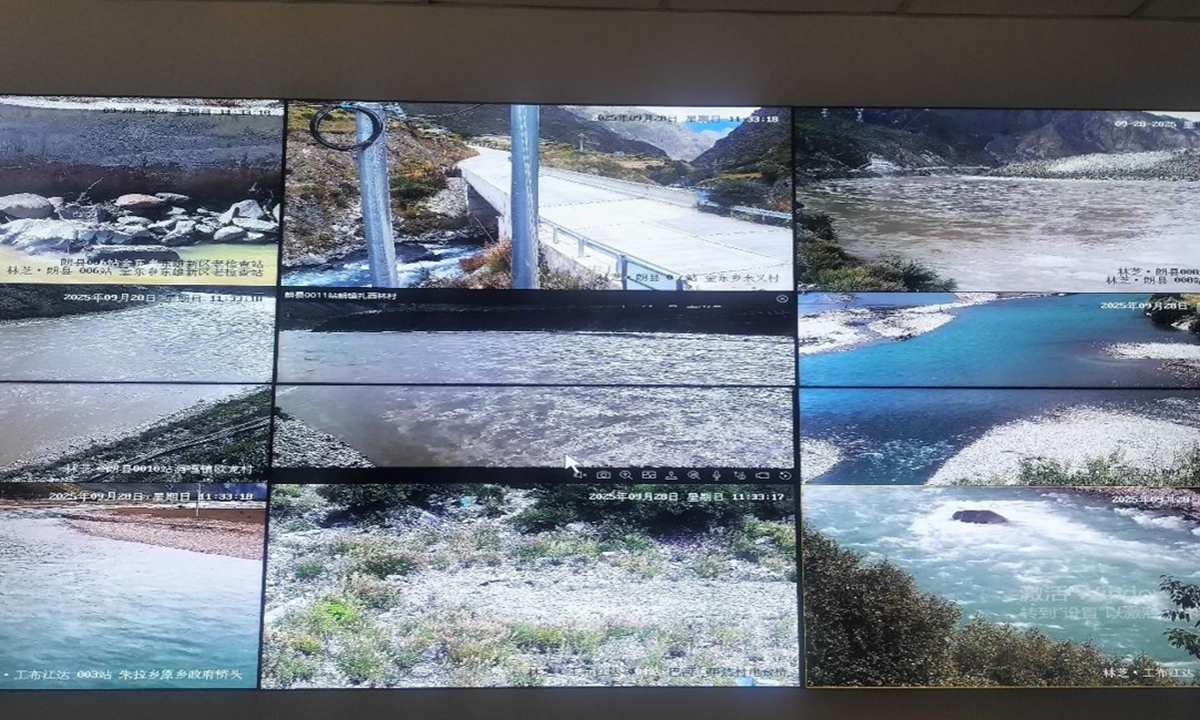
The monitoring system of Yarlung Zangbo River and Nyang River in Nyingchi, Southwest China's Xizang Autonomous Region Photo: Courtesy of Nyingchi water resources bureau
Leveraging its unique water resources, Southwest China's Xizang Autonomous Region has actively advanced smart water conservancy projects by employing technologies such as video surveillance, AI recognition, and drone-based transport to better protect the ecological environment and prevent disasters in the Yarlung Zangbo River basin.
In Nyingchi, Xizang, where the Yarlung Zangbo River and its biggest branch Nyang River run through, 64 video monitoring stations and 10 mountain flood monitoring and early warning stations are now standing along the riverbanks, acting as "eyes" and "ears" to safeguard the health of rivers and lakes, the Global Times learned from the Nyingchi water resources bureau on Sunday.
"Through innovation in both technology and operational models, we have overcome transportation and climate-related challenges in plateau-based water conservancy projects, while also better aligning water services with public needs and urban development," Liu Chengli, Party secretary of the Nyingchi water resources bureau, told the Global Times.
According to the bureau, the county has invested over 15 million yuan ($2 million) to build and launch a smart river and lake management platform in December 2024. "The platform integrates satellite monitoring, ground patrols and online oversight - enabling early detection and timely resolution of river-related issues."
With the 64 video monitoring stations and 10 mountain flood monitoring and early warning stations, by using AI-powered video analysis, the bureau has identified 1,569 cases of disorders, while integrating over 6,500 data points along the Yarlung Zangbo River and Nyang River.
Moreover, technological applications have played a prominent role in the rural drinking water safety and quality improvement project in Nangxian County, according to the bureau.
To address the difficulty of transporting materials across the 45-degree steep slopes on both sides of the Yarlung Zangbo River, drones were deployed for logistics. Each drone can carry 50 to 70 kilograms per trip, flying 60 to 80 times a day. Each trip takes only 3 to 5 minutes - making the process seven times more efficient than manual transport.
"In the past, we relied on people and horses to carry materials, which became nearly impossible during the rainy season. Now, drones can deliver supplies at any time, ensuring the drinking water project stays on track," said Liu Qiang, head of Nangxian County, told the Global Times.
In addition, six sets of integrated water purification systems worth 6.8 million yuan ($930,000) have been installed in the project. The systems use multi-stage filtration to effectively block sediment, absorb odors, and filter bacteria, viruses, and heavy metals. They can also withstand temperatures as low as minus 50 C. Once completed, the project will benefit 2,477 residents across 13 villages by providing safe and standard-compliant drinking water.
Luo Jia, head of the Nyingchi water resources bureau, told the Global Times that further efforts will be made to deepen collaboration between science and industry. The city plans to work with research institutions to address key technical challenges in high-altitude water conservancy, accelerating the implementation of technological innovations to boost the high-quality development of the sector in Nyingchi.
RELATED ARTICLES