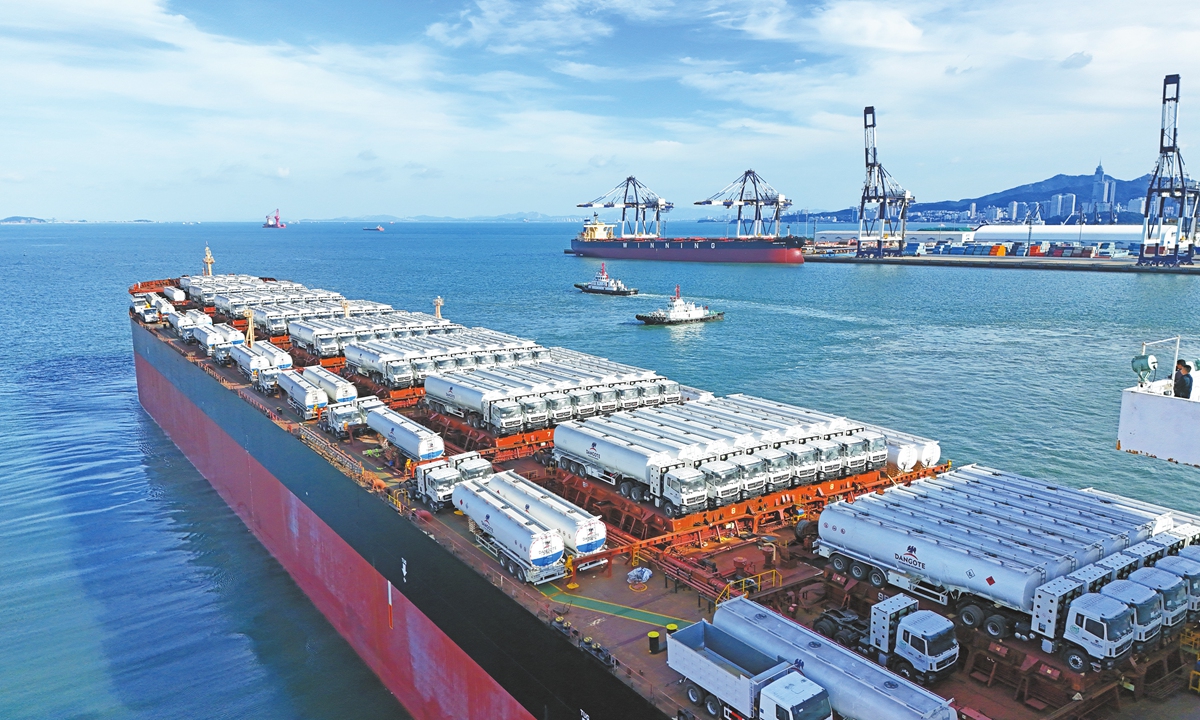
A cargo ship carrying 434 heavy trucks departs from Yantai Port in Shandong for Nigeria on September 21, 2025. Photo: VCG
Editor's Note:
Amid the emergence of the Global South, China-Africa relations have entered a period of fast-track growth in recent years. As the international landscape becomes increasingly complex and interwoven, it is imperative for China and Africa to fortify their solidarity and self-improvement, as well as to further embrace the positioning of the "all-weather China-Africa community with a shared future for the new era." The Global Times, in collaboration with South Africa's Independent Media, has launched a series titled "Global South Dialogue · China-Africa Opinion Power," inviting Chinese and African experts and scholars to engage in in-depth discussions on a wide range of topics related to China-Africa relations and their international context. The second installment featured discussions on how China-Africa trade has defied headwinds and maintained strong growth amid severe shocks from unilateralism and protectionism to the multilateral trading system.
Why is China-Africa trade momentum so strong?
Zhu Yaxiong (an associate professor at the School of Economics and Management, Zhejiang Normal University): China and Africa are bound together by similar historical experiences and a shared sense of mission. Since the 21st century, the establishment and development of the Forum on China-Africa Cooperation (FOCAC) have driven trade between the two sides to new heights, while cooperation in many other areas has also made steady progress.
According to the latest data from the General Administration of Customs of China, China's foreign trade grew 3.5 percent year-on-year to 29.57 trillion yuan ($4.14 trillion) in the first eight months of 2025. In the same period, China's trade with Africa grew 16.6 percent year-on-year, far outpacing the growth of trade with other regions.
China-Africa economic and trade cooperation has not only become a key driver of Africa's economic growth, but also one of the fastest-growing areas of South-South cooperation.
Busani Ngcaweni (director of the Centre for Public Policy and African Studies, University of Johannesburg): China-Africa trade has followed a natural progression, even as Africa's traditional trade with other parts of the world has been in decline.
Trade is like water: You can't stop it. You can divert it and redirect it, but it will always find its way. It is thus natural to see major volumes of trade moving from Africa into China and Asia in general, as opposed to the traditional trading partners or colonial powers in Europe. This is demand-driven.
We also see during the same period a rise in investment from Chinese companies in Africa. For example, the types of Chinese companies investing in South Africa today are not the same as those 30 years ago. Today, they tend to be high-tech companies, financial services, and other firms operating at a higher value-added level, compared to earlier years when investments were more in textile factories and similar industries.
Ehizuelen Michael Mitchell Omoruyi (executive director at Nigeria Research Center, Institute of African Studies, Zhejiang Normal University): The China-Africa relationship can be summarized in two words: investment and trade. These are what define China-Africa cooperation and explain its robust growth.
Because of this, for the first time, Africa can turn resources into development projects, which is exactly what Africa needs to promote, because we need more development. We need to promote fair trade and build infrastructures. This is what we actually need to promote regional integration and advance the African Continental Free Trade Area (AfCFTA).
When we look at the immediate trends, if you look at Africa's efforts to diversify trade beyond raw materials, they are looking at how to increase exports of African agricultural products to China and shift toward value-added goods. These are what Africa needs to create growth, which is part of the reason for the robust growth in China-Africa trade.
Digital trade is contributing to this robust growth. Renewable energy is another area to watch. At the same time, China and Africa should support the improvement of local industrialization and promote diversified, mutually beneficial cooperation to support Africa's long-term development.
Taking China-Africa trade cooperation to the next level
Endalkachew Sime (former state minister of the Ministry of Planning and Development, Ethiopia): When it comes to manufacturing units, the comparative advantage of bringing machinery from China is much greater and more attractive than other alternatives. Africa is the next growth pole, with a fast-growing middle-income population, the youngest population globally, and ample raw material resources suitable for manufacturing.
For trading elements, there are many options Africa can consider. But the logistical and economic advantages of producing final products within Africa, using African raw materials for African markets - especially as the continent integrates quickly under the AfCFTA - represent a very strategic opportunity. I call this the "high-hanging fruit" because achieving it requires intermediate steps.
Looking to the future, I think Africa and China are in a better position to focus on manufacturing.
Ehizuelen Michael Mitchell Omoruyi: China-Africa trade is very strong; it can be even stronger if we support Africa in breaking the colonial trade structures - that is, the patterns of production and distribution.
Africa makes up 17 percent of the global population, but our share of global manufacturing is only 3 percent, and our share of global trade is also about 3 percent. This shows that we are still exporting mainly raw resources instead of value-added products.
I think the first step is to address the colonial pattern of production and encourage African countries to add value to their products before exporting.
The other issue is the pattern of consumption. About 84 percent of Africa's trade is with countries outside the continent. This shows that we are not trading enough among African countries. This is related to the colonial pattern - infrastructure was designed to connect externally, not internally.
However, China brings a different distribution pattern that connects countries together and promotes intra-continental trade.
Another key factor is skills development. Instead of relying on aid to drive growth and reduce poverty, we can replace aid with skills acquisition. This is where China can play a role.
Jointly navigating changes in the global trade landscape
Endalkachew Sime: When trade is disrupted by geopolitics or abnormal diplomacy, you might not get value for the products relative to the money you pay. When there are huge tariffs, both the seller and the buyer are discouraged.
That's why we have to promote multilateralism and free trade as much as possible, even though it may be too good to be true to expect free trade in every part of the economic space.
I think the most strategic approach in these kinds of economic dynamics is to continuously improve and broaden your options. For example, in South-South cooperation, the Global South is facilitating better economic collaboration than before. We need to strengthen these efforts and promote a more liberal and open market system and fair-trade practices for African products.
Tebogo Lefifi (senior program manager and researcher at Nelson Mandela School of Public Governance and director of Africa China Law Desk at University of Cape Town): Against the backdrop of the tariff war, China is still strong, with a clear direction, rules and established terms. On the African side, we still lack sufficient preparation and capacity to engage effectively. We need to deepen strategic partnerships between China and Africa to strengthen this.
The WTO has been weakened, which has created a more fragmented world with overlapping trade blocs. So we are basically at the brink of a system that is almost going to regress, where we might end up with competing standards, more politicized trade and fragmented rules.
I think China-Africa cooperation can, in a way, help shape a more transformative, rules-based trade system in this very turbulent world. I believe the AfCFTA is going to play a very critical role.
Zhu Yaxiong: The US' arbitrary use of tariffs against its global trading partners has triggered widespread discontent. Confronted with the shocks of unilateralism, protectionism and economic coercion, many countries have been forced to rethink and adjust their approaches to international economic and trade cooperation.
Against this complex backdrop, a pressing question arises: Is the world moving toward an international trade landscape without the US or with the US acting as a disruptive force? And is the international community prepared to face such a scenario? What role can the rising Global South play in defending multilateral trade, promoting a fair multipolar world, and advancing inclusive globalization? The answer lies in future global trade practices, where the Global South will play an ever more decisive role.
La croissance du commerce entre la Chine et l'Afrique dans un paysage commercial mondial en mutation
Par Global Times
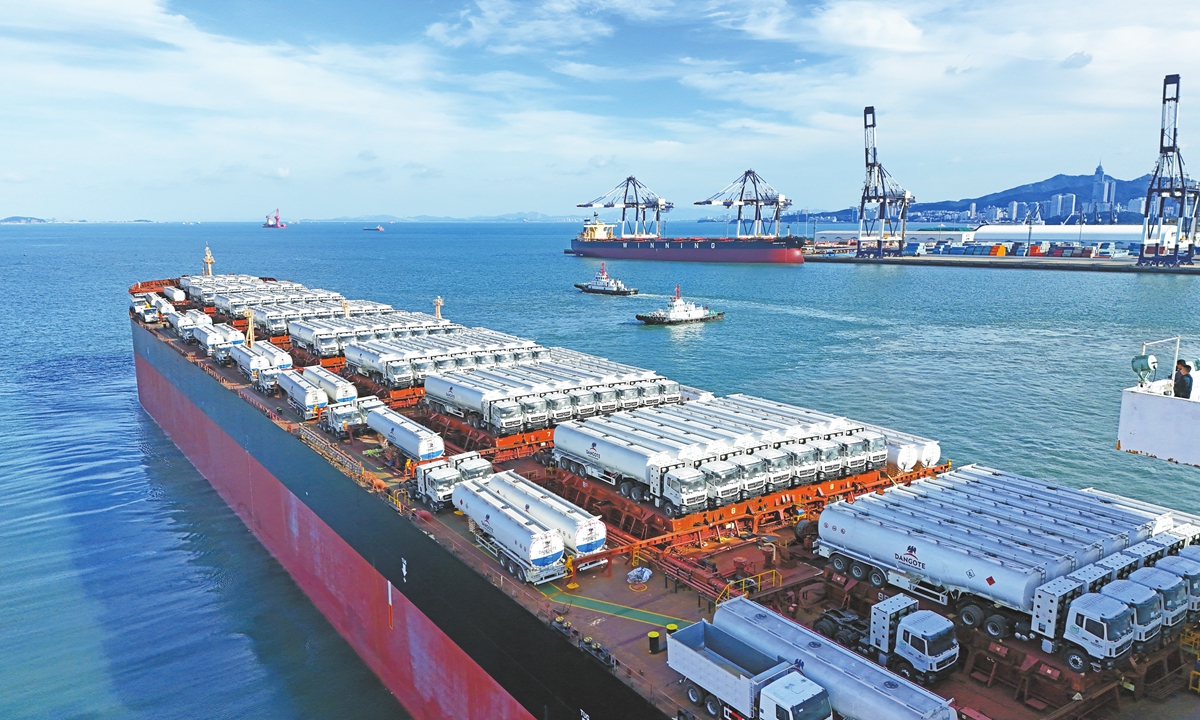
Un navire transportant 434 camions poids lourds a quitté le port de Yantai, province du Shandong pour le Nigeria le 21 septembre 2025. Photo : VCG
Note de la rédaction :
Dans le contexte de l'émergence du Sud mondial, les relations entre la Chine et l'Afrique sont entrées dans une phase de croissance rapide ces dernières années. Alors que le paysage international devient de plus en plus complexe et interdépendant, il est impératif que la Chine et l'Afrique renforcent leur solidarité et leur capacité d'auto-développement, et qu'elles incarnent davantage la vision d'une « communauté Chine-Afrique résiliente, unie par un avenir partagé pour la nouvelle ère. » Le Global Times, en coopération avec Independent Media d'Afrique du Sud, a lancé une série intitulée « Dialogue du Sud mondial · Puissance d'opinion Chine-Afrique », invitant des experts et universitaires chinois et africains à engager des discussions approfondies sur un large éventail de sujets liés aux relations sino-africaines et à leur contexte international. Le deuxième volet est consacré à l'analyse de la manière dont les échanges sino-africains ont résisté aux impacts défavorables et maintenu une croissance robuste, malgré les chocs sévères infligés au système commercial multilatéral par l'unilatéralisme et par le protectionnisme.
Pourquoi l'élan du commerce sino-africain est-il si puissant ?
Zhu Yaxiong (professeur associé à l'École d'économie et de gestion de l'Université normale du Zhejiang) : La Chine et l'Afrique sont liées par des expériences historiques semblables et une mission commune. Depuis le 21ème siècle, la création et le développement du Forum sur la coopération Chine-Afrique (FOCAC) ont promu le commerce entre les deux parties à de nouveaux sommets, tandis que la coopération dans de nombreux autres domaines a également progressé régulièrement.
Selon les dernières données de l'Administration générale des douanes de Chine, le commerce extérieur de la Chine a augmenté de 3,5% en glissement annuel pour atteindre 29,57 billions de yuans (4,14 billions de dollars) au cours des huit premiers mois de 2025. Pendant la même période, le commerce de la Chine avec l'Afrique a augmenté de 16,6% en glissement annuel, dépassant bien la croissance du commerce avec d'autres régions.
La coopération économique et commerciale Chine-Afrique est non devenue non seulement un moteur clé de la croissance économique de l'Afrique, mais aussi l'un des domaines de coopération Sud-Sud à la croissance la plus rapide.
Busani Ngcaweni (directeur du Centre d'études des politiques publiques et africaines de l'Université de Johannesburg) : Le commerce Chine-Afrique a suivi une progression naturelle, même si le commerce traditionnel de l'Afrique avec d'autres parties du monde a été en déclin.
Le commerce est comme un courant d'eau : on ne peut pas l'arrêter. On peut le détourner et le rediriger, mais il trouvera toujours son chemin. Il est donc naturel de voir d'importants volumes commerciaux passer de l'Afrique vers la Chine et vers l'Asie en général, par opposition aux partenaires commerciaux traditionnels ou aux puissances coloniales en Europe. Cela est axé sur la demande.
Nous observons également durant la même période une augmentation des investissements des entreprises chinoises en Afrique. Par exemple, les types d'entreprises chinoises investissant en Afrique du Sud aujourd'hui ne sont pas les mêmes que ceux 30 ans avant. Aujourd'hui, il s'agit plutôt d'entreprises high-tech, de services financiers et d'autres sociétés opérant à un niveau à plus forte valeur ajoutée, par rapport aux années précédentes où les investissements étaient davantage effectués dans des usines textiles et des industries similaires.
Ehizuelen Michael Mitchell Omoruyi (directeur exécutif du Centre de recherche du Nigeria, Institut d'études africaines, Université normale du Zhejiang) : La relation Chine-Afrique peut se résumer en deux mots : l'investissement et le commerce. Voilà ce qui définit la coopération Chine-Afrique et explique sa croissance robuste.
Pour cette raison, pour la première fois, l'Afrique peut transformer ses ressources en projets de développement, ce dont l'Afrique a précisément besoin de promouvoir, car nous avons besoin de plus de développement. Nous devons promouvoir le commerce équitable et construire des infrastructures. C'est ce dont nous avons réellement besoin pour promouvoir l'intégration régionale et faire avancer la Zone de libre-échange continentale africaine (ZLECAf).
Lorsque l'on observe les tendances immédiates, si l'on regarde les efforts de l'Afrique pour diversifier son commerce au-delà des matières premières, on examine comment augmenter les exportations de produits agricoles africains vers la Chine et comment s'orienter vers des biens à valeur ajoutée. Voilà ce dont l'Afrique a besoin pour créer de la croissance, ce qui fait partie des raisons de la croissance robuste du commerce Chine-Afrique.
Le commerce numérique contribue à cette croissance robuste. Les énergies renouvelables constituent un autre domaine à surveiller. Parallèlement, la Chine et l'Afrique devraient soutenir l'amélioration de l'industrialisation locale et promouvoir une coopération diversifiée et mutuellement bénéfique pour soutenir le développement à long terme de l'Afrique.
Faire passer la coopération commerciale Chine-Afrique au niveau supérieur
Endalkachew Sime (ancien ministre d'État chargé de la Planification et du Développement, Éthiopie) : En ce qui concerne les entités de fabrication, l'avantage comparatif d'importer des machines de Chine est beaucoup plus grand et plus attractif que les autres alternatives. L'Afrique est le prochain pôle de croissance, avec une population à revenu intermédiaire en croissance rapide, la population la plus jeune au monde et d'abondantes ressources en matières premières adaptées à la fabrication.
Pour les éléments commerciaux, l'Afrique a de nombreuses options à considérer. Mais les avantages logistique et économique de la fabrication des produits finis en Afrique, à partir des matières premières africaines pour les marchés locaux - notamment en cas d'intégration rapide du continent dans le cadre de la ZLECAf - représentent une opportunité très stratégique. Je l'appelle « résultat à long terme » parce que son obtention nécessite des étapes intermédiaires.
En perspective, je pense que l'Afrique et la Chine sont mieux placées pour se concentrer sur la fabrication.
Ehizuelen Michael Mitchell Omoruyi : Le commerce Chine-Afrique est très solide ; il pourrait être plus robuste si nous soutenons l'Afrique pour briser les structures commerciales coloniales - c'est-à-dire les modèles de production et de distribution.
L'Afrique représente 17 pour cent de la population mondiale, mais notre part de la fabrication mondiale n'est que de 3 pour cent, et notre part du commerce mondial est également d'environ 3 pour cent. Cela montre que nous exportons encore principalement des ressources brutes au lieu des produits à valeur ajoutée.
Je pense que la première étape consiste à remettre en cause le modèle colonial de production et à encourager les pays africains à ajouter de la valeur à leurs produits avant de les exporter.
L'autre enjeu concerne le modèle de consommation. Environ 84 pour cent du commerce de l'Afrique se fait avec des pays hors du continent. Cela montre que nous ne commerçons pas suffisamment parmi des pays africains. Cela est lié au modèle colonial - les infrastructures étaient conçues pour relier l'Afrique à l'extérieur, et non à son intérieur.
Cependant, la Chine apporte un modèle de distribution différent qui relie les pays entre eux et favorise le commerce intracontinental.
Un autre facteur clé est le développement des compétences. Au lieu de compter sur l'aide pour stimuler la croissance et réduire la pauvreté, nous pouvons remplacer l'aide par l'acquisition de compétences. C'est là que la Chine peut jouer un rôle.
Faire face ensemble aux changements dans le paysage du commerce mondial
Endalkachew Sime : Lorsque le commerce est perturbé par la géopolitique ou une diplomatie anormale, vous pourriez ne pas obtenir la valeur des produits par rapport à l'argent que vous verser. Lorsqu'il y a d'énormes tarifs douaniers, le vendeur et l'acheteur sont découragés.
C'est pourquoi nous devons promouvoir autant que possible le multilatéralisme et le libre-échange, même s'il serait illusoire de s'attendre à un libre-échange dans toutes les parties de l'espace économique.
Je pense que l'approche la plus stratégique dans ce genre de dynamiques économiques est d'améliorer et d'élargir continuellement vos options. Par exemple, dans la coopération Sud-Sud, le Sud mondial facilite une meilleure coopération économique qu'auparavant. Nous devons renforcer ces efforts et promouvoir un système de marché plus libéral et ouvert et des pratiques de commerce équitable pour les produits africains.
Tebogo Lefifi (directrice principale de programme et chercheuse à l'École de la Gouvernance Publique Nelson Mandela et directrice du centre Africa China Law Desk à l'Université de Cap Town) : Dans le contexte de la guerre des tarifs, la Chine demeure forte, avec une direction claire, des règles et des conditions établies. Du côté africain, nous manquons encore de préparation et de capacité suffisantes pour nous engager efficacement. Nous devons approfondir les partenariats stratégiques entre la Chine et l'Afrique pour renforcer cela.
L'OMC a été affaiblie, ce qui a créé un monde plus fragmenté avec des blocs commerciaux qui se chevauchent. Par conséquent, nous sommes fondamentalement au bord d'un système qui est presque sur le point de régresser, où nous pourrions nous retrouver avec des normes concurrentes, un commerce plus politisé et des règles fragmentées.
Je pense que la coopération Chine-Afrique peut contribuer, d'une certaine manière, à façonner un système commercial plus transformateur et fondé sur des règles dans ce monde très agité. Je crois que la ZLECAf va jouer un rôle très critique.
Zhu Yaxiong : L'utilisation arbitraire par les États-Unis de tarifs douaniers contre ses partenaires commerciaux mondiaux a déclenché un mécontentement généralisé. Confrontées aux chocs de l'unilatéralisme, du protectionnisme et de la coercition économique, de nombreux pays ont été contraints de repenser et d'ajuster leurs approches de la coopération économique et commerciale internationale.
Dans ce contexte complexe, une question pressante se pose : le monde s'achemine-t-il vers un paysage du commerce international sans les États-Unis ou avec les États-Unis agissant comme une force perturbatrice ? Et la communauté internationale est-elle prête à faire face à un tel scénario ? Pour défendre le commerce multilatéral, promouvoir un monde multipolaire équitable et faire progresser une mondialisation inclusive, quel rôle le Sud mondial émergent peut-il jouer ? La réponse se trouve dans les futures pratiques du commerce mondial, où le Sud mondial jouera un rôle de plus en plus décisif.