China expects 2.36b passenger trips during Golden Week: Ministry of Transport
Eight-day holiday to boost tourism sector, economic recovery
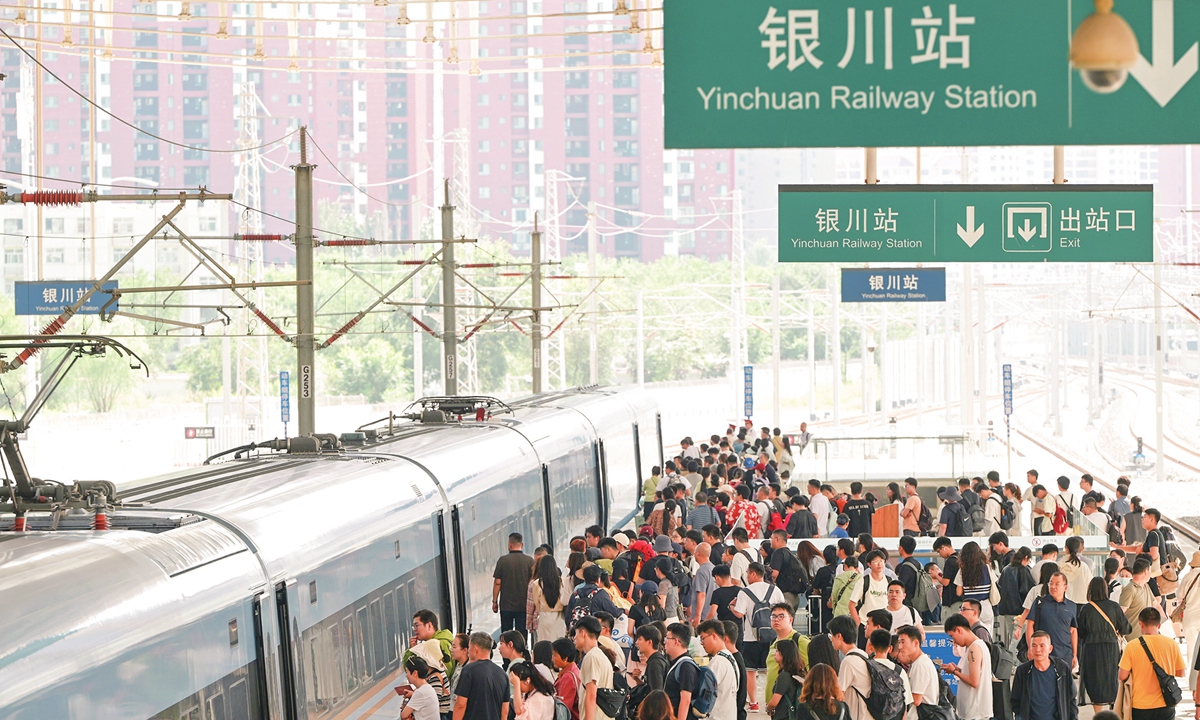
Passengers line up at Yinchuan Railway Station in Northwest China's Ningxia Hui Autonomous Region on August 31, 2025. The 62-day summer travel season concluded on Sunday with robust growth in passenger trips. Photo: CFP
During the Golden Week holiday from October 1 to 8 - one of the country's most important travel periods of the year - inter-regional passenger trips in China are estimated to reach 2.36 billion. That would be a daily average of 295 million passenger trips, up 3.2 percent from the same period last year, state broadcaster CCTV News reported on Sunday, quoting the Ministry of Transport.
At a press conference held by the State Council Information Office on Sunday, Ministry of Transport officials said that market demand is strong for both domestic and international trips during the eight-day holiday, which combines the Mid-Autumn Festival and National Day.
Experts predict that records will be set in both the number of tourists and tourism consumption this year. As China's holiday season progresses, the country is poised to witness a significant uplift in its tourism sector, contributing to broader economic recovery and growth.
During the holiday, people will travel primarily for tourism and family visits, with self-driving remaining a primary mode of transportation, said the Ministry of Transport. About 1.87 billion trips will be made by car, accounting for nearly 80 percent of the total. During peak periods, highway traffic is expected to hit 70 million vehicle runs, with 14 million new-energy vehicles.
The peak travel day is expected to fall on October 1 when the number of travelers may exceed 340 million, surpassing the record of 339 million recorded on the sixth day of the Spring Festival in 2025, said the ministry.
Data from China's major online travel platforms indicated that rail, flight and car rentals could rise compared with last year's Golden Week, as consumers prioritize spending on services and cultural experiences.
The long holidays will drive demand for medium- and long-distance trips, particularly in major city clusters such as Beijing-Tianjin-Hebei, the Yangtze River Delta, the Guangdong-Hong Kong-Macao Greater Bay Area and the Chengdu-Chongqing region in Southwest China.
Domestic and international tourism is showing strong momentum. Demand for family and parent-child trips is expected to surge, with tourism in urban areas such as Guangzhou, Chengdu, Beijing, Shanghai, Xi'an, Hangzhou, Nanjing and Chongqing likely to exceed last year's levels. In terms of outbound travel, there is an anticipated significant increase in the number of tourists heading to destinations such as Russia, Japan, South Korea and Southeast Asia, according to the ministry.
The daily flow of freight vehicles is expected to reach 5.5 to 5.8 million, similar to the 5.55 million recorded during the 2024 National Day holiday. The demand for transportation of key materials, including energy, food, minerals and daily necessities will likely remain stable, with overall operations in railway, port and air cargo transport to see only minimal fluctuations, said the ministry.
As China gears up to celebrate both the National Day and the Mid-Autumn Festival or Moon Festival, a record surge is expected in both inbound and outbound passenger traffic, the National Immigration Administration (NIA) said on Sunday. Demand for cross-border travel is on the rise, driven by favorable policies such as visa exemptions and the increasing resumption of international flights. The NIA predicted that the average daily number of inbound and outbound travelers at main ports of China will exceed 2 million during the holiday period.
Moreover, air passenger traffic during the holidays will hit 19.2 million, up 3.6 percent year-on-year, setting a record high for the period, the Civil Aviation Administration of China (CAAC) said on Sunday.
"This year, the Mid-Autumn Festival and National Day have coincided, resulting in an extended holiday period," said Xiong Jie, a CAAC spokesperson. This has led to a surge in cultural and tourism activities, as well as a variety of sports events, all of which have introduced new dynamics to civil aviation transportation, Xiong added.
With China's continuous improvements in visa-free entry policies, tax-refund policies, payment convenience and transit facilities at gateway airports, the upcoming holidays are expected to bring another surge in outbound travel, led by short-haul destinations in East and Southeast Asia, while traffic to South Asia and Europe is also set to rise markedly, Xiong said.
"It is the last long holiday in 2025, and the best window period for long-distance travel before winter. Based on comprehensive data from all sectors, this year's Mid-Autumn Festival and National Day holidays will see record highs in both the number of tourists and tourism consumption," said Dai Bin, president of the China Tourism Research Institute.
Dai told the Global Times on Sunday that this week-long holiday period is not just a break for travelers - it's also a significant economic event. This boom in tourism will boost the travel industry and have a positive ripple effect on related sectors such as hospitality, retail and dining, contributing to the overall economic recovery and growth.
The holiday period has emerged as a crucial driver of consumption, with a notable increase in cross-regional travel. The surge indicates that consumer confidence remains robust, unaffected by short-term economic fluctuations, Wang Peng, an associate research fellow at the Beijing Academy of Social Sciences, told the Global Times on Sunday.
Data released by the Ministry of Culture and Tourism showed that more than 3.28 billion domestic trips were made in China in the first half of 2025, a year-on-year increase of 20.6 percent. Domestic tourists spent 3.15 trillion yuan ($441 billion) during these six months, up 15.2 percent.
The holiday consumption boom is expected to send positive signals, stabilizing market expectations and providing confidence for economic growth in the fourth quarter and the entire year, Wang added.
RELATED ARTICLES