ARTS / CULTURE & LEISURE
Night tour at Sanxingdui Museum: Ancient relics bridge cultural gaps
By in Deyang Published: Sep 28, 2025 11:24 PM
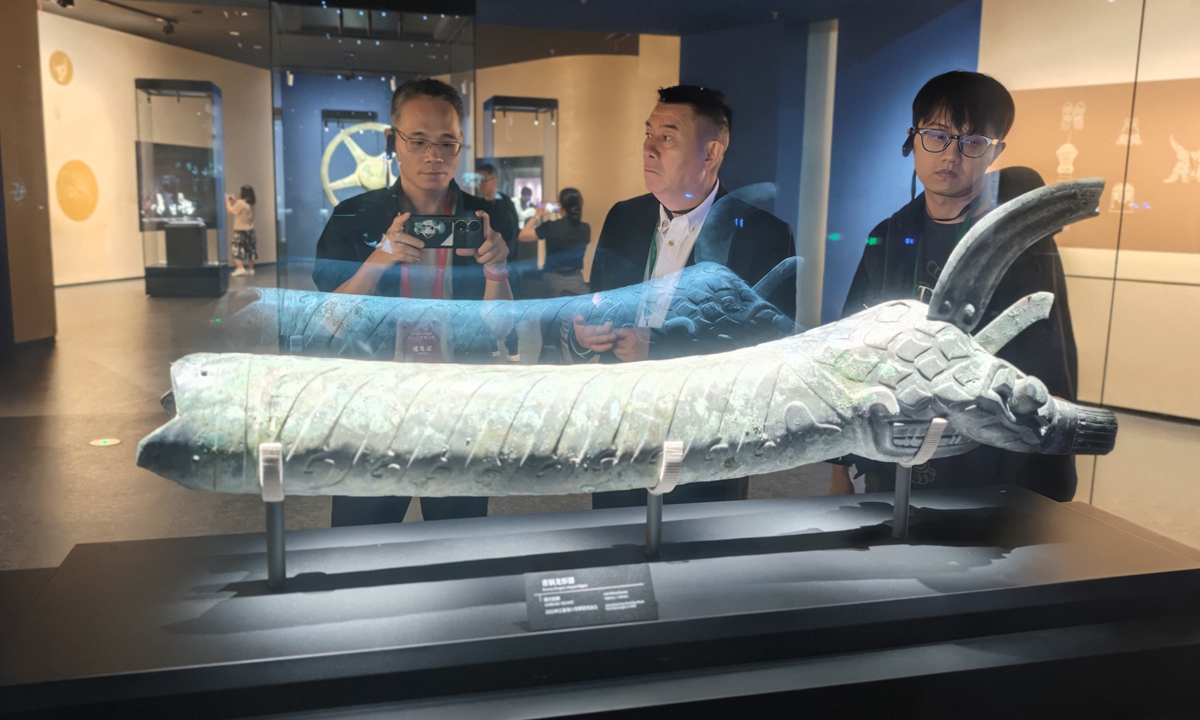
Tourists visit the Sanxingdui Museum in Deyang, Southwest China's Sichuan Province on September 26, 2025. Photo: Chen Xi/GT
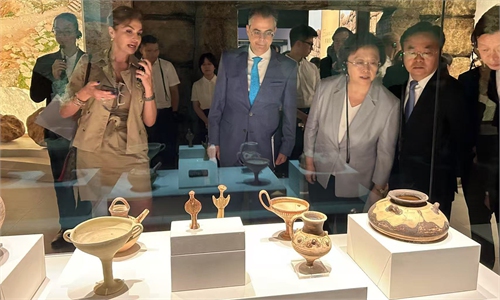
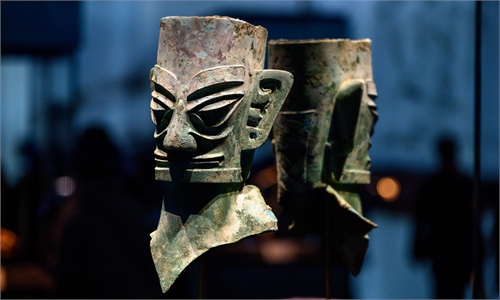
The night before the 2025 Sanxingdui Forum opened, I took a shuttle bus with a group of international guests towards the Sanxingdui Museum. What began as a pre-forum excursion soon turned into a profound encounter with a civilization that has puzzled and fascinated the world for decades. As a reporter, I found myself not just observing, but witnessing how ancient relics bridge geographic and cultural divides.Before setting off, I met two archaeologists from Greece. Though they were already well-versed in the Sanxingdui Ruins through academic texts, they were eager to see it with their own eyes. And when the monumental standing bronze figure, the haunting gold masks and the awe-inspiring Bronze Sacred Tree appeared before us, the impact was indeed beyond words, that is, a visceral, silent shockwave of wonder.
Later, circling back through the halls, I witnessed a scene that encapsulated the entire evening's spirit. The two Greek scholars were there, their foreheads almost touching the glass cases housing the valuable Sanxingdui artifacts. They were utterly motionless, their entire beings focused on every intricate detail as a museum guide softly explained its mysteries.
At another hall, a woman visitor who had flown from Paris just for this event asked me to take her picture with the towering bronze figure.
"I flew all the way here just for this… This group photo will be my most treasured souvenir," the woman said. At that moment, I realized that Sanxingdui's appeal isn't just academic, but is emotional, universal, a reminder that beauty and wonder transcend languages.
The following day's opening ceremony echoed the night's revelations. Experts from around the world voiced their admiration.
Douglas C. Comer, former President of the International Council on Monuments and Sites International Scientific Committee on Archaeological Heritage Management and President of the US National Committee of the ICOMOS, called the Sanxingdui Ruins site "one of the most fascinating, well-researched, and well-presented archaeological sites."
Rima Hooja, a respected archaeologist from India, perceptively noted the symbolic parallels between the gold scepter and power, the sun motifs and universal civilizational echoes, emphasizing that the Sanxingdui Ruins site vividly proves that ancient civilizations did not exist in isolation.
Professor Stamatios Boyatzis from Greece resonated deeply with me most. He saw in Sanxingdui's bronze craftsmanship and the philosophical pursuit of harmony a distant echo of ancient Greek Bronze Age civilizations. This unexpected kinship across continents, he suggested, underscores the profound value of international archaeological collaboration.
Gazing at the glorious Bronze Sacred Tree, he said he felt the essence of the Chinese philosophical concept of "harmony."
When I asked him about the artifact repatriation, specifically regarding the Parthenon Marbles that are currently in the British Museum, his response was thoughtful and poignant.
He told me that cultural relics are the common heritage of humanity, but they should first return to their "homes." Now, both China and Greece have the capability to protect their own heritage, and that is the most compelling reason.
In conversations like these, I felt Sanxingdui transcending archaeology. As Comer noted, in our conflict-ridden times, such cultural exchanges are precious. The Bronze Sacred Tree, once connecting the heaven and the earth for the people of the ancient Shu state, now seems to connect the threads of civilizations across time and space.
The enigmatic smiles behind the bronze masks reflect not just ancient beliefs, but a shared, eternal human quest for origins.
This night visit revealed to me that promoting Chinese cultural heritage abroad should go beyond staging exhibitions. It should also involve building deep academic dialogue and fostering public engagement.
The author is a reporter with the Global Times. life@globaltimes.com.cn
RELATED ARTICLES