World's tallest bridge opens to traffic in Guizhou, marking another milestone in China’s infrastructure building
Bridge to boost local economic, social development
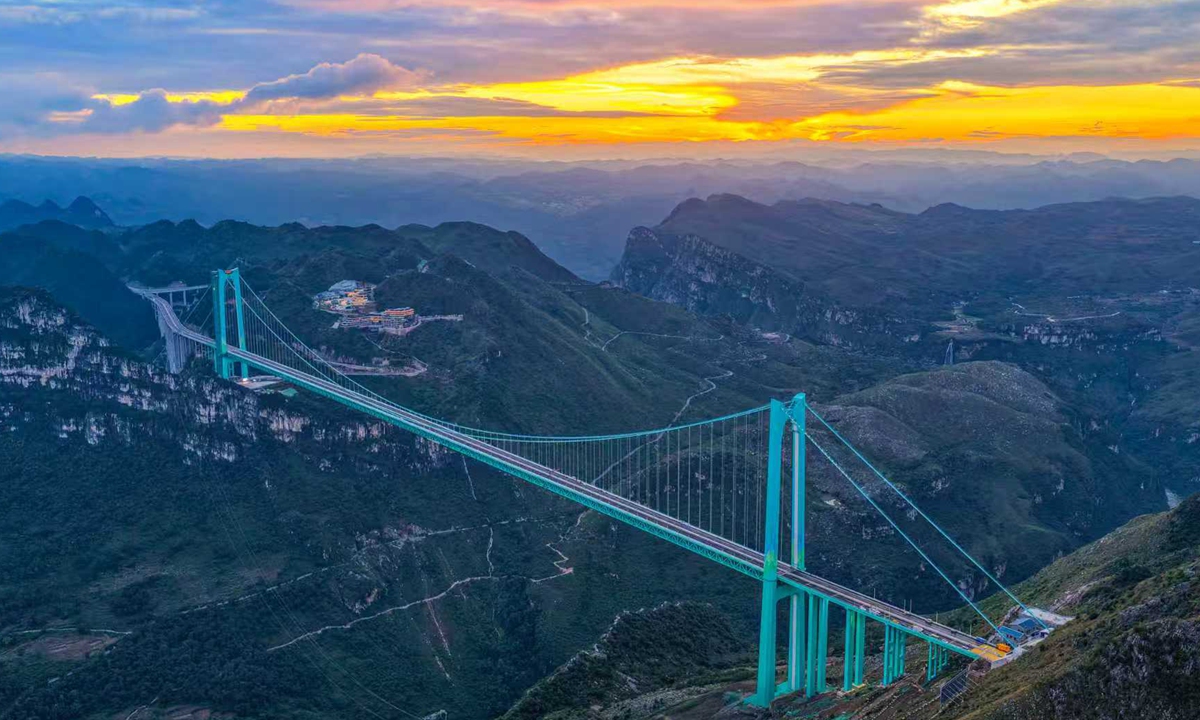
The Huajiang Grand Canyon Bridge, the world's tallest bridge, officially opens to traffic in Southwest China's Guizhou Province on September 28, 2025. Photo: VCG
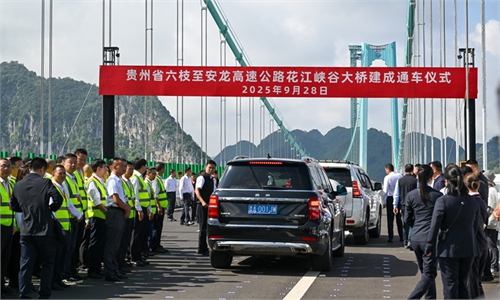
The Huajiang Grand Canyon Bridge, the world's tallest bridge, officially opened to traffic on Sunday morning in Southwest China's Guizhou Province, marking another monumental achievement in Guizhou's world-leading bridge-building legacy and China's robust infrastructure construction.
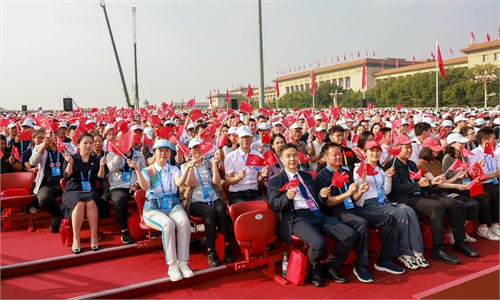
On Sunday morning, local officials and residents from different ethnic groups gathered on and around the new Huajiang Grand Canyon Bridge for a grand ceremony, celebrating a proud moment as the bridge is poised to significantly boost local economic and social development while setting a new global benchmark for bridge-building.
With a vertical height of 625 meters - roughly twice the height of the Eiffel Tower, the Huajiang Grand Canyon Bridge has surpassed the 565-meter-tall Beipanjiang Bridge, which is also in Guizhou, to become the tallest bridge in the world. The 2,890-meter bridge, with a span of 1,420 meters, is also the world's largest span bridge to be built in a mountainous area, according to the Xinhua News Agency.
Beyond its sheer size, the Huajiang Grand Canyon Bridge stands as an engineering masterpiece. Construction began in 2022, and the bridge achieved multiple technological breakthroughs in wind-resistant design, high-altitude construction, and other critical areas. The bridge innovatively employs advanced technologies such as an intelligent cable hoisting system and 2,000 MPa high-strength steel wire, securing 21 authorized patents, according to Guizhou officials.
These achievements will bring tangible benefits to local residents in this remote region, who have long faced difficult transportation conditions. Spanning the border between Qianxinan Buyi and Miao Autonomous Prefecture and Anshun City in Guizhou, the Huajiang Grand Canyon Bridge reduces travel time between the two banks from two hours to two minutes, significantly improving regional connectivity and spurring economic and social development.
Amid the festive buzz of the Huajiang Grand Canyon Bridge's official opening to traffic, Lu Qiong, a resident of the Buyi ethnic group in Guizhou, made a special effort to don her elaborate traditional costume. She arrived at the bridge early, eager to witness this historic moment for her hometown firsthand.
"I feel extremely excited to witness this super project take root in my hometown. It makes our travel much more convenient and will bring more tourists to Guizhou to learn about this beautiful land," Lu told the Global Times on Sunday at the Yundu Service Area overlooking the bridge.
Her family shares a close bond with this bridge. At the Yundu Service Area, they run a snack shop that specializes in Buyi-style specialty foods. They are looking forward to seizing the opportunity of the bridge's opening to share the authentic flavors of their hometown and the rich Buyi ethnic customs with travelers passing through.
Lu's excitement is shared by many local residents in the region.
"For our village, the opening of the bridge brings huge actual benefits," Liang Shaoyu, the former head of Huajiang Village, which is located right below the bridge, told the Global Times.
Liang recalled the challenging times when locals relied on bamboo boats, later a lime-built bridge, and eventually a steel chain bridge to cross the Huajiang River.
"From the age of 8, I witnessed firsthand the harsh conditions in our village," Liang said. Now with better roads, come greater opportunities. As the bridge draws many fans from across the nation, it also brought many business opportunities for Huajiang Village, where many old homes have been turned into modern homestays amid a tourism boom, according to Liang.
In Guizhou, an innovative business model blending transportation and tourism is emerging. This is evident at the Huajiang Grand Canyon Bridge, where tourism facilities and services, including a café perched 800 meters atop the bridge tower and a helicopter sightseeing service in nearby Huajiang Township, have been introduced.
"My favorite view is that of construction workers going up and down on the cables and standing on the cables to work," Xie Chaoqing, a local resident who over the past three years used drones to document the construction process and livestreamed it to fans across the country, told the Global Times. "It shows how great our workers are. China's infrastructure is indeed very impressive. And it is also a microcosm of our country's growing power."
Wide international acclaim
After the bridge opened to traffic, the Global Times observed that license plates from across the country were seen driving onto the bridge and pulling into the service area.
Beneath the bridge deck, equally thrilling activities were taking place inside the steel truss structure of the Huajiang Grand Canyon Bridge, where the "Guizhou in Motion" 2025 International High Bridge Extreme Sports Invitational Tournament commenced on Sunday afternoon.American athlete Jamie Leibert, dressed in traditional Chinese attire, expressed his honor and excitement to participate in the event at the world's highest bridge, while French team representative Mateo Massoni praised the bridge as "one of the most unique structures in the world." Both athletes, along with other international visitors, marveled at the bridge's grandeur, with Massoni emphasizing that its 625-meter drop offers "unreplicated freedom."
The tournament had previously been held at two other world-class bridges in Guizhou -the Beipanjiang Bridge and the Balinghe Bridge.
China has emerged as the global leading power in infrastructure building, and Guizhou in particular has become known globally for its world-class bridges. To date, this mountainous province has more than 32,000 bridges built or under construction. Among the top 100 highest bridges in the world, Guizhou fills nearly half the spots, and the top three, are all located in the province, according to official data released by the Guizhou provincial transportation department.
Beyond engineers' firsthand insights, Global Times reporters also heard consistent recognition of this spirit during interviews with local residents, entrepreneurs, construction workers, and engineers alike. They noted that this ethos is deeply rooted in the practice of Chinese modernization: Guizhou's bridges are never merely "steel and concrete structures," they are vital arteries that connect remote mountain villages to the national development grid, transform "geographical barriers" into "channels for prosperity," and ensure the benefits of modernization reach every ethnic group and every corner of the country.
"When some foreign journalists came to visit, they wondered why a bridge was built in this place. Their countries probably wouldn't build bridges in such places. In China, our commitment goes to bringing prosperity to all our people, especially those in our less developed western provinces, so they can have a better life," Liu Hao, chief project engineer of the Huajiang Grand Canyon Bridge at Guizhou Communications Construction Group, told the Global Times.
To further improve its transport network, China has continued to make investments in infrastructure during the 14th Five-Year Plan period (2021-25). China has built the world's largest highway network, with a total highway mileage of 191,000 kilometers, covering 99 percent of cities with a population of more than 200,000, Minister of Transport Liu Wei said during a press conference on July 21.
RELATED ARTICLES