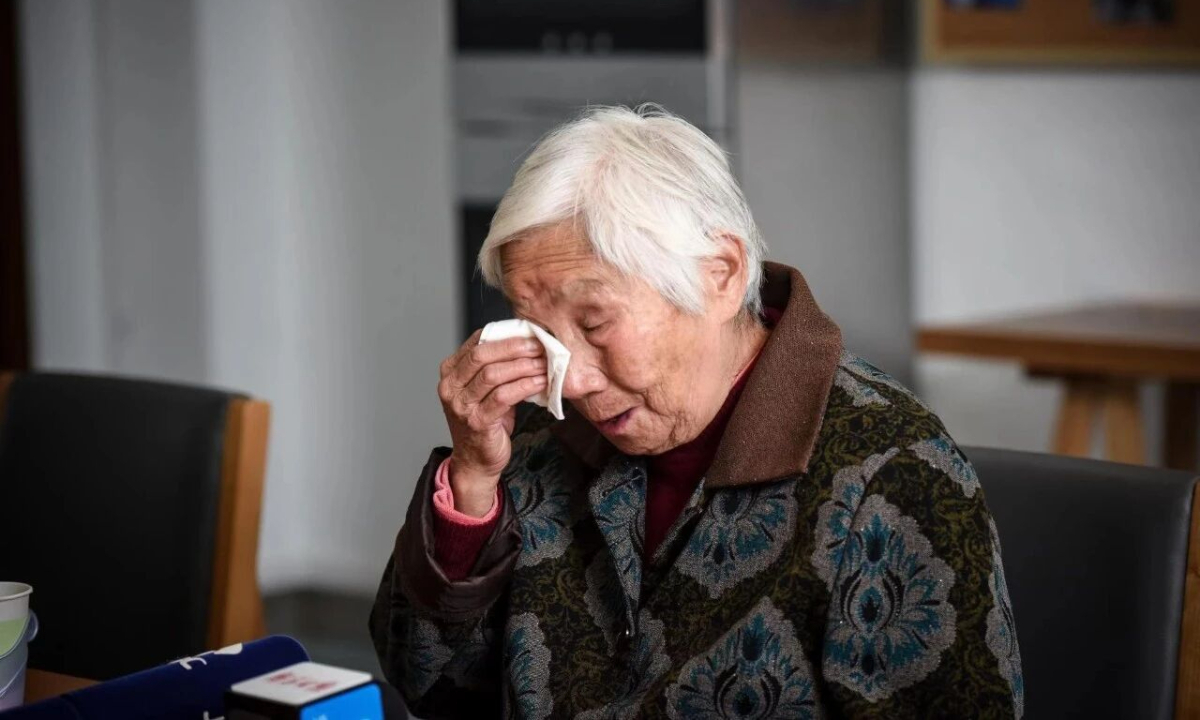
Nanjing Massacre survivor Xiong Shulan Photo: Memorial Hall of the Victims of the Nanjing Massacre by Japanese Invaders
The Memorial Hall of the Victims of the Nanjing Massacre by Japanese Invaders announced on Monday that Nanjing Massacre survivor Xiong Shulan passed away on Saturday, at the age of 94. As of now, only 25 registered survivors of the massacre remain alive, said the memorial hall, citing data from the association for aid to victims of the Japanese aggression of Nanjing and the inheritance of historical memory of the Nanjing Massacre.
The Japanese Imperial Army captured Nanjing on December 13, 1937. Invaders then carried out mass killings, sexual violence and other atrocities, resulting in the deaths of approximately 300,000 Chinese civilians and unarmed soldiers over six weeks, reported the Xinhua News Agency. The Nanjing Massacre remains one of the most barbaric episodes of World War II.
Born in 1931, Xiong she was only 6 years old in 1937. Her family consisted of five members: her father, mother and elder sister, among others. "In December 1937, we fled from the invaders, taking a small boat to Jiangxinzhou. When Japanese soldiers approached, we hid in an underground burrow. My mother was five months pregnant at the time; she fell during the escape and suffered a miscarriage after we returned. My aunt had bound feet and walked slowly. She couldn't hide in time and was gang-raped by Japanese soldiers. My uncle was killed by Japanese troops—his death was extremely brutal," she recalled before death.
Xiong recalled that near Jiangdongmen, where the memorial hall now stands, "corpses were piled up in terribly high mounds." She herself survived only because her head was shaved and she was disguised as a boy.
Xiong Shengbao, son of survivor Xiong Shulan, recalled that his mother began sharing her painful memories with him when he was in elementary school. "It was profoundly sorrowful," he said.
Shortly after the memorial hall opened in 1985, Xiong often attended lectures and spoke to young people about the past, so that more would learn of this history, according to her son.
Global Times
