IN-DEPTH / IN-DEPTH
GT investigates: 'Doxxing' phenomenon following Charlie Kirk's death draws attention on social media platforms, including those in China
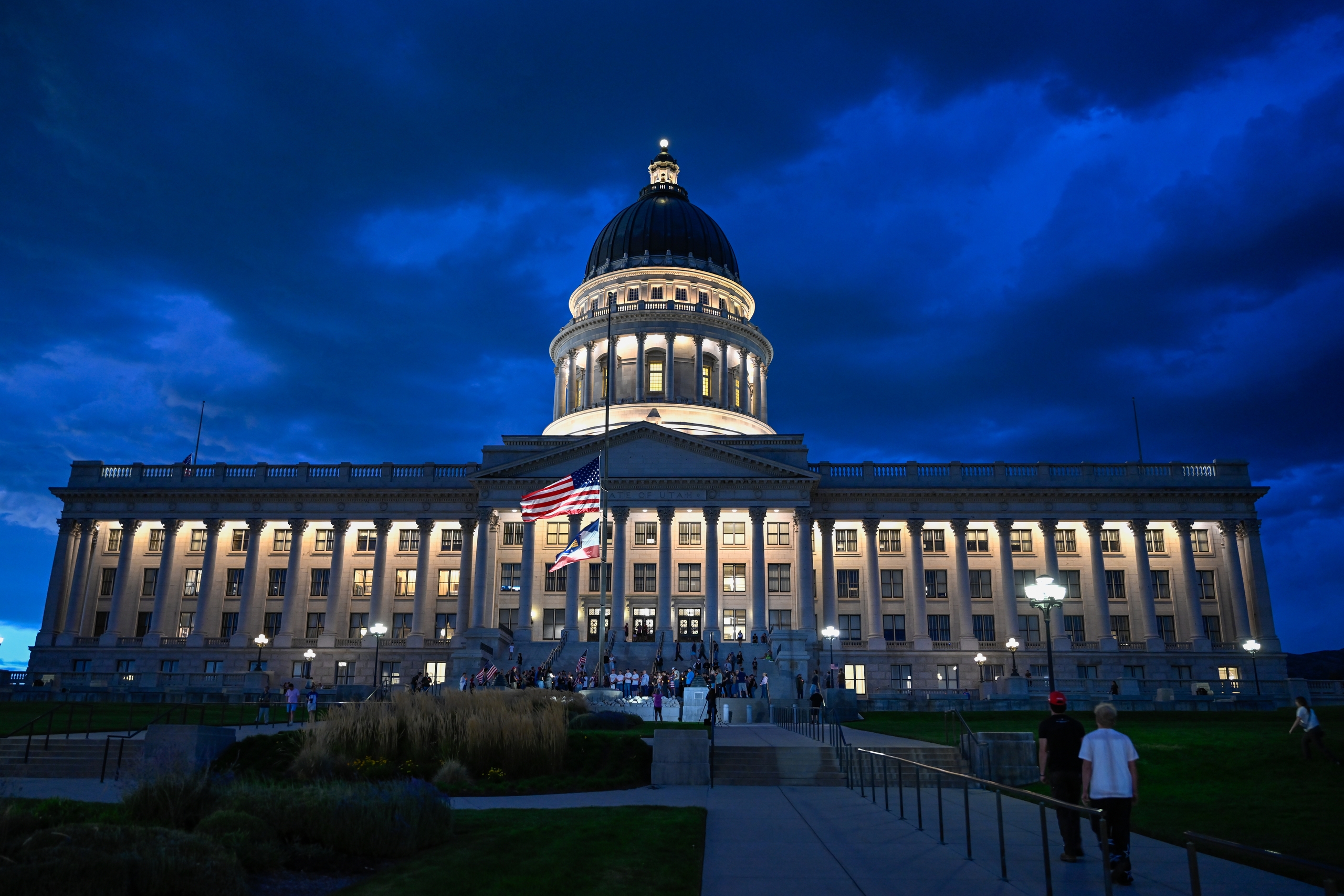
Some people hold a vigil on the steps of the Utah State Capitol in Salt Lake City to mourn the death of the US conservative activist Charlie Kirk on September 11, 2025. Photo: VCG
The unexpected death of a radical right-wing figure in the US, which would further exacerbate societal divisions and chaos in the country, is triggering attention and discussions on international social media platforms, including some in China.
Charlie Kirk, 31, was assassinated on September 10 while speaking at a campus event at Utah Valley University. With more than seven million followers on short-video platforms, this “influential right-wing activist” as described by some US media has posthumously triggered a larger crisis in the US following his death. Some individuals who opposed, or merely refrained from endorsing, Kirk’s views, have reportedly been subjected to “doxxing” - the act of exposing personal information online through human flesh searches. They are enduring, or may soon face, online harassment and violence, potentially leading to even greater dangers.
Questions such as “How should one evaluate Charlie Kirk’s life?” and “What do you think about Americans being doxxed for ‘celebrating’ his death?” have surged on Zhihu, China’s Quora-like platform,, with some of the most highly discussed ones drawing over a million views each. On other popular Chinese social media platforms like Weibo and Xiaohongshu, there are also many posts heatedly discussing Kirk and things related to him.
“[I feel that] the US has entered a very terrifying moment,” wrote a user on Zhihu, in a comment that has garnered nearly 1,000 “upvotes.” For many in China, the violence and chaos following Kirk’s death, along with the extreme rhetoric and deadly conflicts that have emerged in recent years within US society, starkly contrast with the “civilized” “fair” and “inclusive” image of the US long promoted by the Western media, scholars, and internet influencers.
What exactly was the doxxing phenomenon triggered by the Kirk incident in the US? How does the Chinese public perceive the chaotic online and offline reactions in the US following Kirk’s death, as well as the intensifying societal divisions in the country? In this story, the Global Times explores those who have instigated or fueled the doxxing, and share insights from Chinese experts, online influencers, and ordinary netizens on this event.
The doxxing nightmare
For some individuals in the US, a website called “Expose Charlie’s Murderers” has become a waking nightmare these days.
First launched as “Expose Charlie’s Murderers” and later rebranded “Charlie Kirk Data Foundation,” the site emerged in the public eye following Kirk’s death. It collected and encouraged submissions of personal information about those who posted messages “celebrating” Kirk’s assassination, and claimed to create a searchable database of this information. The site was taken down on September 16 after it began accepting donations in cryptocurrency, CNN reported the same day.
However, it appears that the site has resurfaced under a new guise. The Global Times found that a verified X account named “Charlie Kirk Data Foundation,” which had previously indicated its connection to the doxxing website through many posts, shared a new domain, “cancelthehate.com,” on September 20. “Check it out,” the account urged.
While Global Times reporters have yet to find any active doxxing features on the newly established site, it suggested that an information database would be available soon, inviting visitors to “check back soon for the new process.” Even more concerning, the site indicated that the information database would extend beyond the US. “You will soon be able to report in every country in the world, with real time verification and monitoring, and no longer just the United States,” the site said on the database page.
How extensive will this database be? “We’re now at well over 50,000 confirmed identities and nearing 60,000. Keep pushing,” the “Charlie Kirk Data Foundation” account wrote on X on September 15. “This doesn’t even include all your DMs (direct messages) and comments - which we’ll get to soon,” it added. “This is for Charlie Kirk. Can we get to 100,000?”
Such chilling rhetoric stands in stark contrast to the site’s new name, “Cancel the Hate.” It is not difficult to imagine that, if tens of thousands of personal details are widely disseminated, it could lead to increased harassment, firings, and violent incidents, inciting further panic and hatred.
US resident Rebekah Jones, said she contacted the police twice about death threats and about the “hit list,” her name for the doxxing site. Earlier, Jones posted about Kirk, writing: “Save your sympathies for the innocent bystanders caught in the crossfire of MAGA (make America great again)’s violent political messaging machine,” according to a September 16 article by Radio New Zealand.
Such a scenario has left observers and ordinary netizens in China astonished. “I used to hear about Americans being doxxed for not supporting LGBTQ rights, and now it’s those who ‘celebrate’ Kirk’s death. Are the left and right in the US engaged in some kind of magical duel? What’s wrong with the US?” wrote a Weibo user.
“When positions become shackles, reason becomes the first casualty,” commented “Niu Tan Qin”, a well-known blogger and media figure with over two million followers on Chinese social media.
‘Witch hunt’
To date, there has been no publicly available and credible evidence to confirm the true identities of the creator(s) behind the doxxing websites, from its original iteration “Expose Charlie’s Murderers” to the current “Cancel the Hate.” Some US media outlets, such as WIRED magazine, have reported that the website(s) are (or were) operated anonymously.
Yet this enigmatic platform has become a collective carnival for some US right-wing, as many well-known right-wing influencers and opinion leaders were found to have openly fueled this “witch hunt” targeting ordinary individuals.
Laura Loomer, whom CNN called a “prominent far-right influencer,” posted on X just hours after the fatal shooting, stating, “ I will be spending my night making everyone I find online who celebrates his death famous, so prepare to have your future professional aspirations ruined if you are sick enough to celebrate his death.”
Jimmy Kimmel, host of the late-night talk show “Jimmy Kimmel Live,” was previously taken off the air following a controversy over his comments about Kirk. Kimmel is reportedly to have returned to ABC on September 23, but that day’s episode “won’t be aired on dozens of local ABC stations,” reported The Guardian.
“Attempts to call out people designated as being celebratory of Kirk’s death, or merely critical of Kirk’s life, work to give shape and weight to that enemy,” Whitney Phillips, assistant professor of information politics and ethics at the University of Oregon, told CNN. As a result, disconnected groups can be perceived as “a downright spiritual enemy of conservatives, and by extension, of America itself,” Phillips said.
Some Chinese netizens also wondered: why has Kirk’s death triggered such intense emotions in the US?
“Kirk’s influence among young conservative right-wing Americans cannot be underestimated. The death of such a pivotal political figure - assassinated in the midst of advocating his political ideals - will undoubtedly send massive shockwaves through American society and further exacerbate its existing divisions,” said Cao Fengze, an online influencer who has long focused on international political topics with over 420,000 followers on Zhihu, in an interview with the Global Times.
Cao said that nowadays, the right-wing’s voice on the internet is growing louder, breaking the previous pattern in the US where left-wing elites might have held more dominance over mass communication. “Conversely, the same logic applies: if the left-wing were in power, they may crack down on the right-wing in the same way - and this has become a normal phenomenon in US society,” he noted.
A split, ‘unexpected’ US
Some comments on Chinese social media such as Sina Weibo said the online “riots” reminded Chinese netizens of the Capitol riot in 2021 in the US, lamenting how the US’ current state increasingly betrays its carefully crafted positive international image.
So, why has US society become like this, fraught with division, hostility, and a state where one is either an enemy or a friend with no middle ground? In the eyes of Chinese observers and US studies experts, the Kirk incident and its subsequent repercussions, including doxxing campaigns, are hardly accidental. Analysts point to a confluence of mounting social tensions, accumulating public discontent, deepening societal rifts, and the rising influence of right-wing groups in recent years as the root causes.
Shen Yi, a professor of international relations at Fudan University, told the Global Times that Kirk’s death has ignited a firestorm of emotions because America is experiencing a 1930s-style economic depression: globalization has eroded the middle class, making incremental redistribution impossible and forcing a zero-sum struggle over interests.
The expert further noted that US society has entered a state of perpetual political mobilization. Rather than engaging in cooperation and compromise, the two parties have turned to large-scale demagogic campaigns. The phenomena of doxxing and witch hunts reflect extreme polarization: manufacturing enemy groups and inciting mass conflict to divert attention from economic grievances.
This reveals three structural challenges facing the US today, according to the scholar: first, the mutually reinforcing spiral of polarized narratives between political factions; second, fragmented information flows on social media that amplifies emotional reactions and turn hate speech into real-world actions, escalating offline risks; and third, the persistently weak governance capacity at both federal and state levels, which fails to address pressing challenges.
“The US is staging more frequent farces for the world to see, making it evident that the ‘universal values’ it espouses cannot even cure its own ills,” read one Weibo comment, reflecting the views of many Chinese netizens. “Instead of pointing fingers at other countries to deflect domestic tensions, it should focus on managing its own affairs first.”
RELATED ARTICLES