China's super-gravity facility launches core equipment, including world's largest centrifuge
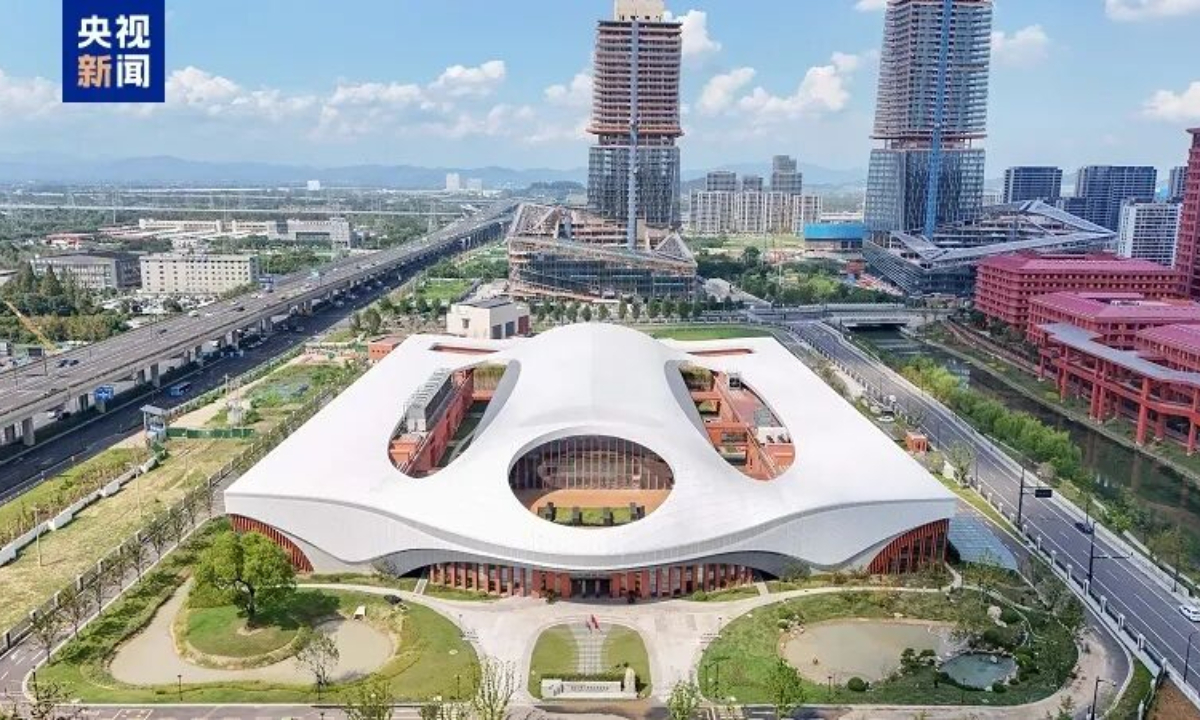
China put into operation the core equipment of its super-gravity centrifuge simulation and experiment facility, including the world's largest centrifuge with a capacity of 1,300 g·t (gravity acceleration·tons) in Hangzhou, East China's Zhejiang Province, on September 29, 2025. Photo: CMG
China on Monday put into operation the core equipment of its super-gravity centrifuge simulation and experiment facility, including the world's largest centrifuge with a capacity of 1,300 g·t (gravity acceleration·tons), China Media Group reported.
Located in Hangzhou, East China's Zhejiang Province, and led by Zhejiang University, the facility is a major national science and technology infrastructure project entirely developed domestically. It can generate a "super-gravity field" thousands of times stronger than Earth's gravity, enabling what scientists call "space-time compression."
The technology allows large-scale real-world changes to be replicated on a much smaller scale and within a shorter timeframe. This provides critical support for research ranging from kilometer-level natural disasters to the migration of pollutants over millennia, according to the report.
The facility integrates super-gravity fields with extreme environments and will ultimately include three centrifuges. In addition to the world's largest unit already in operation, two more centrifuges with capacities of 1,500 g·t and 1,900 g·t are under construction, with completion scheduled for the end of 2026.
From deep-sea energy exploration to earthquake-resistant architecture, and from nuclear waste disposal to new materials research, the super-gravity centrifuge simulation and experiment facility is expected to become a powerful driver of multidisciplinary innovation, the report said.
In a super-gravity field, researchers can reproduce major disasters, geological evolution and extreme environments in the laboratory on a very small scale and within a very short time, said Chen Yunmin, chief scientist of the super-gravity centrifuge simulation and experimental facility, and professor at Zhejiang University, Xinhua News Agency reported, in describing why to build the facility.
For example, under an experiment at 100 times Earth's gravity, a 100-meter real-world object can be "scaled down" to 1 meter, and a 100-year process of pollutant migration can be "compressed" to just 3.65 days, per Xinhua. This "time-space compression" effect will provide vital support for major national scientific and technological tasks, the development and testing of new engineering technologies, and advances in the frontiers of material science, the report said.
Global Times
RELATED ARTICLES