S.Korea visa-free policy for Chinese group tourists takes effect, aimed at enhancing exchanges amid complex bilateral ties and challenges
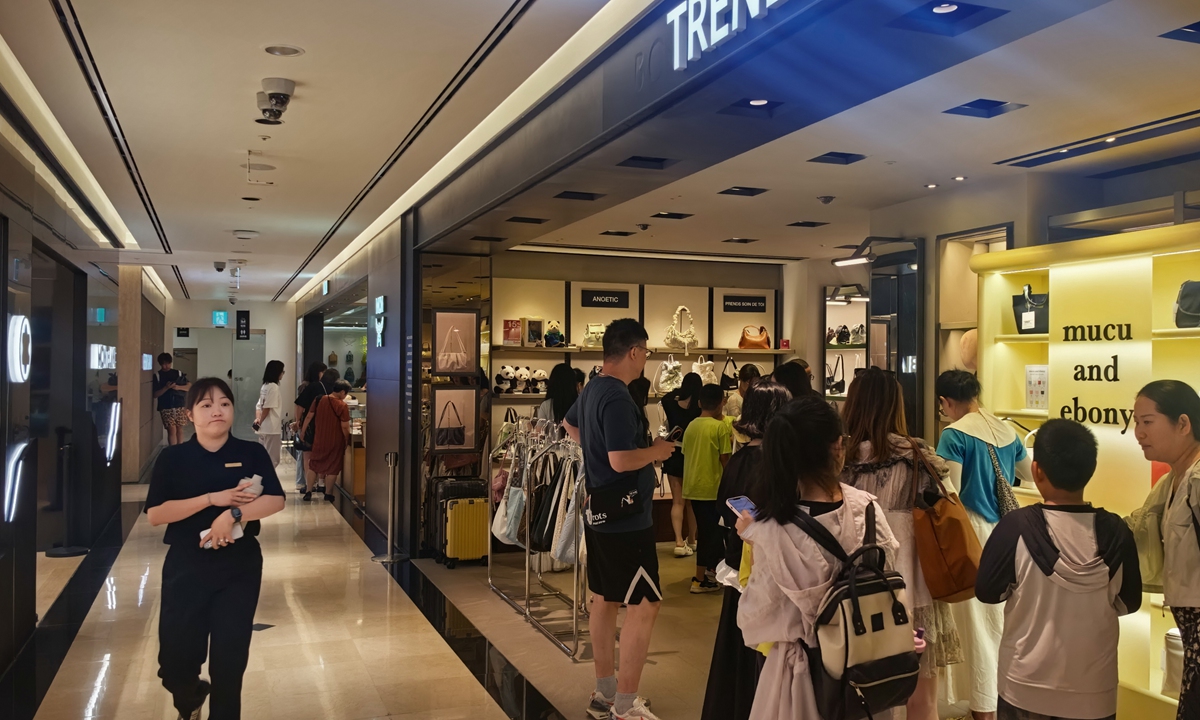
Chinese tourists shop at a store in the Shilla Duty Free Shop in Jeju, South Korea on July 9, 2025. Photo: Liu Yang/GT
As South Korea's visa-free policy for Chinese tour groups takes effect on Monday, its tourism sector has ramped up efforts to attract Chinese travelers, anticipating an influx of visitors. Experts view this as a positive signal for the two countries to enhance exchanges amid complex relationship in concurrent international landscape.The visa exemption policy has fueled hopes of higher spending in the tourism and retail sectors, while also raising concerns about tourist safety amid rising anti-China sentiment in the country, Korea Times reported.
According to the policy, Chinese tour groups of three or more will be allowed to enter South Korea without a visa for up to 15 days. The program will run from September 29, 2025 through June 30, 2026, and is open to groups recruited by government-designated domestic and overseas travel agencies.
Jeju Island will continue existing visa-free policies for individuals and groups, allow stays of up to 30 days.
In response to a question on South Korea' visa-free policy, Chinese Foreign Ministry spokesperson Guo Jiakun said on August 7 that China and South Korea are important neighbors. Enhancing people-to-people exchange is in the common interests of both peoples.
China has permitted people from nine countries - Slovakia, Norway, Finland, Denmark, Iceland, Andorra, Monaco, Liechtenstein and South Korea - to visit China visa-free for tourism, business, family visits and transit effective from November 8, 2024 to December 31, 2025, Xinhua News Agency reported in November 2024. As of June 2025, China has granted 240-hour visa-free transit program to 55 countries.
According to the Korea Times, the government expects the policy to draw roughly 1 million additional Chinese visitors by the time it ends in June next year.
Korea Tourism Organization data shows that Chinese visitors make up the largest share of foreign visitors to South Korea in July at 34.7 percent, or 602,147 people — up 31.2 percent from a year earlier.
The tourism industry is ramping up efforts to attract Chinese tour groups, including offering promotions and small gifts, WeChat pay and Alipay discounts, food delivery coupons, and expanding foreign-language staff and tax refund terminals, per the Korea Times.
Jia Jianqiang, founder and CEO of Beijing-based online agency 6renyou, told the Global Times that the tourism market of South Korea has resumed quickly this year, with the improvement in bilateral political atmosphere and a slew of policies.
Jia's agency is developing packages that would highlight special features of South Korea, such as skin care.
The exemption is also expected to give a strong boost to silver-hair groups. Applying for a visa is the biggest headache for these travelers, as it involves numerous documents and lengthy processes. With the visa-free policy in place, they can travel as long as they have a passport with them.
Following Singapore implementing a visa-free policy in 2024, the number of silver group tours has seen a double-digit increase, Jia said, expecting a similar trend in tours to South Korea.
Such visa relaxation for Chinese tour groups is practical as well as a concrete action to develop China-South Korea relations, since people-to-people exchanges can enhance mutual understanding between countries, Lü Chao, a Korean Peninsula affairs expert at the Liaoning Academy of Social Sciences, told the Global Times.
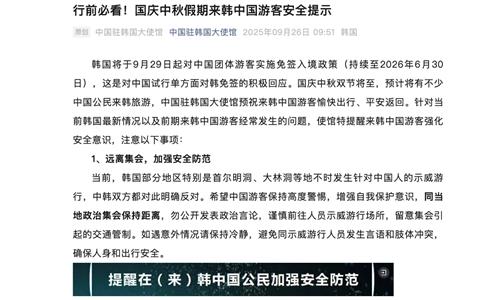
However, the anti-China sentiment in South Korea could cast shadow over such exchanges. Chinese Embassy in South Korea issued a safety notice on Friday for Chinese tourists expected to visit during the upcoming National Day holidays and Mid-Autumn Festival.
The notice advised travelers to keep vigilant and enhance self-protection, avoid local political gatherings and making politics-related remarks, among other warning reminders.
Protesters from ultra-right civic groups held an anti-China rally Sunday, Yonhap News Agency reported. South Korean President Lee Jae-myung had previously condemned rallies and demonstrations targeting tourists from China, describing them as "not freedom of expression, but disturbance."
The visa-free policy marks a positive step toward deepening tourism cooperation between China and South Korea and possible positive influence on bilateral ties. Yet, the long-term effectiveness of this policy hinges on whether South Korea can adequately address operational challenges as well as properly deal with the big-picture geopolitics, analysts said.
RELATED ARTICLES