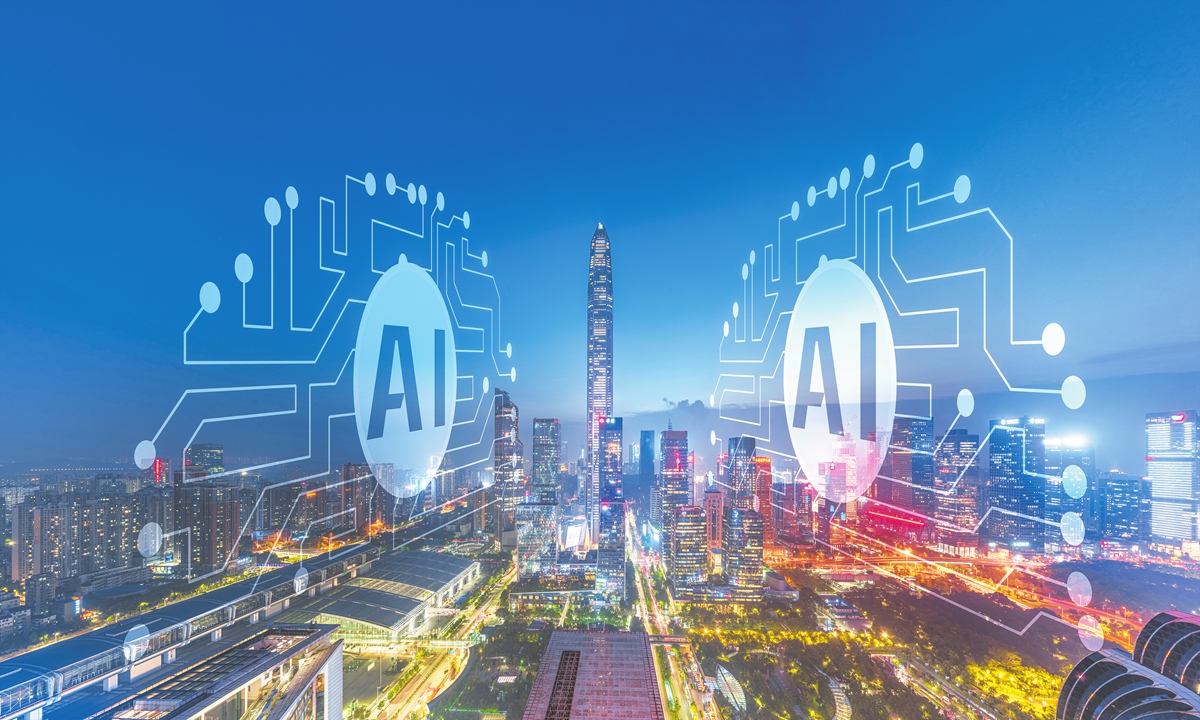
An AI conceptual city in Shenzhen File photo: VCG

The US' erratic trade policy has seen a series of new actions recently, adding uncertainty and amplifying economic disruptions. The US announced fresh tariff measures on patented drugs and heavy-duty trucks, while the US' Department of Commerce launched a new Section 232 investigation to explore additional tariff options on the grounds of "national security." These moves have once again heightened concerns over the unpredictability of US tariff policy.
This year, Washington has increasingly relied on tariffs not merely as a tool to reduce the trade deficit, but as a major instrument of strategic leverage in international trade exchanges. The US' reinforced trajectory suggests further impacts on the global economic and trade landscape.
Yet the repeated escalation also reflects a deeper problem: US policies have fallen short of Washington's expectations. If earlier rounds of tariffs had achieved their intended objectives, there would be little need for fresh measures. The extension of tariffs exposes the US government's frustration with the lack of intended results and prompts a search for new goods categories.
The US policy pace further reveals a sense of anxiety. Tariff measures are being introduced with high frequency and intensity, but the US government faces growing domestic pressure. Rather than delivering the intended impact on trading partners, tariff actions have instead raised costs for US importers and consumers.
This uncertainty has also amplified market disruption. Since April, Washington has swung between imposing and suspending tariffs. Such reversals leave US importers struggling to adapt and distort the transmission of costs through supply chains. Moreover, the widening scope of US tariffs risks compounding external shocks. Beyond raising domestic costs, they also hurt neighboring economies and US allies. Such a highly uncertain and erratic policy path is likely to remain a destabilizing factor for global trade in the months ahead.
Regarding China-US trade, there was tariff-related front-loading that emerged after the US additional tariffs and China's countermeasures earlier this year. After China and the US held multiple rounds of trade talks, the current suspension of additional tariffs is set to remain in place until November. Yet beyond this window, uncertainty remains.
Despite intensifying external pressures, China's trade performance has continued to display remarkable resilience. Several factors explain this strength. In the face of further uncertainty stemming from US tariffs, China has ample room for adjustment and maneuver, and has prepared itself on multiple fronts.
First, diversified trade partnerships have expanded export opportunities.In the face of US tariff hikes and other restrictive measures from Washington, China's strong manufacturing base remains indispensable to global markets. Chinese products are widely recognized for their competitive quality and price advantages.
Second, the building of a unified national market and the advancement of "dual-circulation" development pattern are gaining momentum.China is accelerating the building of a unified national market, enabling smoother resource allocation and better circulation efficiency. The depth and breadth of domestic demand continue to expand, with consumer confidence rebounding and capital market performance improving.
Third, industrial upgrading and technological breakthroughs are strengthening competitiveness. With market-oriented reforms deepening, China has placed greater emphasis on cultivating new quality productive forces. Exports of high-tech and brand-driven, technology-intensive products are rising strongly. Notably, even under Washington's "small yard, high fence" approach, China has achieved breakthroughs in frontier technologies. The back-and-forth changes in US tariff policy and their spillover effects will continue to weigh on the global trade order. Yet China's economy, supported by diversified exports, a deep domestic market, and ongoing industrial upgrading, has ample capacity and strong resilience.
The author is a senior fellow at the Center for International Security and Strategy, Tsinghua University. bizopinion@globaltimes.com.cn
RELATED ARTICLES