Readers’ Reflections: CPC showcases exceptional wisdom, governance ability in fostering ethnic harmony
Editor's Note:
Recently, Chinese President Xi Jinping, also general secretary of the Communist Party of China (CPC) Central Committee and chairman of the Central Military Commission, led a central delegation to attend a grand gathering in celebration of the 70th founding anniversary of the Xinjiang Uygur Autonomous Region. On September 24, while listening to work reports from the CPC Xinjiang regional committee and the regional government, President Xi once again stressed that "it is imperative to foster a strong sense of the Chinese nation as one community in Xinjiang and promote the construction of the community."
Just about a month earlier, while attending a grand gathering to mark the 60th founding anniversary of the Xizang Autonomous Region, President Xi delivered the same requirement after listening to work reports from the CPC Xizang regional committee and the regional government. President Xi attaches great importance to the work of ethnic unity in Xinjiang and Xizang. He has convened a number of important meetings and articulated the original and pioneering conclusion of "reinforcing the sense of the Chinese nation as one community," establishing it as the focus of our Party's work on ethnic affairs and indeed for all our endeavors in ethnic minority areas in the new era.
Multiple important speeches included in the book series Xi Jinping: The Governance of China reflect President Xi's ideas for strengthening and improving the Party's work on ethnic affairs. For example, in the article "Heighten a Sense of Chinese Identity" in Volume III, President Xi pointed out: "We must fully implement our Party's theories and policies concerning ethnic groups, work together for common prosperity and development, and help all ethnic groups remain as closely united as the seeds of a pomegranate, so that the Chinese nation will become a more inclusive and cohesive community." In the article "Unite the Chinese Nation as One Community" in Volume V, Xi emphasized that "heightening the sense of national identity is a shared mission of the entire Party, the whole country, and the people of all ethnic groups."
In the 13th installment of the special series "Decoding the Book of Xi Jinping: The Governance of China," the Global Times, along with People's Daily Overseas Edition, continues to invite Chinese and foreign scholars, translators of Xi's works, practitioners with firsthand experience and international readers to discuss the theme of "fostering a strong sense of the Chinese nation as one community and promoting the construction of the community," in a bid to explore its profound practical significance and value in action.
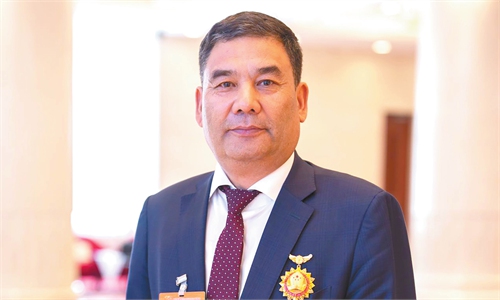
In the 13th article of the "Readers' Reflections" column, the Global Times (GT) reporter Ma Tong interviewed Gustavo Alejandro Girado (Girado), director of Sino-Latin American Research Center at the National University of Lanús, president of the Argentina Sinologist Council, also former Counsellor and Consul General at the Argentina's Embassy in China.
GT: President Xi recently led a central delegation to attend activities marking the Xinjiang Uygur Autonomous Region's 70th founding anniversary. When listening to work reports from the CPC Xinjiang regional committee and the regional government, he emphasized the full, faithful and comprehensive implementation of the Party's guidelines for governing Xinjiang in the new era. Focusing on the overarching goal of ensuring social stability and enduring prosperity, Xinjiang should uphold the principle of pursuing progress while ensuring stability in its work and attach the same importance to development and security, Xi said. How do you understand this statement? Based on your observation of China's development, what is the significance of prioritizing social stability in the governance in border areas?
Girado: Although I am from a country with different political practices and governance frameworks, I must admit that China's achievements since its reform and opening-up are remarkable. Whether it's the long-term peace and stability achieved across its vast territory or the remarkable wisdom demonstrated in managing multi-ethnic relations, the CPC has showcased exceptional governance capabilities. These experiences are worth studying closely and learning from, as they inspire us to think about how to tailor some of these successful approaches to Latin America's unique context.
In the report to the 20th National Congress of the CPC, President Xi emphasized that "national security is the bedrock of national rejuvenation, and social stability is a prerequisite for building a strong and prosperous China." I was particularly impressed by his remarks during an inspection tour in Xinjiang in 2022, where he called for "developing Xinjiang into a region that is united, harmonious, prosperous and culturally advanced, with healthy ecosystems and people living and working in contentment." These ideas and practices offer valuable insights for less developed countries and regions worldwide, helping to improve livelihoods, narrow development gaps, and gradually catch up to more advanced development level. Given the results achieved so far, I believe the Chinese people have every reason to be pride of their collective success.
GT: President Xi has often used the "pomegranate seeds" metaphor to symbolize ethnic unity. Volume III of Xi Jinping: The Governance of China includes the article "Heighten a Sense of Chinese Identity", in which he emphasized, "We must fully implement our Party's theories and policies concerning ethnic groups, work together for common prosperity and development, and help all ethnic groups remain as closely united as the seeds of a pomegranate, so that the Chinese nation will become a more inclusive and cohesive community." How do you see this concept contributing to ethnic unity? What lessons might it offer for governance in other multi-ethnic countries?
Girado: The metaphor is a uniquely Chinese concept that vividly symbolizes ethnic unity and is easily understood, embodying profound wisdom. It not only resonates within the country but also offers a distinct perspective for the world to understand China's ethnic policy. People can vividly sense the power of unity and coexistence from this metaphor. Since the founding of the People's Republic of China, one of China's greatest achievements has been bringing together people of all ethnic groups, with their diverse languages and cultures to unite and build a cohesive republic.
China has gradually forged a cohesive society grounded in shared values. From the economically advanced and globally connected eastern seaboard to inland regions with tougher natural conditions, people are able to share in development opportunities. This unity gives true meaning to the nation. What's especially striking is that it has been achieved through a collective effort involving everyone, where individuals pursue their own growth while putting the interests of the whole first. In my view, the ability to bridge differences and achieve unity in such a diverse society is one of the most remarkable and praiseworthy accomplishments of the CPC's governance.
GT: Volume V of Xi Jinping: The Governance of China includes the article "Unite the Chinese Nation as One Community," President Xi said, "In promoting Chinese modernization and achieving common prosperity, none of our 56 ethnic groups will be left behind. We should support the integration of ethnic minority areas into the overall development of the country, and promote closer economic integration and connections among all regions." How do you assess China's progress in modernizing and coordinating development in its border regions? What has the government done right to achieve rapid economic growth while maintaining social stability?
Girado: The Belt and Road Initiative (BRI) is a major milestone in advancing coordinated regional development in western China. President Xi has stressed advancing the building of the core area of the Silk Road Economic Belt and incorporating Xinjiang's regional opening-up strategy into the country's overall plan of westward opening-up. These policies not only deepen economic and social integration between border regions and the rest of the country, but also create new development opportunities for the broader Central and West Asia region. For example, Xinjiang region's deep engagement with neighboring nations in infrastructure and industry has helped optimize regional supply chains, create jobs, and drive industrial upgrading.
Governing border areas usually with challenging geography with vast territories and sparse populations, is inherently complex. Although I am not yet sure what new policies may be introduced around the anniversaries, it is clear that China's governance measures, such as its system of regional ethnic autonomy, have clearly been effective and suited to national conditions. These policies have already delivered tangible results in social and economic development, including steady growth in per capita income, significantly expanded access to basic public services, and substantial progress in the education system, particularly higher education.
In recent years, the steady rise in tourists visiting Xizang and Xinjiang has helped locals develop a more open, global perspective. This internationalization mirrors and supports the broader integration process, as local authorities increasingly engage in provincial, regional, and international cooperation, fostering deeper external exchanges and collaboration.
GT: President Xi has also emphasized that "Ethnic minority areas should thoroughly and precisely apply the new development philosophy by promoting further reform and opening up, boosting competitive industries with local features, and developing new quality productive forces based on local strengths." Xinjiang and Xizang have made notable progress in sectors like clean energy, the digital economy, low-altitude aviation, specialty agriculture, and tourism. How significant are these innovations to improving local livelihood and promoting sustainable regional growth?
Girado: The real highlight here is the focus on developing industries with distinctive advantages and adapting to local conditions. Too often, generic economic discussions on industrial competitiveness or market conditions stay at the macro level, and overlook regional differences in resources, talent, and production systems. President Xi's emphasis on tailoring policy is therefore highly valuable. When the Chinese government talks about boosting technological support or developing agricultural equipment manufacturing, it is offering tailored guidance based on unique conditions of each region.
For less-developed regions, this approach is critical, as these areas usually feature uneven growth and widening wealth gaps. Broad, one-size-fits-all policies can overlook local realities, deepen inequality and stall economic progress. By focusing on eco-friendly agriculture, livestock farming, and innovative industries tailored to local conditions, China turns industrial competitiveness into more than just an abstract slogan. This approach helps close regional gaps, promotes sustainable development, and uplifts people's lives.
GT: Some Western media and politicians keep pushing negative narratives about Xinjiang and Xizang, despite significant economic, social, and ethnic unity progress is achieved in these regions. In your view, what's driving this bias in their narratives? How can the international community better understand and fairly assess the real development in China's border regions?
Girado: Negative narratives persist, and sometimes even intensify. This indicates that our past efforts to present the facts are facing resistance from forces attempting to construct a contrary perception. Clearly, some nations seek to place China in the international spotlight and portray it as a "counterforce" against Western interests. Those who focus on the facts understand that this is far from the truth.
But the drive to portray China negatively is powerful. These forces try to amplify global criticism of China, even when such critiques are unfounded. Vested interests in certain countries manipulate media discourse to serve their own ends. They seek to uphold a postwar order that, though increasingly fragile, still benefits them — even at a cost. Today, China seems to face pressure precisely because of its pursuit of an independent, cooperative, and win-win path of peaceful development, becoming a target for some countries defending their own agendas.
As someone from a developing country, I deeply understand the challenges caused by external interference. Many nations have long suffered from actions that impede their ability to develop independently. In this light, I fully understand the challenges China faces when unfairly criticized or undermined. I hope the principle of win-win cooperation will ultimately prevail over conflict and confrontation.
RELATED ARTICLES