US' fresh tariff threats on furniture add uncertainty, likely to backfire on own industries and consumers: expert
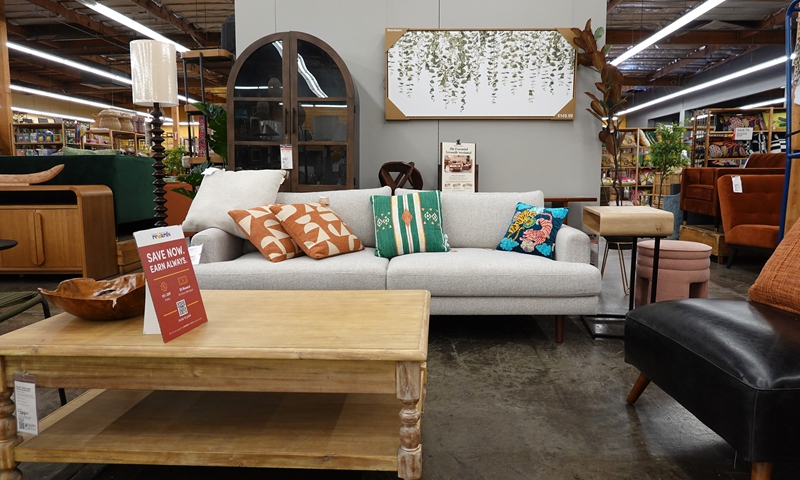
Furniture is displayed at a Cost Plus World Market store on August 12, 2025 in Greenbrae, California. Photo: VCG
Responding to a foreign media inquiry for comment regarding the US President Donald Trump's announcement on Monday that new tariffs would be imposed on imports of timber, kitchen cabinets, bathroom vanities, and upholstered furniture, Chinese Foreign Ministry spokesperson Guo Jiakun said at a regular press conference on Tuesday that there are no winners in tariff or trade wars, and protectionism leads nowhere.
The US president on Monday announced plans to impose additional high tariffs on furniture imports, which a Chinese expert warned could further disrupt global supply chains while exposing US companies and consumers to higher costs.
"In order to make North Carolina, which has completely lost its furniture business to China, and other Countries, GREAT again, I will be imposing substantial Tariffs on any Country that does not make its furniture in the United States," Trump claimed in a social media post on Monday.
According to a proclamation signed Monday, imports of certain upholstered wooden products will be subject to a 25 percent ad valorem duty rate. Also, imports of kitchen cabinets and vanities will be subject to a 25 percent ad valorem duty rate.
The proclamation threatens to further increase the duty rates of the corresponding products unless reaching an agreement with the US side.
The action is the first three sectors that Trump said last week would get steep new duties as early as October 1, including patented pharmaceutical imports, and heavy truck imports. But Monday's proclamation sets the start of the lumber and furniture duties two weeks later, at 12:01 am EDT on October 14, Reuters reported.
The import duties will make it more challenging for companies to hold down prices, while executives in the industry have raised concerns over the lack of manufacturing capacity in the US, as the country relies heavily on imports from China, Mexico and Vietnam, another report by Reuters said.
Bloomberg also reported on Tuesday that home builders have warned they also could deter investments in new houses and renovations. Canada stands to be hit hard by the order, as it's by far the US' largest wood supplier, the report said.
The US latest move on furniture tariffs aimed at pressuring countries including its allies and major trade partners into making greater concessions, including in bilateral negotiations, He Weiwen, a senior fellow at the Center for China and Globalization, told Global Times on Tuesday. "However, its impact on the US industries and consumers is clear."
"In the furniture sector, the US cannot fully replace imported products through domestic production, as it lacks both the adequate skilled labor and the complete industrial chain necessary. Restoring such production would take many years," He said.
The Chinese expert said that the notion of "self-sufficiency" is largely a political slogan, representing a complete rejection of globalization, which has already created a system of division of labor.
Despite the impact of tariffs on exports, China has maintained resilient furniture exports to the US, one of its main markets, according to industry data. According to the latest data released by the China National Furniture Association in August, in the first half of the year, the US accounted for 23.0 percent of China's total furniture exports, remaining the main export destination.
In addition to furniture, the US President threatened to impose a 100 percent tariff "on any and all movies that are made outside of the United States."
Investors largely shrugged at Trump's movie-tariff threat. Shares of Netflix Inc. and Warner Bros. Discovery Inc. were little changed as of 9:46 am in New York. Walt Disney Co. stock rose 1.1 percent, Bloomberg reported.
"The US is apparently using tariffs as a tool to achieve its political objectives," He said. While many uncertainties still remain, the Chinese expert noted that these duties could eventually backfire on the US film industry itself, including the box office, if they are implemented in the future.
Global Times
RELATED ARTICLES