China's Jiaolong manned submersible conducts world’s first joint operation with ROV in Arctic waters: report
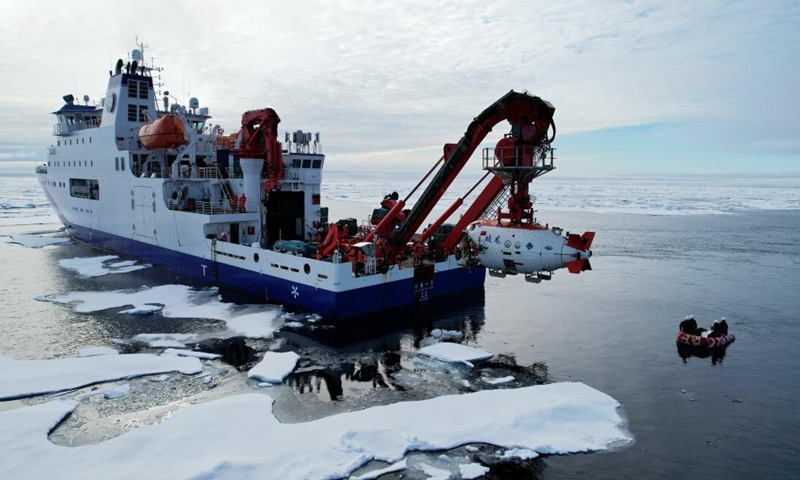
Jiaolong, China's manned submersible, conducts a manned deep dive in the Arctic ice. /Photo taken by Liu Shiping from Xinhua News Agency
During China's 15th scientific expedition to the Arctic Ocean, the Jiaolong manned submersible carried out a joint underwater operation in the Arctic waters with a remotely operated vehicle (ROV), which is the world's first such operation, the China Media Group (CMG) reported on Saturday.This marks another achievement for the scientific expedition, in addition to Jiaolong's completion of China's first manned deep-sea dive beneath Arctic ice-covered waters, according to CMG.
"As a manned submersible, the Jiaolong has always operated at a single point underwater. This time, we expanded its operational capabilities. We tried a collaborative operation between the Jiaolong and a remotely operated vehicle (ROV), which required solving challenges such as communication and positioning before moving on to the next step of joint operations," said Fu Wentao, chief pilot of the Jiaolong submersible during its first dive in the Arctic.
The first joint dive was conducted on August 14, during which the Jiaolong and the ROV tested underwater precision positioning and communication, and verified the underwater two-submersible operation model.
The second dive on August 15 involved a coordinated underwater operation between the two submersibles. During this dive, the ROV was used to film the Jiaolong collecting biological and sediment samples on the seabed. The Jiaolong transferred items such as rocks and operational markers to the ROV. The two submersibles also captured video footage of each other in the deep sea, according to CMG.
The collaborative operation of manned submersibles and ROVs can achieve a synergy where the whole is greater than the sum of its parts, compensating for the limitations of manned submersibles in large-scale underwater sampling, the CMG reported, citing Li Dewei, a project leader at the National Deep Sea Center.
The deep integration of human creativity and machine precision represents an inevitable trend for future deep-sea technology development and exploration, Li said.
In another first, scientists used a new survey method that combines AI-based identification with environmental DNA detection to identify deep-sea life on the seabed.
Over 10,000 images of deep-sea biological life forms were provided as technical support for AI-powered biological identification while environmental DNA detection served as supplements to verify the accuracy of AI identification results.
China's 15th scientific expedition to the Arctic Ocean, its largest-ever scientific exploration in these waters, concluded in late September.
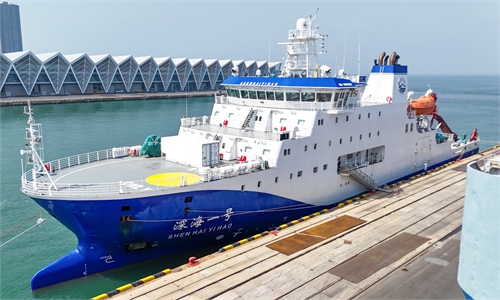
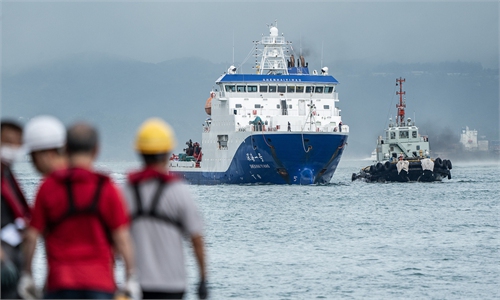
The expedition was jointly carried out by four vessels — Xuelong 2, Jidi, Shenhai 1 and Tansuo 3.
Preliminary studies revealed major differences in benthic organism density, biodiversity and individual body size across Arctic sea areas. The findings will help reveal spatial distribution patterns of polar deep-sea organisms and assess the impacts of climate change on deep-sea ecosystems, according to the Ministry of Natural Resources.
Global Times
RELATED ARTICLES