China is breaking West's monopoly over 'green discourse' in LatAm with cooperation results

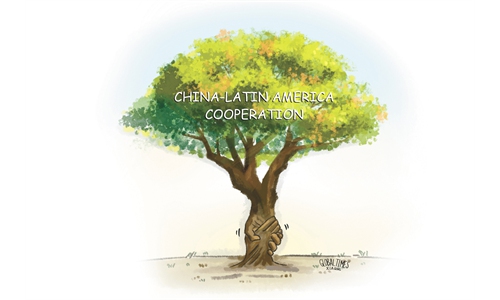
Illustration: Liu Rui/GT
For a long time, Latin America has been labeled in Western narratives as a "resource exporter" and a "debt trap region." The region was locked into the global division of labor as a "raw-material appendage," with its development path almost entirely dependent on the industrial demand of Europe and the US. The logic of Western writing has never changed: Latin America is a "backyard" for resources, not an entity with independent development.
Today, however, the scenes on Latin American streets are quietly rewriting this narrative, with the Chinese presence becoming indispensable in Latin America's energy transition. In Santiago, Chile's capital, more than 2,000 Chinese-made electric buses shuttle through the city streets, becoming the metropolis' new "mobile business card." On the Andean plateau of Argentina, 1.2 million solar panels at the Cauchari photovoltaic power station glisten under the blazing sun. In northeastern Brazil, wind farms invested and built by the Chinese company Goldwind supply clean electricity to millions of residents.
These are not merely engineering projects, but strategic deployments: a redistribution of geopolitical power driven by green energy is underway. China is shifting from its old identity as merely the "world's factory" toward that of a "global green engine." Latin America's abundant natural resources make it a crucial partner for China's green industrial ambitions.
In fact, the cooperation between China and Latin America in green development is not an "accidental complementarity," but a "forward-deployed strategy" by China to reshape the global green industrial layout. Through investment, financing, and infrastructure construction, China is integrating Latin America into its own green value chain system. It is also repositioning itself in the Global South - not as a passive consumer of resources, but as a shaper of green modernization.
In line with this strategy, China's engagement with Latin America differs fundamentally from that of the West. China does not view Latin America as a mere "energy warehouse," but as a key frontier of the new energy industry chain. From wind and solar to lithium batteries, China is not just "buying resources" unilaterally, but "building industries" bilaterally. This approach enables Latin America to participate fully in manufacturing, application, and value creation, moving beyond the traditional role of raw material supplier.
At the same time, in advancing these projects, China has not copied Western "green discourse." Western rhetoric on renewable energy often carries a shade of "green colonialism." Latin American countries are asked to shoulder responsibilities for emission reduction and green transition, yet remain stuck at the low end of the value chain. Such asymmetry means Latin America's green development cannot escape dependency.
China's narrative, by contrast, emphasizes development rights and energy equity, linking green transition with national development goals. It is rooted in a development logic, stressing "development through green transition." For developing regions like Latin America, this narrative is grounded in reality and far more aligned with actual needs, making China's green narrative more appealing in Latin America than that of the West.
China has not abstracted the green transition into "emission reduction obligations," but concretizes it into tangible "job opportunities," "industrial upgrading" and "development paths." It builds industrial parks, trains local talent, and provides low-cost financing to help Latin America extend its industrial chain. This enables the region to become a "green manufacturer" and "value creator", granting it genuine strategic agency and choice.
By altering Latin America's role in the industrial chain and shaping the narrative, China is breaking the West's monopoly over discourse, while Western "green sermons" in Latin America will appear increasingly hollow and distant. From "world's factory" to "global green engine", China's renewable energy footprint is both an economic endeavor and a strategic breakthrough. It challenges Western dominance in supply chains and narrative control, while giving Latin America unprecedented room for autonomous development.
The author is an associate professor at the School of International Studies at Renmin University of China. opinion@globaltimes.com.cn
RELATED ARTICLES