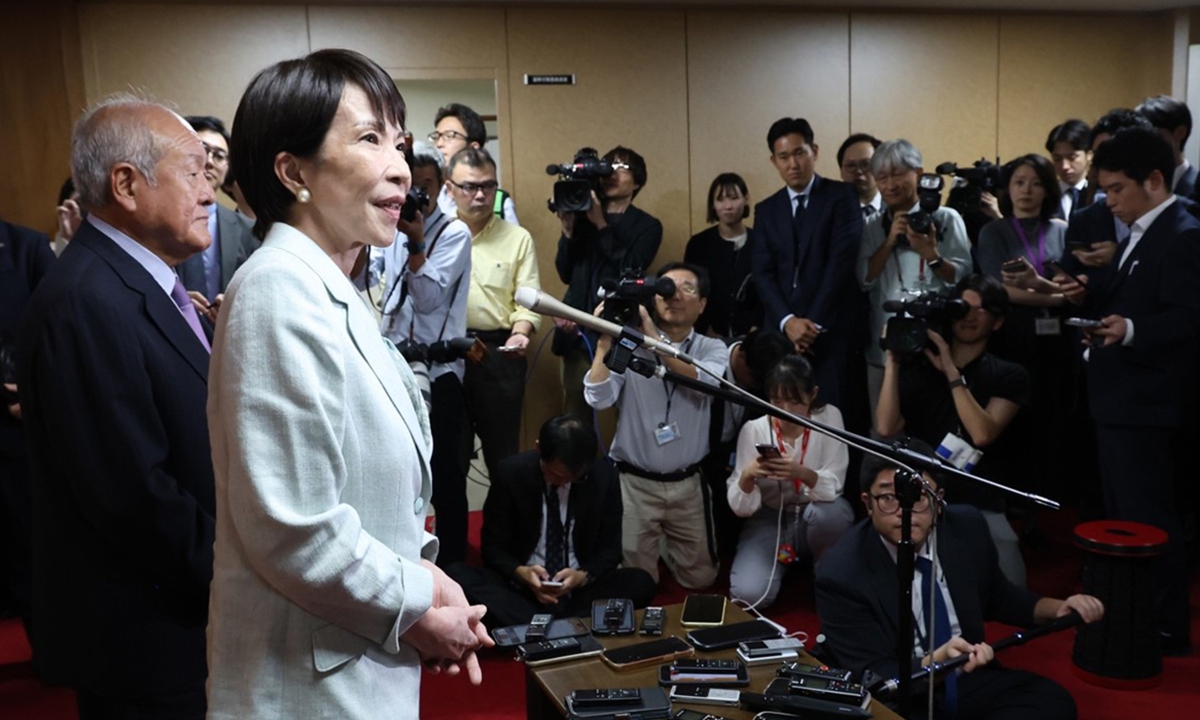
New Liberal Democratic Party (LDP) President Sanae Takaichi speaks to media after meeting with Komeito leader Tetsuo Saito at LDP headquarters in Tokyo on October 7, 2025. Photo: VCG
Since Sanae Takaichi was elected president of Japan's ruling Liberal Democratic Party (LDP) and is expected to become Japan's first woman prime minister, her potential foreign policy has drawn significant attention. From the perspective of Japanese domestic opinion, there are concerns about how the future Takaichi cabinet will manage relations with neighboring countries such as China and South Korea. However, addressing the "US risk" presents an even more critical diplomatic challenge. US President Donald Trump's visit to Japan later this month will likely serve as the first test of Takaichi's diplomatic skills and the resilience of the Japan-US alliance.
Takaichi's previously displayed right-wing hawkish stance appears to align to some extent with the US domestic political landscape and regional strategic objectives.
However, her right-wing position, tinged with historical revisionism, along with Japan's domestic political instability and potential trade frictions between Japan and the US, could pose structural challenges to Japan-US relations on three levels: strategic trust, policy coordination and regional stability.
First, historical revisionism could undermine the foundation of strategic trust between Japan and the US. The cornerstone of the Japan-US alliance lies not only in shared security interests but also in the joint commitment to upholding the international order established after WWII. In 2013, when former Japanese prime minister Shinzo Abe visited the Yasukuni Shrine, it not only provoked strong protests from China and South Korea but also drew criticism from the US, putting significant pressure on Japan. If Takaichi, as prime minister, persists with revisionist rhetoric and actions, it would not only openly provoke Asian nations that suffered from Japanese aggression but also put the US in an awkward position.
More critically, if Takaichi adopts a hardline stance on historical issues and territorial disputes, it could lead to renewed tensions in Japan-South Korea relations, directly threatening the US-Japan-South Korea "iron triangle" alliance system that Washington has painstakingly sought to build. This would disrupt US strategic arrangements in East Asia, a scenario Washington is keen to avoid.
Second, there is a potential policy coordination dilemma between "Japan First" and "America First." In the economic and trade sphere, Takaichi's advocacy of economic nationalism naturally conflicts with "America First" philosophy.
The Ishiba administration, after eight rounds of arduous negotiations, reached a tariff framework agreement with the US: Japan committed to opening sensitive markets such as automobiles and agricultural products to the US, along with a $550 billion investment pledge, in exchange for a 15 percent baseline tariff on Japanese imports to the US. Takaichi has taken a critical stance toward this agreement, said that a "do-over" of the agreement was not off the table.
However, fulfilling this promise after taking office will be far from easy. If Japan's progress on market access and investment commitments falls short of US expectations, Washington may resume exerting maximum pressure on Japan.
In the security domain, Takaichi's radicalism could prove to be a double-edged sword. The US vision of Japan's "normalization" entails a controlled and orderly enhancement of military capabilities within the framework of the US-Japan alliance to support America's global hegemony. However, Takaichi's roadmap carries a stronger emphasis on breaking free from postwar constraints and pursuing the status of an independent military power. In particular, discussions about "nuclear sharing" touch on the most sensitive nerve in East Asia, potentially triggering a regional arms race and disrupting US efforts toward nuclear non-proliferation and strategic deployment. A Japan that "runs rampant" in security matters would not only fail to serve as a reliable partner for the US but could also drag the US into unnecessary crises.
Finally, there is a risk of misalignment in Japan-US regional strategic objectives. Takaichi is seen as adopting a hardline stance toward China, which contrasts with Washington's approach of promoting strategic competition while managing differences to avoid conflict. Washington does not want its allies' overly aggressive actions to hijack US China policy, particularly regarding the highly sensitive Taiwan question. If Takaichi pursues adventurist actions on related issues, it could trigger regional conflicts, fundamentally at odds with the Trump administration's strategic goal in the region.
For Japan, if Takaichi pursues aggressive nationalism and historical revisionism, it could lead to Japan's isolation on the international stage.
A Japan with severely deteriorated relations with its neighbors would see its influence in East Asia significantly diminished.
The author is a distinguished research fellow at the Department for Asia-Pacific Studies of the China Institute of International Studies. opinion@globaltimes.com.cn
RELATED ARTICLES