China's 15th National Games makes history with deep-sea methane hydrate flame
By Published: Oct 09, 2025 10:13 PM

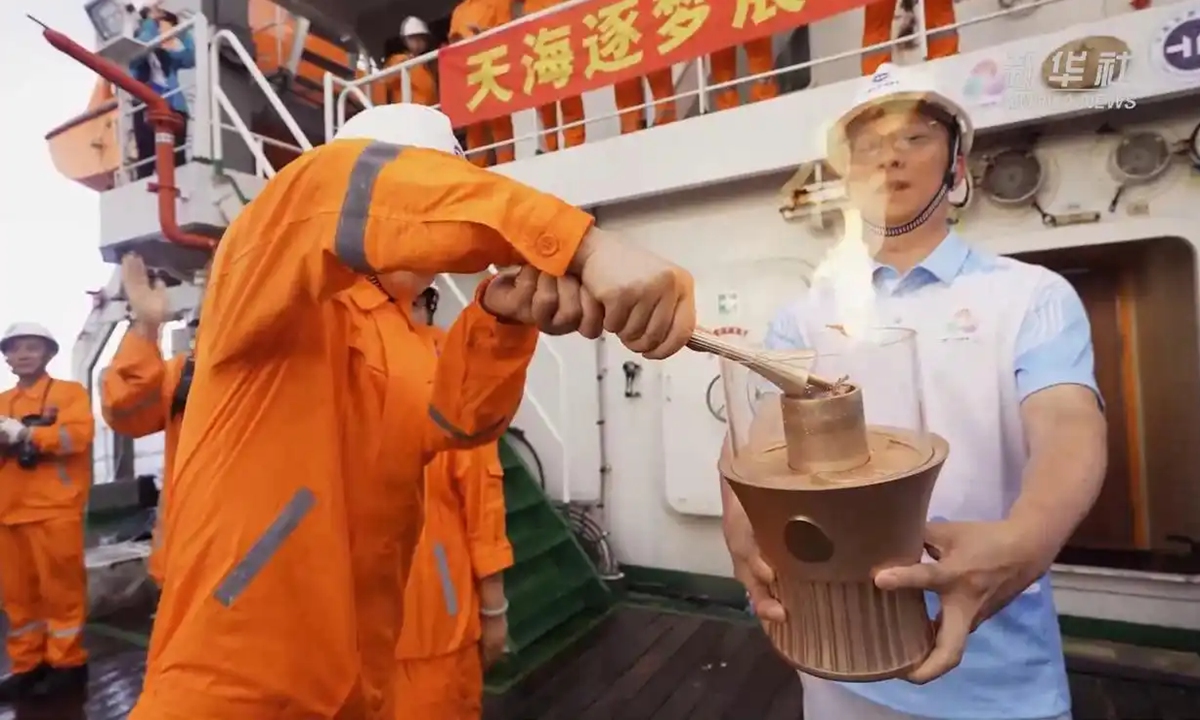
The flame lighting ceremony for China's 15th National Games, the 12th National Games for Persons with Disabilities and 9th National Special Olympic Games takes place in Guangzhou, the capital of South China's Guangdong Province, on October 9,2025. Photo: Xinhua
The flame lighting ceremony for China's 15th National Games, the 12th National Games for Persons with Disabilities and 9th National Special Olympic Games was held in Guangzhou, the capital of South China's Guangdong Province, on Thursday.
The flame used fire sourced from methane hydrate, or combustible ice, harvested from a depth of 1,522 meters in South China Sea, in a first for a major sporting event that highlights the country's advances in deep-sea technology, according to a document that the organizer sent to the Global Times on Thursday.
The ceremony also launched the countdown to the opening of the Games, which will be jointly hosted by Guangdong, Hong Kong and Macao special administrative regions.
Held at the Guangzhou Marine Geological Survey (GMGS) under China Geological Survey pier beside Meng Xiang, China's first domestically designed and built deep-ocean drilling vessel, the ceremony saw leaders from Guangdong, Hong Kong and Macao jointly light the official cauldron with the deep-sea flame, symbolizing regional unity.
The flame was later divided into four lanterns, handed to representatives of each host's organizing committee for a torch relay across Hong Kong, Macao, Guangzhou and Shenzhen in November before the opening ceremony, according to the document.
The concept for the deep-sea fire collection was proposed in June 2024, involving a consortium of research institutes and companies that proposed merging deep-sea technology with clean energy to align with the Games' "green, shared, open, and clean" ethos.
After months of planning, the mission launched in September with Marine Geology No. 2, a support vessel for Meng Xiang, which sailed to the Haima Cold Seep area in the South China Sea, tracing the ancient Maritime Silk Road.
At the heart of the operation was the Haima, a remotely operated vehicle (ROV), a 4,500-meter-class submersible.
On September 18, Haima descended to the seabed, where its robotic arm collected methane hydrate from cold seep vents.
"Depressurization 'awakened' the dormant hydrate, releasing methane gas, the fuel for our flame," Chen Zongheng, a GMGS senior engineer, told the Global Times.
Within hours, solar panels on the vessel converted sunlight to electricity, transmitted to the seabed to ignite the gas, creating a "fire and water" spectacle. The ROV then placed a permanent marker at the site to commemorate the feat.
After successful testing, the final mission was executed with precision. The team used self-developed ultra-high-definition 4K cameras to document the entire process, creating what Chen described as "a vivid science lesson for the general public."
The technology underscores China's maritime prowess. Meng Xiang, commissioned in November 2024, made China the third nation capable of building ocean drilling vessels.
Wang Jingli, another senior engineer from GMGS, told the Global Times that the mission's environmental synergy. "Methane hydrate burns into only carbon dioxide and water, a clean energy source that perfectly matches our green hosting goals," Wang said. This integration of solar power and deep-sea robotics marked the first time a major sports flame was obtained "in situ" from the deep seabed.
China's 15th National Games will be held from November 9 to 21, while the 12th National Games for Persons with Disabilities and the 9th National Special Olympic Games will take place from December 8 to 15.
RELATED ARTICLES