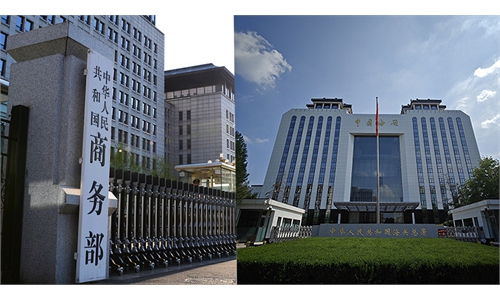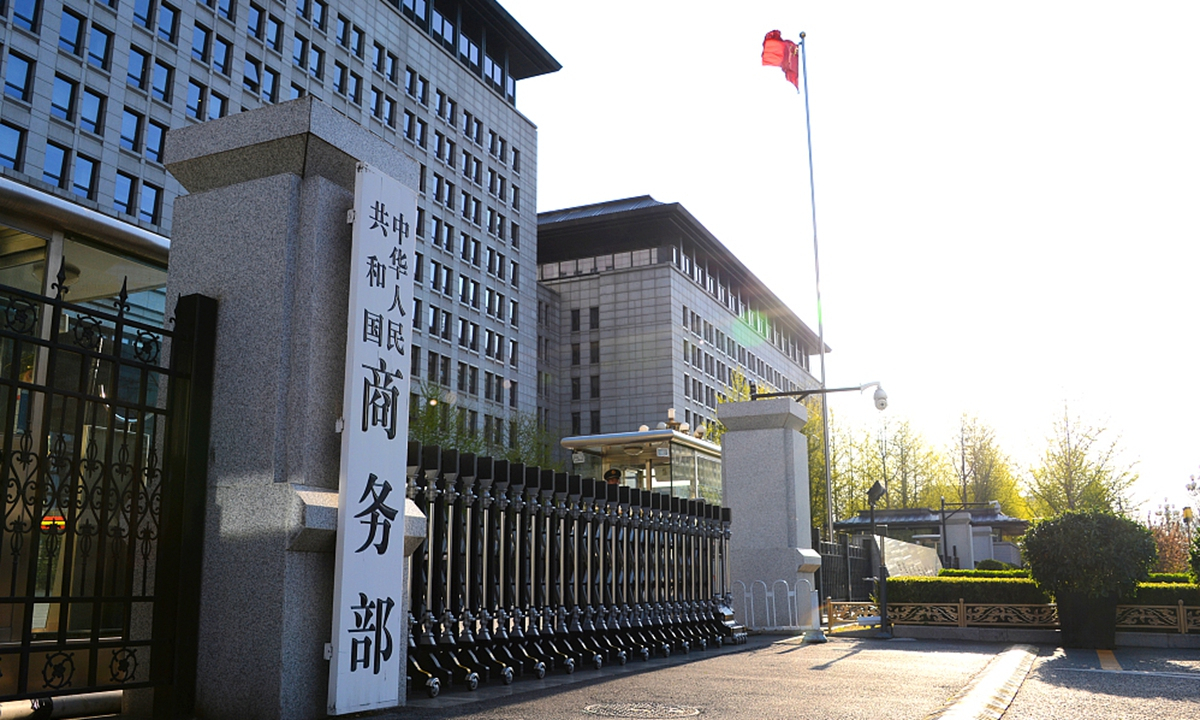
The Ministry of Commerce (MOFCOM) Photo: VCG
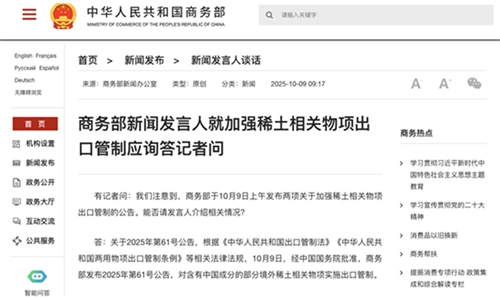
Two Chinese government agencies on Thursday announced multiple new rare earth-related export control measures, including export controls on technologies related to rare earths, requirements for overseas entities to obtain a dual-use items export license, as well as export controls on items related to superhard materials, rare earth equipment and raw materials, five medium and heavy rare earth elements, lithium batteries as well as artificial graphite anode materials.
According to a press release published on the Ministry of Commerce (MOFCOM) website on Thursday, exports of technologies and their carriers related to rare earths mining, smelting and separation, as well as metal smelting, magnetic material manufacturing, and the recycling and utilization of rare earths from secondary sources will not be permitted without approval. The measure will take effect immediately.
It also noted that exports of technologies for the assembly, debugging, maintenance, repair and upgrading of production lines for rare earths mining, smelting and separation, metal smelting, magnetic material manufacturing, and the recycling and utilization of rare earths from secondary sources will not be permitted without approval.
China also requires overseas organizations and individuals to obtain a dual-use items export license before exporting certain rare earths-related items to any country or region outside China, according to a separate statement issued by the ministry on Thursday.
Export applications destined for overseas military users, as well as to importers and end-users on the control and watch lists, shall not be approved in principle, it said.
In addition, MOFCOM, in conjunction with the General Administration of Customs, issued on Thursday announcements on implementing export control measures for items related to superhard materials, rare earth equipment and raw materials, five medium and heavy rare-earth elements such as holmium, lithium batteries as well as artificial graphite anode materials. These four measures will take effect on November 8.
"Given the dual-use nature of these items, China implements export controls in line with the law. This is a commonly adopted practice internationally, and will better maintain national security and interests while better carrying out the country's international non-proliferation obligations," a MOFCOM spokesperson said on Thursday when commenting on the considerations of the four measures.
These measures do not target any specific country or region, and for legally compliant export applications, the Chinese authorities will grant permits upon review, the spokesperson stressed, noting that China is willing to engage in communication and dialogue with relevant parties on export control policies and practices to jointly promote and facilitate compliant trade.
"MOFCOM further refines the 'de minimis rule' and 'foreign-direct product rule' in Thursday's statements, which marks a new phase in China's dual-use item export controls, with the extraterritorial application of export controls now being formally implemented. These measures are set to strengthen the role of export controls in safeguarding national security and fulfilling non-proliferation obligations," said Shi Xiaoli, a professor at the School of International Law, China University of Political Science and Law.
Responsible move
Rare earth elements - also called "industrial vitamins" - are not only crucial for manufacturing new-energy vehicles, consumer electronics and wind turbines, but also play an indispensable role in advanced military equipment such as fighter jets and nuclear facilities.
For a period of time, certain overseas organizations and individuals have transferred rare earth items originating from China to related entities directly or after processing. Then, the materials are directly or indirectly utilized in military and other sensitive fields, causing significant harm or potential threats to China's national security and interests, while having an adverse impact on international peace and stability and undermining international non-proliferation efforts, according to MOFCOM.
"Preventing such strategic resources from being used to undermine international peace and security is a responsible move shared by all countries to uphold international non-proliferation obligations. It is justified and necessary for China to take the measures," He Weiwen, a senior fellow at the Center for China and Globalization, told Global Times on Thursday.
He Weiwen stressed that China's move also aligns with the WTO rule of "national security exception" that allows WTO members to take necessary measures to protect their essential security interests.
In April this year, MOFCOM and the General Administration of Customs implemented export control measures on certain items related to seven types of medium and heavy rare earths. Meanwhile, related rare earth technologies were listed on China's Catalogue of Technologies Prohibited and Restricted from Export in 2001, and related exports must comply with legal procedural requirements, according to the MOFCOM spokesperson.
"Currently, certain countries and regions have revived the Cold War mentality, intensifying geopolitical and value-based alliances while over-generalizing national security concepts and abusing the extraterritorial application of export controls to seek competitive advantages and global hegemony. Their misuse of 'national security exception' has been repeatedly ruled as violating WTO rules, yet they persist in undermining the authority of WTO rules," Shi said.
In contrast, according to MOFCOM's announcements, China's extraterritorial export controls apply only to rare earth-related items, and licenses are granted for exports that do not harm national security, ensuring limited impact on global industrial and supply chains, Shi said.
Open for cooperation
The MOFCOM spokesperson on Thursday stated that China is prepared to enhance communication and cooperation with all parties through multilateral and bilateral export control dialogue mechanisms, thereby facilitating compliant trade and ensuring the security and stability of global industrial and supply chains.
Noting that the scope of items subject to the control measures is limited, the spokesperson said multiple licensing facilitation measures will be implemented concurrently.
The spokesperson added that the Chinese government will grant licenses for applications that comply with relevant regulations. The spokesperson clarified that exports for humanitarian assistance purposes, including emergency medical care, public health emergency response and disaster relief, will be exempt from the licensing requirement.
"China's objective is to regulate exports of rare earth-related technologies rather than ban them, and to facilitate trade that adheres to established regulations rather than disrupt normal commercial activity," Wu Chenhui, an independent analyst who closely follows the critical minerals industry, told the Global Times on Thursday.
Over the past several decades, China has been boosting the development of the rare earth industry with opening-up, a collaborative and shared approach that not only meets domestic economic development needs but also makes significant contributions to global rare earth supply chains and fosters global economic growth, Wu said.
In recent years, China has introduced multiple policies and measures in aspects including industry entry standards, sector consolidation, and environmental protection, which effectively promoted the sustainable and healthy development of the industry. In October 2024, a set of regulations on rare earth administration in China took effect, aimed at promoting the high-quality development of the rare earth industry while maintaining the safety of national resources and industries.
As long as companies are not engaged in activities that undermine China's national sovereignty, security, or development interests, export control measures will not affect their normal business operations and trade activities, let alone the stability and security of international industrial and supply chains, He Weiwen said.
China has approved a certain number of export license applications for rare earth-related items, considering the rising global demand for medium and heavy rare earth elements driven by industries such as robotics and new energy vehicles, according to MOFCOM on June 7.
RELATED ARTICLES