Ishiba's statement on WWII explores Japan's failure to avoid war; statement stresses drawing upon lessons but sidesteps perpetrator responsibility: expert
By and Xing Xiaojing Published: Oct 10, 2025 10:04 PM

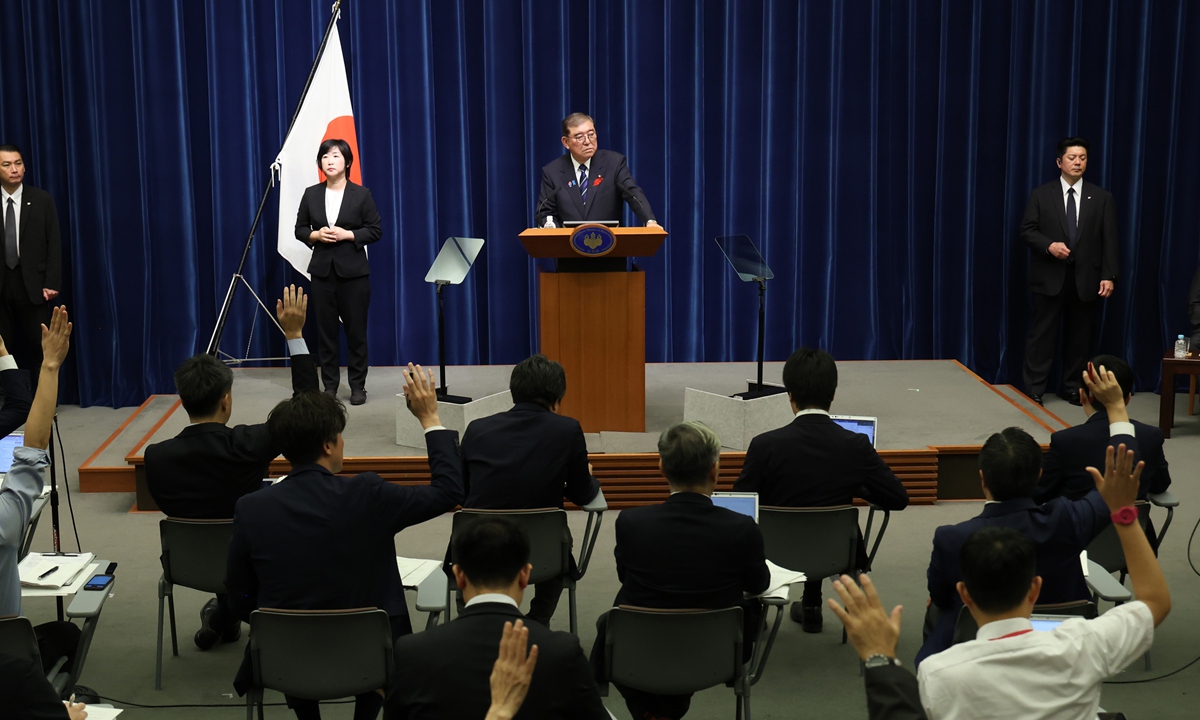
Japanese Prime Minister Shigeru Ishiba delivers his thoughts on the 80th anniversary of the end of World War II at the Prime Minister's Office in Tokyo on October 10, 2025. Photo: VCG
Despite his impending resignation and opposition from his party's conservative forces, outgoing Japanese Prime Minister Shigeru Ishiba still delivered a personal statement on Friday to mark the 80th anniversary of the end of World War II, focusing on "why domestic political systems were unable to brake the momentum toward war," according to multiple Japanese media outlets.
Commenting on Ishiba's personal statement, Chinese experts said that the statement's significance lies in its profound reflection on the political and institutional flaws of prewar Japan. To some extent, it serves as a critique of the historical revisionism currently spreading within Japan and can be viewed as an implicit warning to right-wing conservative forces represented by Sanae Takaichi, new president of Liberal Democratic Party. However, given the severe lack of a comprehensive and accurate historical understanding in Japanese society, the practical impact of Ishiba's warning remains limited and is unlikely to fundamentally alter the distorted historical perspectives and revisionist tendencies prevalent in the country, experts remarked.
"On the 50th, 60th, and 70th anniversaries of the war's end, prime ministers' statements were issued. As for the historical recognition expressed in these statements, I inherit the positions of successive cabinets," Ishiba stated at a press conference on Friday afternoon, read the full text of Ishiba's statement released by Sankei Shimbun.
However, he pointed out that the three previous statements did not extensively address why Japan was unable to avoid that war.
Citing a research indication and many intellectuals that claimed impossibility of successfully waging the war, Ishiba posed a question -- "Why, then, did Japan's government and military leaders, aware of these realities, fail to decide against war and instead plunge into a reckless conflict, sacrificing countless innocent lives at home and abroad?"
"On this 80th anniversary, I wish to reflect on these questions together with the people of Japan," said Ishiba, listing five major factors leading to the war -- problems with the Meiji Constitution, then Japanese government, the Diet, the media, as well as intelligence collection and analysis.
Ishiba continued, "It is precisely because those with direct memory of the war are dwindling year by year, and the erosion of this memory is a genuine concern, that I believe we must encourage each and every citizen, including the younger generations, to actively reflect on the past war and the nature of peace, and apply these reflections to the future. This, I am convinced, will further strengthen the foundation of our nation as a peaceful state."
At the conclusion of his address, he declared, "Together with the Japanese people, I will spare no effort, drawing upon the manifold lessons of the past war, to ensure that such horrors are never repeated."
In issuing his personal statement, Ishiba has comprehensively addressed why Japan went to war and the internal mechanisms behind the political failure to prevent it—a first for a Japanese prime minister on postwar decennial anniversaries and the very reason for his insistence on its delivery, Xiang Haoyu, a research fellow at the Department for Asia-Pacific Studies of the China Institute of International Studies, told the Global Times on Friday.
"Although the three previous post-anniversary statements by Japanese prime ministers contained reflections on history to varying degrees, Ishiba's focus lies on examining the 'process' that led to the war, emphasizing internal causes such as 'political failure' and 'military insubordination.' This analytical approach marks a departure from the perspectives taken by earlier political leaders," Xiang said.
According to the expert, at a time when Japan is witnessing the rise of right-wing conservative forces exemplified by the ascent of Takaichi and the Sanseito party, Ishiba is apparently intent on cementing his political legacy by issuing a personal statement that carries significant contemporary relevance. The expert believes this statement serves as a warning about the risks facing Japan's postwar democratic system and its peaceful development path.
"Even if he touches upon some sensitive issues, he failed to offer a sincere apology to the people of the victimized countries for the history of aggression. While his statement holds certain rational significance and raises directions worthy of reconsideration, the avoidance of perpetrator responsibility and the aggressive nature of the war undoubtedly constitutes a profound shortcoming," Da Zhigang, a research fellow at the Institute of Northeast Asian Studies at the Heilongjiang Provincial Academy of Social Sciences, told the Global Times on Friday.
"By avoiding direct phrasing such as war responsibility, and instead concentrating on reflections concerning Japan's civil-military relations and war mechanisms, his personal statement reflects both his cognitive constraints and a tactical choice to sidestep potentially intense controversy, which could undermine the statement's weight and impact," Xiang said.
Backlash from more conservative LDP forces
Ishiba's statement was not only a fulfillment of his personal political aspiration but also a response to the intra-party opposition, according to experts.
Mainichi Shimbun reported Friday that following the LDP's election of the hard-line conservative Sanae Takaichi as its new president, voices within the LDP—which is increasingly emphasizing a "return to conservatism"—are growing more critical of Ishiba's message, according to the report. "This has triggered internal friction even in the final stages of his administration," Mainichi Shimbun revealed.
Significant opposition exists within the LDP against an outgoing Japanese prime minister issuing such a personal statement, with some having called for its abandonment, Sankei Shimbun reported Thursday.
Takaichi expressed opposition during the leadership election on September 25, telling the Sankei Shimbun, "The 70th-anniversary statement is the best. No new message is necessary."
Da believes that Ishiba aims to leave a historical record and political legacy. "By issuing a personal statement, he also intends to warn Japanese society: without seriously examining historical issues, Japan risks repeating past mistakes," the expert said. He emphasized that "This is also part of Ishiba's engagement with conservative forces within the party and society."
"By focusing on why Japan embarked on the path to war, he has also used historical reflection to offer implicit criticism of the rising trends of populism, insular nationalism, and exclusionism in contemporary Japanese society," said Xiang.
"Issuing this personal statement enables Ishiba to delineate a moderate, rational approach to history—distinct from the revisionist line advocated by conservatives like Takaichi—and secure a unique political legacy focused on historical reflection," Xiang said.
The sharp division within the LDP over Ishiba's statement profoundly reflects deep-seated rifts regarding historical perception, not only in the party but also in Japanese society at large, as well as the intense struggle between different political lines in Japan, according to Xiang.
As Ishiba's statement coincided with a political crisis—the collapse of Japan's ruling coalition—on the same day, a shadow of deepening uncertainty now hangs over Tokyo.
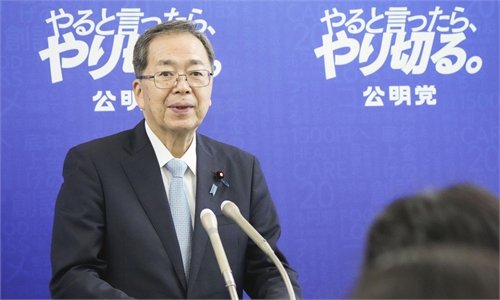
Japan's Komeito party has told the leader of the Liberal Democratic Party (LDP) that it will quit the ruling coalition. This will bring an end to a partnership that has lasted more than a quarter of a century, NHK reported on Friday.
Will the outgoing Japanese prime minister's personal message steer Japan toward a path of rationality and reflection, or the right-wing conservatives reclaim political dominance and expand the influence of their revisionist historical views amid the impending cabinet transition? The outside world is watching with a cautious, wait-and-see attitude, the Chinese observers said.
RELATED ARTICLES