China builds world-leading meteorological observation system during 14th Five-Year Plan period; boosts global cooperation: authority
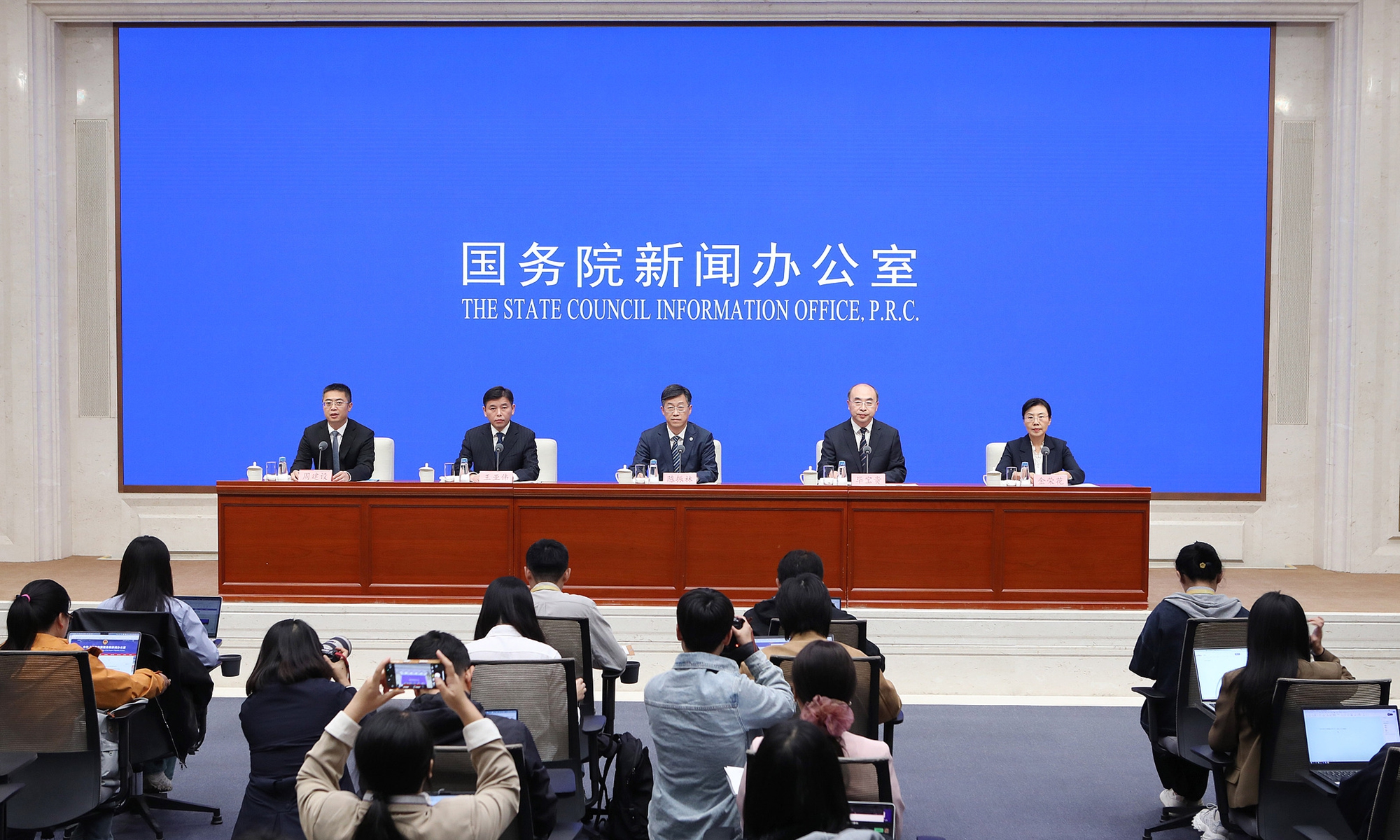
The State Council Information Office holds a press conference in Beijing on October 11, 2025, on high-quality meteorological development during the 14th Five-Year Plan period (2021-2025). Photo: VCG
China has built the world's largest, most comprehensive and most integrated meteorological observation system, Bi Baogui, deputy administrator of the China Meteorological Administration (CMA) said on Saturday during a press conference when introducing the country's progress in meteorological development during the 14th Five-Year Plan period (2021-25), China Central Television (CCTV) reported.
The system integrates land, sea, air and space-based technologies and comprises nine Fengyun meteorological satellites, 842 weather radars and more than 90,000 ground observation stations. Besides, China's self-developed BeiDou sounding system has reached a world-leading level, breaking the GPS system's monopoly in the field of atmospheric sounding, according to the CMA.
During the 14th Five-Year Plan period, the monitoring capabilities of China's weather-radar network, which covers more than 90 percent of the country's densely populated areas, have reached a globally advanced level, said the authority. China's nationwide comprehensive detection rate for severe weather exceeds 80 percent, enabling more precise monitoring of mesoscale hazardous weather phenomena.
Moreover, 35 small commercial meteorological satellites were incorporated into the CMA's observation system, enhancing the observation capability of the Fengyun satellite system when facing occultation, according to the report.
MAZU, a multi-hazard early warning system launched by the CMA in July, has already been implemented in multiple countries worldwide, said a CMA spokesperson at the Saturday press conference.
China has been sharing advanced meteorological services and high-level early warning practices as well as building early warning platforms with countries around the world. Currently, the CMA provides public access to more than 100 meteorological data products across 12 categories, serving 153 countries and regions globally, according to the CMA.
Global Times
RELATED ARTICLES