White House reportedly attempts to warn London over dropping so-called 'China spy' case; observer criticizes move as potentially interfering other's judicial independence
By Published: Oct 12, 2025 05:56 PM Updated: Oct 12, 2025 08:10 PM

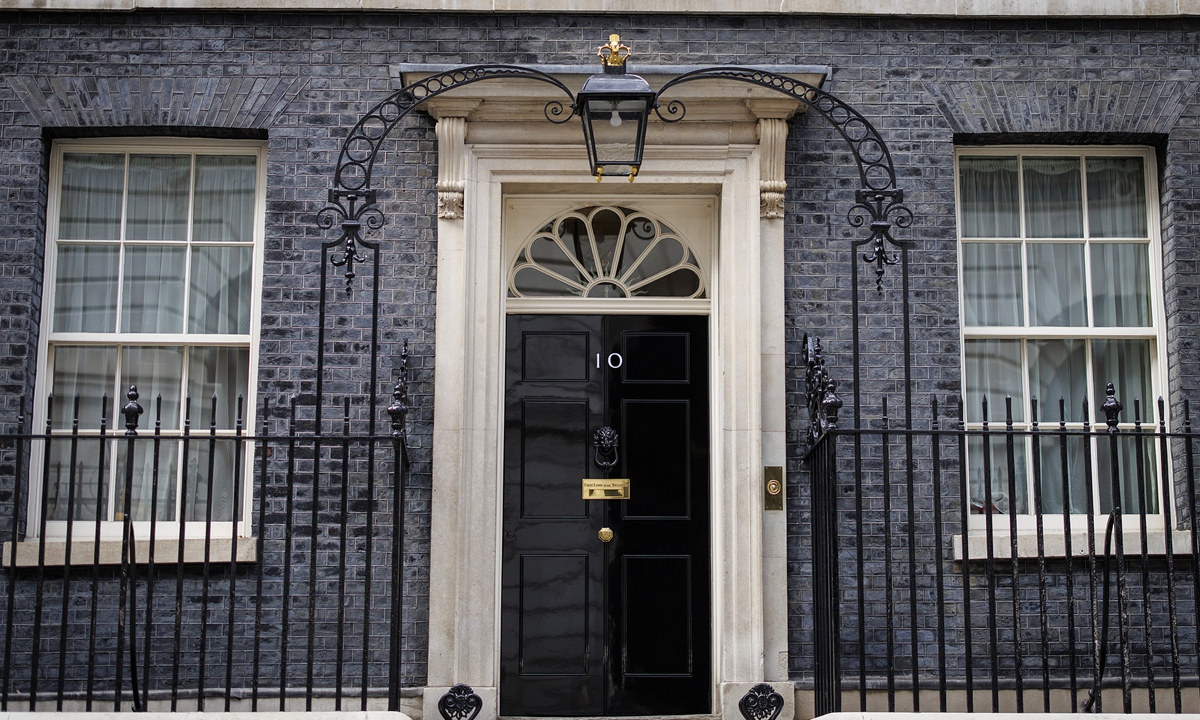
The entrance to the British prime minister's official residence, 10 Downing Street, in London Photo: VCG
Although UK judicial authorities have dropped the so-called "China spy case" - a clear demonstration of the allegations being pure fabrication, British media revealed on Sunday that the White House has sent a warning to UK Prime Minister Keir Starmer, claiming that Britain's failure to prosecute the two alleged "China spies" risks damaging their special relationship and jeopardizing intelligence sharing between London and Washington.
According to reports, the two British nationals, Christopher Berry and Christopher Cash, were arrested in March 2023 on so-called accusations of providing information prejudicial to the interests of the state in breach of the Official Secrets Act. Cash worked as a parliamentary researcher and was director of the China Research Group, while Berry had previously worked in China. Their case was dropped because the evidence gathered did not meet the threshold to go to trial.
In response to allegations over the so-called "China spies," Guo Jiakun, spokesperson for the Chinese Foreign Ministry, stated on Thursday at a press conference that "now that the UK judicial authorities have dropped the case, it is all the more evident that the so-called 'spying for China' allegation is pure fabrication."
China firmly opposes narratives that peddle "spying activities" and the "China threat" theory to vilify China, and we urge some in the UK to avoid being paranoid, Guo said.
Despite the case has been dropped, the hype surrounding it is not over.
The BBC, the Sunday Times and GB News covered the latest developments on Sunday. According to the Sunday Times, the White House claimed that the collapse of the case "risks undermining the special relationship" between the UK and US. A senior White House official was quoted by the Sunday Times asserting that the US exercises "extreme caution in sharing information with foreign governments subject to adversarial coercion and influence."
The BBC previously reported on October 6 that Downing Street strongly denied that the government was involved in the collapse of the prosecution against the two men accused of spying for China.
According to the BBC, Number 10's press secretary said "the suggestion that the government withheld evidence, withdrew witnesses or restricted the ability of a witness to draw on a particular bit of evidence are all untrue."
The UK's Crown Prosecution Service (CPS) has said that the case collapsed after the government refused to provide evidence that China was a threat to UK national security, the Financial Times reported on October 7.
After a more than two-year investigation into the "China spy case," some American and British anti-China forces still refuse to accept the verdict, revealing that, for them, the truth takes a backseat to advancing their China-bashing agenda, some Chinese experts remarked.
If the latest British media reports are true, the US has threatened the UK by leveraging the "special relationship" and "intelligence sharing" between the two countries, in an attempt to interfere with the judicial independence of another country, which exposes that the US has not abandoned its mindset of containing and suppressing China, Cui Hongjian, director of the Department of European Studies, China Institute of International Studies, told the Global Times on Sunday.
The US is forcing the UK to make a binary choice between the "special relationship with the US" and "improving relations with China," which is, in essence, a threat to the UK's policy autonomy, Cui pointed out.
According to the expert, the UK Labour government has demonstrated a willingness to adjust its China policy and improve bilateral relations.
The Sunday Times reported that in a meeting last month, national security adviser Jonathan Powell revealed the government's evidence would be based on the national security strategy, which was published in June and does not refer to China as an "enemy."
Cui said that London needs to weigh its options in a complex environment: whether to withstand the pressure and adhere to a China policy that aligns with British interests, or to reluctantly sacrifice the interests of China-UK relations to meet unilateral US demands.
RELATED ARTICLES