Walking the difficult path together: GGI’s message for global unity
By Published: Oct 12, 2025 08:37 PM
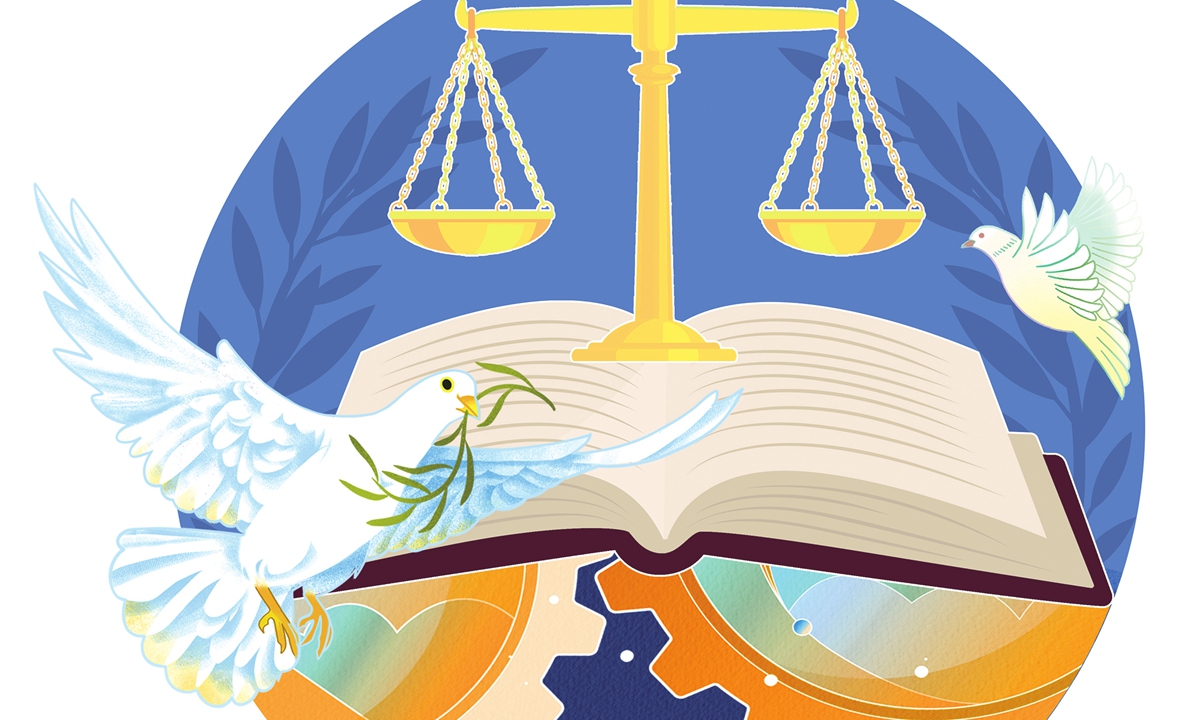
Illustration: Liu Rui/GT
"We must all hang together, or, most assuredly, we shall all hang separately." This quote, arguably coined by Benjamin Franklin in 1776, when the American Declaration of Independence was signed by members of the Continental Congress in Philadelphia, can be applied to the historic fork in the road of international system transformation two and a half centuries later. An evident paradox of recent global developments is that the world is getting more and more economically and socially interconnected and interdependent, but at the same time it is becoming more and more politically disunited and fragmented.
The common challenges of today and opportunities of tomorrow call for enlightened strategic planning and for long-term joint efforts of a planetary scale. And yet, immediate concerns, personal anxieties and legacies of the past fuel situational opportunism, impulsive reactions to unpredictable changes and drive us further apart. The deep splits within the contemporary international system can be traced along many lines: East vs West, North vs South, major powers vs small ones, nation states vs non-state actors, and so on. If these and other divisions are not bridged or, at least narrowed, before too long, the uncontrollable vessel of human civilization is doomed to result in a shipwreck of epic proportions.
This is what the Global Governance Initiative (GGI) is all about. On September 1, at the "Shanghai Cooperation Organization (SCO) Plus" Meeting in North China's port city of Tianjin, President Xi Jinping outlined a new framework to reform and to improve the global governance system. The GGI emphasizes sovereign equality of all countries, respect for international rule of law, multilateralism, a people-centered approach and real results that could enhance global governance. The initiative aspires to help build a more just and equitable international order that upholds the UN's central role and addresses such critical global challenges as climate change, poverty, pandemics, inequality, inclusive social and economic progress.
Predictably, the GGI has been fully endorsed by other SCO leaders summoned in Tianjin, as well as by numerous opinion-makers around the globe.
On the other hand, the US administration's motto is clear: "every nation for herself" on burning matters as trans-border migrations, climate change, environment protection or trade tariffs. In this almost Darwinian vision of the global politics jungle the only ultimate law is the survival of the fittest.
Such a crude and brutal approach to international relations is supposed to appeal to ordinary folks in America and elsewhere fed up with the negative side-effects of globalization and with the poor performance of existing multilateral bodies, including the UN itself. The public worldwide is deeply frustrated with transnational bureaucracies that often demonstrate a lot of red tape, resource waste, nepotism, double standards, and even sheer incompetence and corruption.
But the public is not stupid, it is not that easy to seduce it with seemingly attractive, but empty promises of what an anarchic world disorder can offer. The public support for multilateralism has never disappeared. The broad international interest in such multilateral bodies as SCO, BRICS, APEC and G20 is a clear manifestation of this continuous support.
The GGI is only the first step in a long road toward a better world order. The road is going to be bumpy, with a lot of potholes, long ascensions and sudden drops ahead.
Skeptics will question the destination and whiners will beg for taking a U-turn. But all these complications are not reason enough to pass up the journey to a new global order and not the justifications for taking the wrong fork in the road. We should be in a position to walk this difficult and lengthy path by helping each other, not by fighting each other - this is the most important GGI message to the international community. The mission is arduous, but attainable. As Nelson Mandela wisely noted many years ago, "it always seems impossible, until it is done."
The author is a member of the Russian International Affairs Council. opinion@globaltimes.com.cn
RELATED ARTICLES