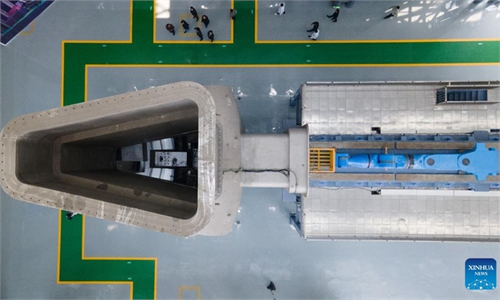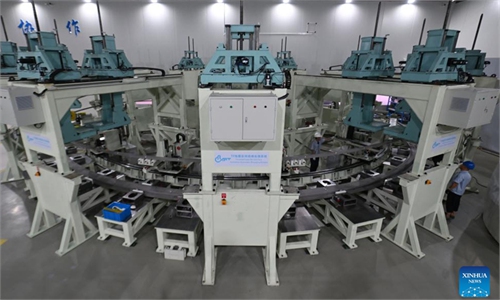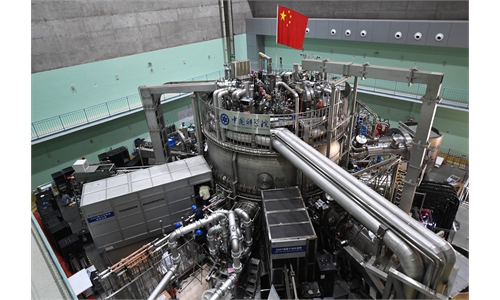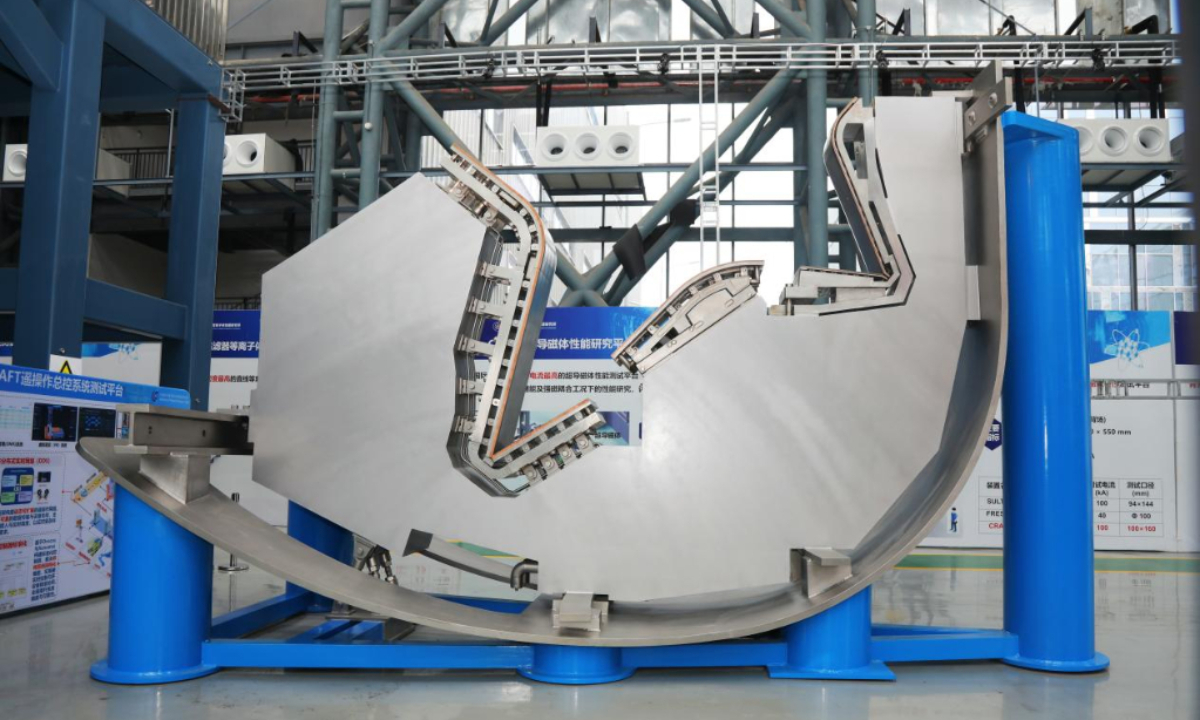
Prototype component of the divertor of China's Comprehensive Research Facility for Fusion Technology (CRAFT) Photo: Xinhua
China has achieved an important breakthrough in the development of its next-generation "artificial sun" with the prototype component of the divertor of China's Comprehensive Research Facility for Fusion Technology (CRAFT), passing expert evaluation and acceptance procedures on Monday, Xinhua News Agency reported.
The CRAFT is a platform on which engineers develop and test key components of fusion energy reactors.
Test results show that the component's steady-state heat load capacity reaches 20 megawatts per square meter, and the plasma-facing surface of the target plate has an alignment error of less than 1 millimeter, significant progress that marks the successful development of China's independently designed divertor prototype with the largest of its kind globally and capable of withstanding the highest thermal load.
As a key component enabling the steady-state operation of a fusion reactor core, the divertor plays a crucial role in removing fusion products and heat, as well as controlling impurities. It operates under extremely complex and harsh conditions.
The CRAFT divertor prototype features an innovative, integrated hybrid divertor-blanket design. In theory, this design could increase the tritium breeding ratio by more than 3 percent, offering a viable auxiliary pathway toward tritium self-sufficiency.
The flat-plate structure allows the component to maintain the tungsten surface below its recrystallization temperature while withstanding a steady-state heat load of 20 megawatts per square meter, effectively forming a "shield" for the fusion reactor.
The divertor prototype system is one of the 19 key subsystems of CRAFT. The successful development of this component marks a major achievement in China's fully self-sufficient and controllable research and development of divertor technology, laying a solid technical foundation for its future engineering application in Chinese fusion reactors, according to Xinhua.
The related technologies can not only support for other fusion devices but can also be applied in fields such as aerospace, advanced medical equipment, industrial electronics, and new energy vehicles.
Global Times
RELATED ARTICLES