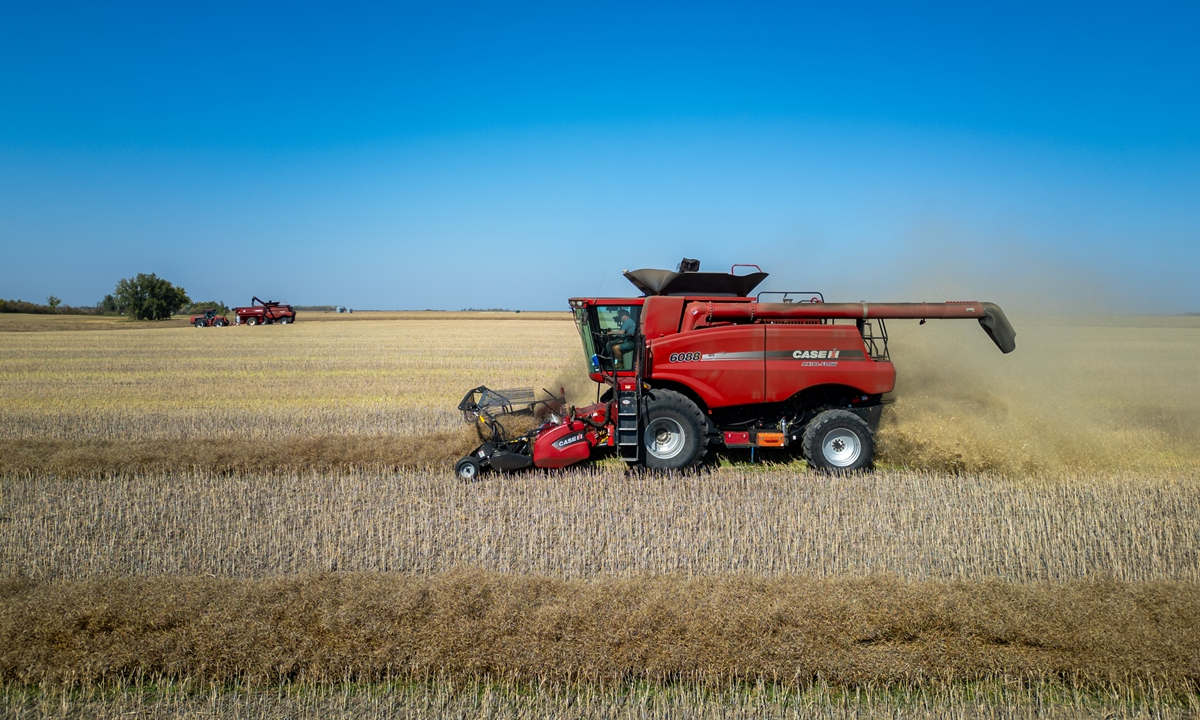
A combine harvester on a field during a canola harvest near Regina, Saskatchewan, Canada, on September 21, 2025 Photo: VCG
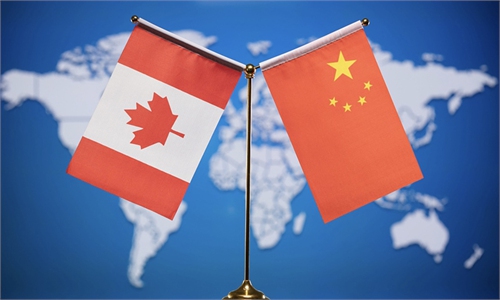
The premier of Manitoba, one of Canada's three Prairie Provinces, has urged the Canadian prime minister to scrap Canada's 100 percent tariff on Chinese electric vehicles (EVs), with the policy already taking a heavy toll on the province's canola and pork industries, according to media reports.
In a letter to Mark Carney on Saturday, Wab Kinew said that the country's approach "has created a two-front trade war that disproportionally affects Western Canada," the Canadian Press reported on Sunday (local time).
The report noted that China's tariffs on some Canadian agricultural products have already caused a sharp drop in canola prices, and pointed to its severe damage on Canada's pork sector. One vertically integrated pork producer in Manitoba is reporting a $19 million negative impact on an annual basis, the premier said in the letter.
In August 2024, Canada, following the lead of the US and the EU, said that it would impose a 100 percent tariff on imports of Chinese EVs and announced a 25 percent tariff on imported steel and aluminum from China, Reuters reported at the time.
This unilateral move prompted China to initiate an anti-discrimination probe in September last year, and it announced in March 2025 that it would impose additional tariffs on some products imported from Canada based on the ruling of the probe, according to the Xinhua News Agency.
Effective from March 20, an additional 100 percent tariff will be imposed on imported rapeseed oil, oil cakes, and peas originating from Canada, while aquatic products and pork will be subject to an additional 25 percent tariff, Xinhua reported on March 8.
Following the move, China's Foreign Ministry said on March 10 that China's countermeasures against Canada's discriminatory restrictive measures on some Chinese imports are "fully necessary, justified, reasonable and lawful," urging Ottawa to take concrete steps to correct its "wrongdoings."
Kinew said in his letter that "every day the tariffs remain in place, the harm to Prairie producers deepens," adding that Canada's trade policy must balance long-term industrial goals and national security with immediate economic realities as well as the national responsibility to grow every region of Canada's economy, the Canadian Press report said.
Some other Canadian provinces have voiced similar calls and concerns over Ottawa's trade policies toward China. Saskatchewan Premier Scott Moe has previously said that he wanted Ottawa to do away with the EV tariff, but only if the country remained on good terms with the US, and he has since said that removing it would not be a simple fix, according the report.
However, Moe is again facing calls to stand up for farmers after new figures show exports from the province to China have drastically fallen, the CBC reported last week.
Data showed that Saskatchewan exported $96 million in goods to China in August, a 76 percent year-on-year drop, according to the CBC report.
A statement from Moe's office on Wednesday said that Ottawa and Beijing must continue to talk with one another. "Saskatchewan will continue to call on the federal government to make this happen and remains ready to offer any insight or assistance if required," it said.
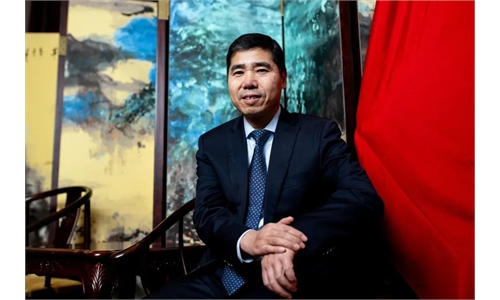
China's Ambassador to Canada Wang Di said during an interview for the CTV program Question Period aired on Sunday that the current tariff dispute between China and Canada was not provoked by China. "China should not be blamed for this issue. The problem lies with Canada, and it is Ottawa that must first correct its discriminatory measures," Wang said.
China would reciprocate in kind if Ottawa lifts its "unilateral and discriminatory measures" against China, specifically pledging to scrap tariffs on Canadian products if Canada removes its EV tariffs, the ambassador said, according to a transcript of the interview posted by the Chinese Embassy in Canada on its WeChat account.
"As long as bilateral economic and trade cooperation is promoted in the spirit of mutual benefit and win-win, it will surely get better and better. Unilaterally pursuing one's own interests at the expense of the other's makes such cooperation unsustainable," Wang said in the interview, adding that China is willing to further strengthen exchanges and cooperation with Canada in various fields.
Global Times
RELATED ARTICLES