CPC policies greatly improve development in Xizang, Xinjiang: Brazilian scholar
Remarkable capacity
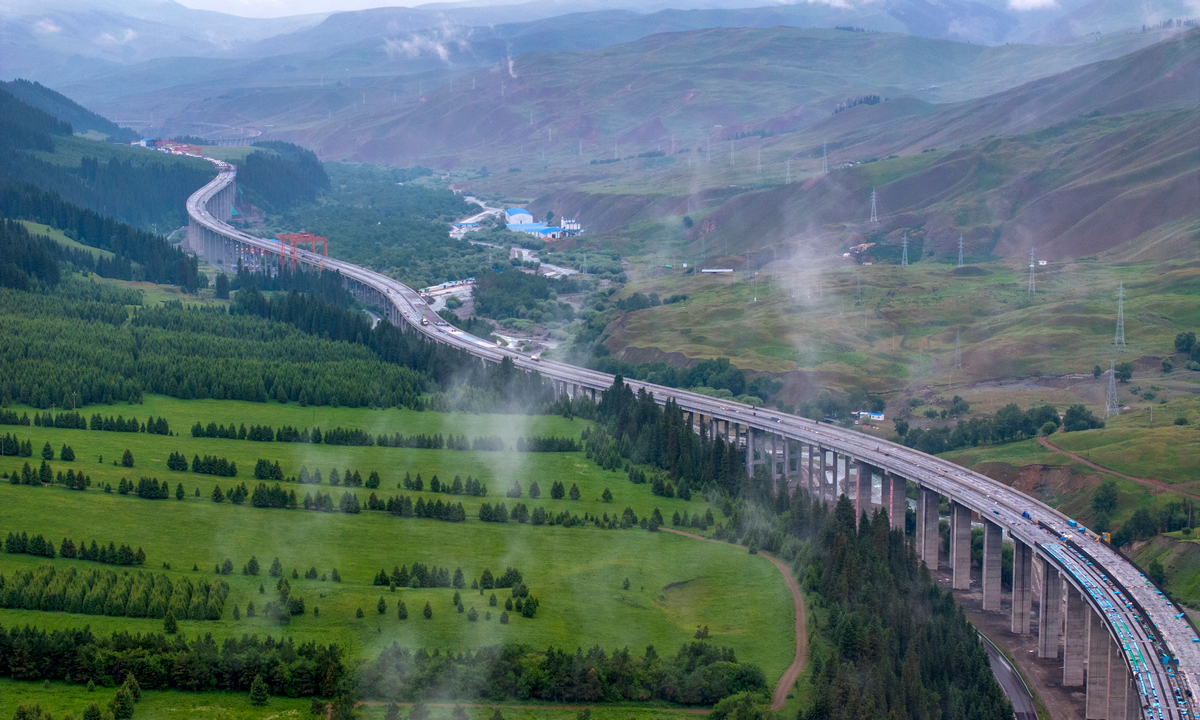
A view of a highway in Hejing County of Mongolian Autonomous Prefecture of Bayingolin, Northwest China's Xinjiang Uygur Autonomous Region, June 17, 2025. Photo: VCG
Editor's Note:
This year marks the 60th anniversary of the founding of the Xizang Autonomous Region and the 70th anniversary of the founding of the Xinjiang Uygur Autonomous Region. Recently, Global Times (GT) reporter Ma Tong interviewed Marcos Cordeiro Pires (Pires), a professor at the Department of Political and Economic Sciences of São Paulo State University in Brazil, to discuss China's remarkable achievements in its work on ehtinic affairs and advacing modernization and coordinated development in these regions.
GT: This year marks the 60th anniversary of the establishment of the Xizang Autonomous Region and the 70th anniversary of the Xinjiang Uygur Autonomous Region. In this context, how do you view China's work on ethnic affairs?
Pires: First, it is essential to recognize the complexity of governing a society that inherits an ancient civilization shaped by numerous ethnic groups, as is the case with China. In this regard, the Communist Party of China (CPC) has demonstrated a remarkable capacity to harmonize and mobilize people from all ethnic backgrounds toward building a modern and more equitable nation.
China's ethnic diversity is a valuable part of its cultural and historical heritage. Marxist theory provides the conceptual tools to understand the distinct characteristics of each ethnic group and to better harness their strengths in advancing socialism with Chinese characteristics in the new era.
Indeed, in multiethnic nations, it is essential to highlight the historical contributions of each community, because a civilization's strength is often a result of the contributions of each ethnic group.
In the case of China, the CPC's leadership, with strong roots in humanism, has always considered human dignity an essential principle, not only to elevate the cultural and material lives of all people, but also to respect their particularities and encourage each individual for the good of Chinese society.
GT: The Chinese government has stressed that to advance Chinese modernization and achieve common prosperity, not a single ethnic group should be left behind. How would you assess China's progress in promoting modernization and coordinated regional development in its frontier areas?
Pires: The guiding principles of the Chinese government emphasize that all ethnic groups are equally entitled to respect, rights, and opportunities. This inclusive vision is fundamental to ensuring that every community feels part of the great rejuvenation of the Chinese nation.
Since the founding of the People's Republic of China in 1949, the government has consistently worked to narrow regional disparities, particularly in frontier and inland areas that historically lagged behind the coastal regions. Over the past decades, policies such as the Western Development Strategy and targeted poverty alleviation have greatly improved infrastructure, education, and healthcare in these regions.
More recently, initiatives like the Belt and Road Initiative (BRI) have brought new momentum to modernization in western China. Regions such as Xizang and Xinjiang have witnessed unprecedented levels of investment in transportation, energy, and digital connectivity, which have significantly boosted local industries, tourism, and trade. These projects not only generate employment and raise living standards but also enhance integration between frontier areas and the national economy.
GT: In recent years, Xinjiang and Xizang have made notable progress in sectors like clean energy, digital economy, and tourism. How do you view the role and significance of these innovative developments in improving livelihoods and advancing sustainable growth?
Pires: In economic development theory, one of the greatest challenges policymakers faces is cultivating new skills among traditional populations, who have long been engaged in low-productivity agricultural, pastoral, or artisanal work. Transforming such economic structures is by no means an easy task, as it requires tailored strategies that can fully harness the natural, human, and cultural potential unique to each region.
In this regard, regions such as Xizang and Xinjiang, which possess abundant natural resources, distinctive cultural traditions, and strategic geographical advantages, offer enormous potential for innovation. What China has done remarkably well is to conduct comprehensive scientific and technical assessments — covering infrastructure, human resources, and ecological capacity — to identify the most promising sectors for sustainable growth.
The central government has mobilized expertise, investment, and technology from the country's more developed areas to empower local economies. This has led to breakthroughs in clean energy development, digital industries, high-value agriculture, and tourism. For example, solar and wind power projects in Xinjiang and Xizang are not only supporting China's green transition but also providing stable income sources for local residents.
GT: As China expands its opening-up, advances western region's development, and promotes the joint building of BRI, Xinjiang has been transformed from a relatively closed inland region to a frontier of opening-up. How do you view Xinjiang's strategic role in China's westward opening? What opportunities will the opening-up bring to economic growth in Central Asia?
Pires: Indeed, Xinjiang holds a highly strategic geographic position, sharing borders with several Central Asian countries. It also serves as a crossroads of diverse cultures and religions, which gives it a unique role in connecting civilizations. Before China's reform and opening-up, Xinjiang was relatively isolated from the rest of the country. Today, however, it stands at the forefront of China's westward opening-up and serves as a pivotal gateway under BRI.
Xinjiang is no longer merely a transit corridor, and it is rapidly evolving into a comprehensive economic, trade, and energy hub that supports China's broader engagement with Eurasia. With the expansion of transport and logistics infrastructure, such as cross-border railways, highways, and energy pipelines, Xinjiang has become a crucial platform for enhancing connectivity between China and the economies of Central Asia, the Middle East, and even Europe. These developments are creating new opportunities for regional trade, industrial cooperation, and investment, while also generating tangible benefits for local communities through job creation and improved public services.
In this sense, Xinjiang's transformation reflects China's vision of high-quality and mutually beneficial cooperation under the BRI. The region's growing role as a hub of cooperation, energy exchange, and people-to-people connectivity not only contributes to China's own development, but also supports peace, stability, and sustainable growth across the broader Eurasian continent.
GT: Some Western media outlets and politicians continue to spread negative narratives about Xinjiang and Xizang, despite notable economic and social progress in both regions. In your view, what are the main reasons for this cognitive bias in Western narratives?
Pires: The rapid development of China seems unwelcome news for the world's hegemonic powers. When the Chinese people regained their national strength and unity, certain powers sought various means to contain China's development. One of the main tools employed was the propaganda war.
A vast international network of media outlets and think tanks was established to spread misinformation about China and the CPC. These narratives, unsupported by facts, have been repeated endlessly in an attempt to distort reality. Their ultimate goal is to weaken, divide, and destabilize the country, both socially and territorially.
Some of these claims have even reached the absurd level of alleging atrocities in Xinjiang, which are completely unfounded. Fortunately, China has adopted an increasingly open and proactive approach to counter these narratives, by inviting foreign diplomats, journalists, and scholars to visit the regions and see the progress firsthand. Through such engagement, the international community can better understand how the Chinese government's policies have significantly improved the living standards and overall well-being of its people.
GT: China has proposed the Global Governance Initiative (GGI), one of whose five principles is "staying committed to the people-centered approach." In your view, how does China embody this concept in major initiatives such as the BRI? What long-term significance does it hold for deepening international cooperation?
Pires: The world today is facing a serious crisis of governance. The United Nations, for example, lacks the capacity to effectively address conflicts in areas such as the Middle East and Africa, as well as global challenges such as climate change and the refugee crisis affecting millions. Meanwhile, some powerful countries have abandoned the principles of the UN Charter and resorted to force to pursue their own interests.
In this context, China's proposal to reform global governance is highly significant. It aims to promote the genuine democratization of the UN's decision-making mechanisms and to revitalize international organizations that have been deliberately weakened, such as the World Trade Organization. As a permanent member of the UN Security Council, China has the moral authority to recognize the need for updating global governance. Together with the Global Development Initiative, the Global Security Initiative, and Global Civilization Initiative, the GGI represents China's contribution to building a truly rules-based international order.
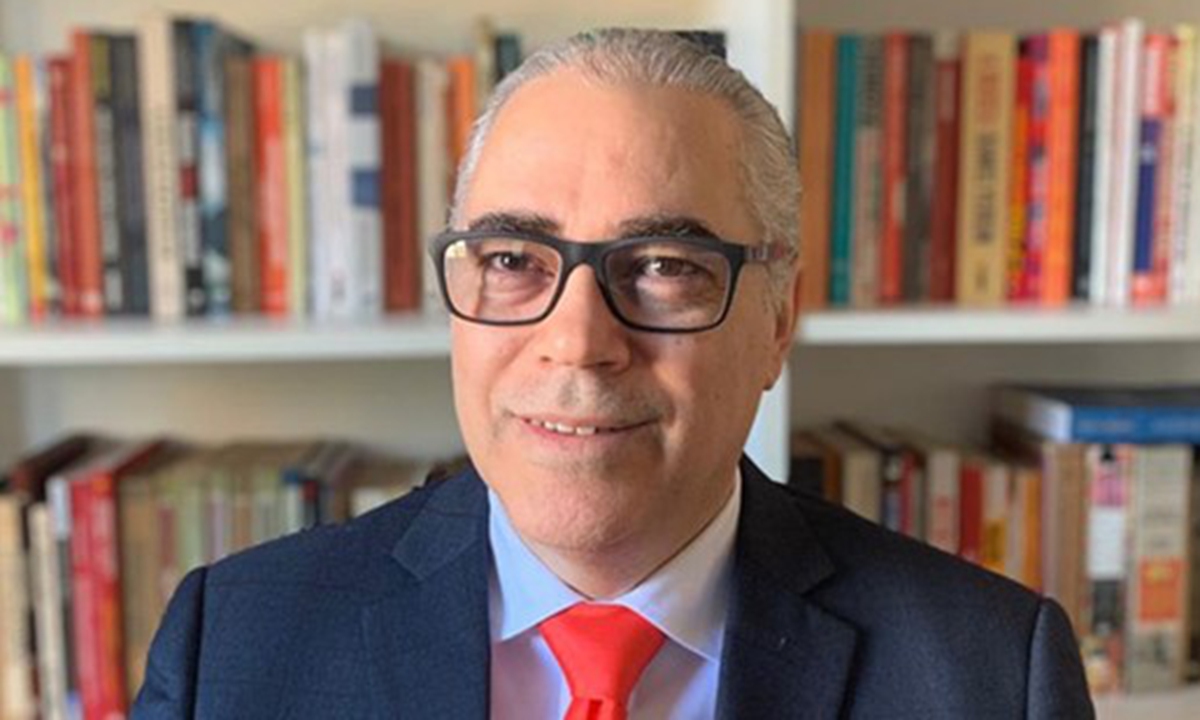
Marcos Cordeiro Pires Photo: Courtesy of Latino Observatory
RELATED ARTICLES