General guidelines of the eight-point decision hold universal relevance: Brazilian scholar

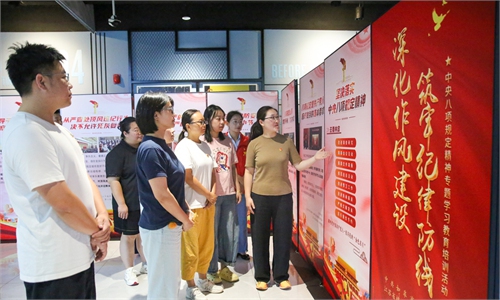
A study session on thoroughly implementing the CPC's eight-point decision is held on June 12, 2025, in Nantong, Jiangsu Province. Photo: VCG
Editor's Note:
Since its introduction in 2012, the eight-point decision has not only become a "golden hallmark" of the efforts of the Communist Party of China (CPC) to improve Party conduct in the new era, but it has also served as a mobilization order for Party members to uphold credibility with concrete actions, stay clean and dedicated in their work, and create new achievements. The Global Times invites experts and scholars from around the world to discuss the efficacy, global significance of the eight-point decision and the examples it sets for ruling parties in other countries, especially those in the Global South. In the second article of the series, Global Times (GT) reporter Liu Xuandi interviewed Marcos Cordeiro Pires (Pires), professor at the Department of Political and Economic Sciences of São Paulo State University in Brazil. Pires told the Global Times that "the general guidelines of the eight-point decision hold universal relevance, as they could help address sensitive challenges faced by political parties worldwide."
GT: How do you view the long-term governance approach the CPC has adopted in strengthening its work conduct?
Pires: It is vital to reclaim the role of the CPC members as the vanguard of Chinese society. The people are the source of the CPC's strength and the Party members are the most prominent representatives of the people; therefore, each official must shoulder greater responsibility. Each member also serves as the public face of the Party within their respective organizations. They must maintain an exemplary posture and remain attentive to the real needs of the people. The eight-point decision is a guideline to ensure the Party does not stray from its base of support. In this sense, two principles are particularly essential to each Party member: clear, direct communication with citizens, and austerity in the use of public resources. To the extent that these principles are pursued, the CPC's governance has been very successful in leading the people toward the great goal of rejuvenating the Chinese nation.
GT: The first provision of the eight-point decision is to improve research and analysis of actual conditions when doing grassroots-level studies. In your view, how does this practice of emphasizing work grounded in reality and maintaining close ties with the public further strengthen the bonds of trust between the CPC and the people?
Pires: The CPC's commitment to investigation and research is fundamentally aligned with its theoretical foundations in scientific socialism. By grounding its work in empirical reality rather than subjective opinions, the Party can access the actual state of the productive forces, which are undergoing technological advancements associated with the Fourth Industrial Revolution. Without mastery of advanced analytical and production techniques, China cannot achieve technological modernization or deliver the well-being desired by its population. Over the past decades, under the leadership of the CPC, Chinese society has made rapid advancements in the most advanced sectors of global technology, including telecommunications, clean energy and artificial intelligence. This wealth of knowledge and accurate analysis of reality are enabling the improvement of the lives of the Chinese people, especially the eradication of extreme poverty, thereby reinforcing public trust and strengthening the bond between the Party and the people.
GT: Chinese President Xi Jinping urges the leading officials as the "key few" to set an example for those below them. You have visited China multiple times. During your visits, what qualities of the CPC officials have impressed you the most? What are your assessments about their work conduct?
Pires: I had the opportunity to meet with several CPC officials during visits to universities and research centers in several Chinese cities. In all these places, I spoke with highly informed individuals, characterized by a high level of public spirit and attitudes commensurate with their responsibilities. I believe that without this attitude, which most CPC members share, it would be impossible to lead the people in a very challenging international situation. It is these officials that ensure China's internal cohesion, a crucial element for national development and global stability.
GT: The CPC has grown from just over 50 members a century ago to more than 100 million Party members today, becoming the largest political party in the world. What do you believe is the fundamental reason behind the CPC's capacity to maintain long-term governance and resilience?
Pires: An important element in assessing the CPC's leadership capacity is its legitimacy. Under the CPC's leadership, the Chinese people have risen and secured the sovereignty to choose their own path without submitting to the interests of any other country. The CPC has never separated itself from the people. Its policies have been grounded in improving conditions across Chinese society.
GT: A comprehensive assessment of the CPC requires placing it within the broader landscape of global political parties. How do you view the distinctive features of the CPC when contrasted with ruling parties in Western countries?
Pires: The CPC has adapted Marxism to China's existing theoretical traditions, rather than imposing preset models that did not fit Chinese realities. Furthermore, the CPC's governance has ensured the implementation of long-term policies, while also retaining the capacity to adjust plans in response to rapid changes in the political, economic and social environment. By contrast, over the past 45 years, many Western political parties have been constrained by neoliberal ideologies and have struggled to keep pace with global social and economic shifts. Citizens in major Western countries are increasingly frustrated with alternating governing parties that fail to break the financial grip of global elites and meet the public's needs for prosperity and security. Despite election promises to enhance well-being, these Western parties tend to neglect critical areas, such as health, education and social security, as public budgets are controlled in favor of policies that benefit the financial sectors, thereby undermining the viability of the welfare state.
GT: How do you view the relevance of the eight-point decision for political parties in other countries?
Pires: In theory, China's governance model could offer valuable lessons for other developing nations. This is evident in its achievements in social stability, political predictability, well-being and technological progress. While China's unique conditions - vast cultural heritage, large population and socialist system born from a popular revolution - cannot be easily replicated elsewhere in practice, the general guidelines of the eight-point decision hold universal relevance, as they could help address sensitive challenges faced by political parties worldwide.
For instance, these rules involve crucial matters such as prioritizing scientific knowledge over opinions without a factual basis, and reaffirming the legal and ethical principles that all representatives of the people must follow, such as combating corruption and acting in accordance with general standards of morality. It is also worth noting that a significant part of the crisis of political party representation in Western competitive electoral systems is linked to the mismatch between citizens' interests and the stance of leaders who often align themselves with plutocrats - a disconnect that China's governance model strives to avoid. In this sense, these principles could guide the conduct of political parties across Latin America and beyond.
RELATED ARTICLES