
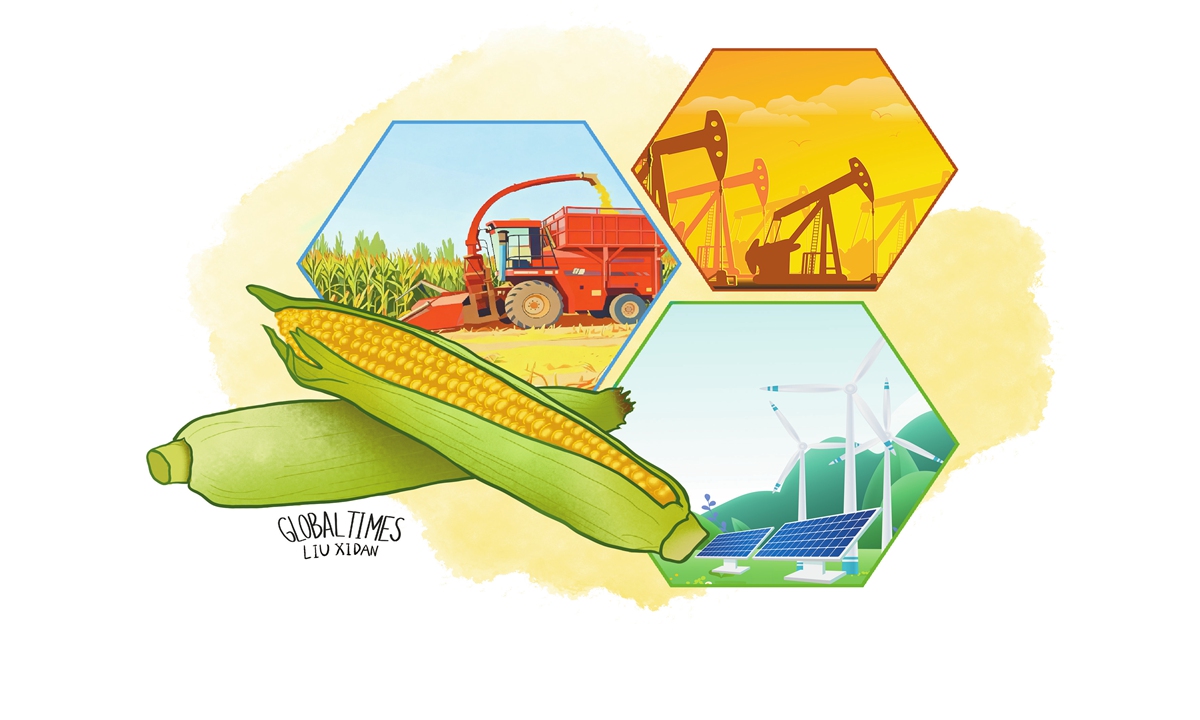
Illustration: Liu Xidan/GT
As the golden harvest season unfolds across Aksu in Northwest China's Xinjiang Uygur Autonomous Region, some 2.9 million mu (193,333 hectares) of corn are telling a story where tradition meets technology. According to CCTV News on Monday, corn yields in Wushi county have reached 949.6 kilograms per mu (14.23 tons per hectare), up 44.9 kilograms from last year. Behind these figures lies a tale of scientific innovation and mechanized farming - an approach that stands in sharp contrast to persistent Western allegations of so-called "forced labor." In Xinjiang, innovation is not a slogan; it is a tangible engine driving economic modernization.Xinjiang's achievements are striking even by global standards. The OECD-FAO Agricultural Outlook 2025-2034 projects that average corn yields worldwide will reach 6.5 tons per hectare by the end of the next decade. In Wushi county, top corn yields have already surpassed twice the global projections, reflecting the results of a systematic, high-tech approach to cultivation. From advanced seed breeding and the development of high-standard farmland to precision techniques such as dry seeding followed by irrigated emergence, Xinjiang's corn demonstrates how targeted innovation can achieve a consistently high performance.
Corn, however, represents only a small part of Xinjiang's broader technological advancement. In recent years, some Western countries have sought to cast a shadow over the region with baseless allegations of "forced labor," aiming to slow its economic development. Xinjiang has responded not with retreat but through intensified innovation, charting a development path that leverages indigenous technology to navigate external pressures. This approach not only reinforces regional economic resilience but also contributes to the modernization of Xinjiang's wider industrial landscape.
Grain and food processing, one of Xinjiang's major industrial clusters, has been significantly strengthened by technological advances. According to media reports, 2024 grain yields reached 524.8 kilograms per mu, 130 kilograms above the national average, marking the first time Xinjiang has ranked first nationwide. These results demonstrate how targeted innovation, underpinned by modern agricultural practices, can enhance both productivity and the broader economic impact of the region's food sector.
Beyond grain and food processing, Xinjiang has in recent years actively promoted the integration of scientific and industrial innovation, focusing on building a modern industrial system and developing new quality productive forces tailored to local conditions. The region has established 10 major industrial clusters, including strategic emerging sectors such as advanced manufacturing and new materials.
Jinrixinjiang magazine reported in June that the region has carried out 2,635 science and technology projects related to the construction of Xinjiang's 10 major industrial clusters. These efforts have produced a number of landmark scientific achievements, including the development of high-temperature thermosensitive ceramic materials capable of measuring temperatures up to 1,600 C, and breakthroughs in construction technology of the world's longest (22-kilometer-level) high-altitude, cold-region, high-speed highway tunnel.
While some foreign media reporters who have never visited Xinjiang craft narratives of "forced labor" from their offices and depict the region as economically backward, the reality on the ground tells a very different story. In springtime in Aksu, high-powered tractors equipped with BeiDou navigation systems automatically control upgraded planters along preprogrammed routes for precision corn planting. This application of BeiDou's high-precision positioning technology exemplifies a sophisticated integration of agricultural mechanization, industrial innovation, and digital information systems, reflecting the cumulative achievements of Xinjiang's multi-sector technological development.
According to a Xinjiang Daily report published in January, Xinjiang had a total of 2,529 high-tech enterprises at the end of 2024, a year-on-year increase of 32.34 percent, ranking second in the country in terms of its growth rate. The region's advances in scientific and technological innovation have injected new momentum not only into agriculture but also across a wide range of industries, including infrastructure sectors such as power, and energy industries such as oil and gas. These developments have accelerated the clustering and expansion of strategic emerging industries, including the digital economy and artificial intelligence, underscoring Xinjiang's broader drive toward a diversified, technology-driven economy.
From the precision planting of corn in Aksu to the steady growth of high-tech enterprises across multiple sectors, Xinjiang's technological advances have contributed directly to regional economic development. These achievements illustrate the region's capacity to innovate and modernize its industries while continuing to progress despite external pressures.
Unfounded Western allegations have not slowed Xinjiang's development. In this context, the high corn yields offer a vivid illustration of how targeted scientific and technological efforts are supporting tangible economic growth across the region.
The author is a reporter with the Global Times. bizopinion@globaltimes.com.cn
RELATED ARTICLES