‘We trust that South Korean people can tell right from wrong, hope South Korean media will face the essence of these issues squarely,’ says Chinese envoy
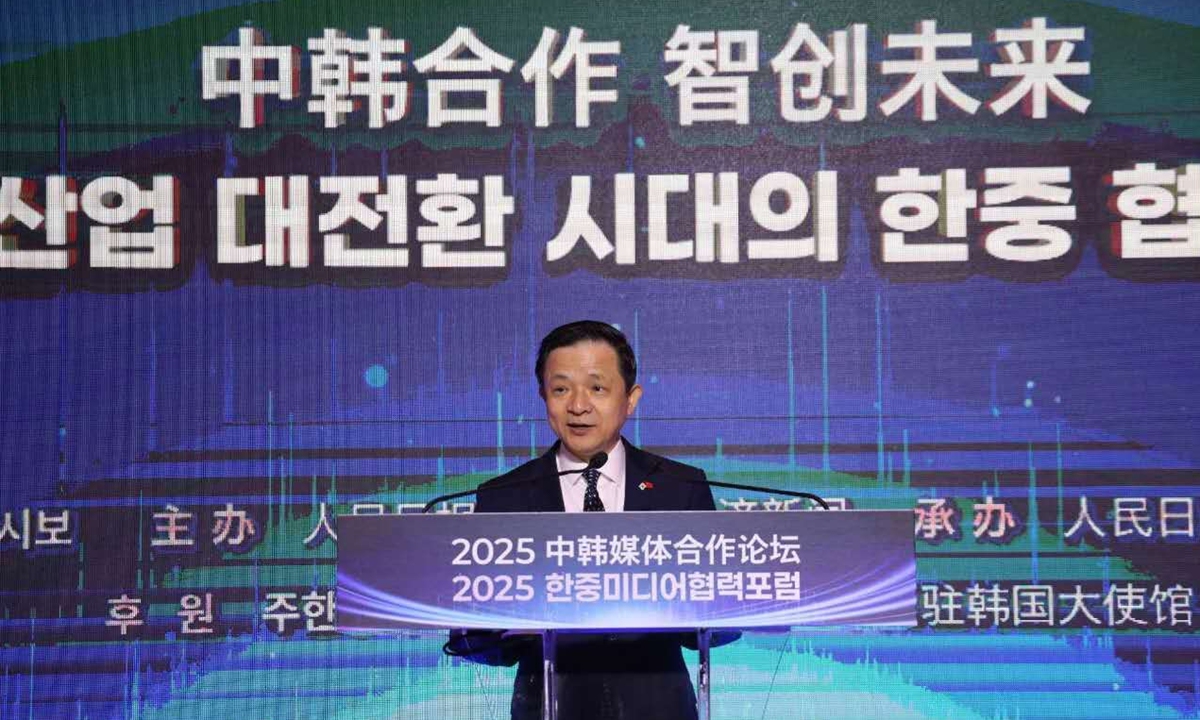
Chinese Ambassador to South Korea Dai Bing speaks at the 2025 China-South Korea Media Cooperation Forum held in Seoul on October 13, 2025. Photo: Courtesy of the Chinese Embassy in South Korea
President Yu Shaoliang, Chairman Chang Dae-whan, former speaker Park Byeong-seug,
Ladies and Gentlemen,
Good morning! I am delighted to attend the 2025 China-South Korea Media Cooperation Forum. On behalf of the Chinese Embassy in the Republic of Korea, I would like to extend my warm congratulations on the opening of this forum, express my gratitude to the People's Daily and South Korea's Maekyung Media Group for their efforts in organizing it, and pay my sincere respect to all media professionals who have long worked on the frontlines of China-Korea news reporting.
China and South Korea are close neighbors and important partners. Our friendship dates back centuries, and our interests are deeply intertwined. In the past, present, and future, strengthening friendly cooperation has always been the wisest choice that best serves the fundamental interests of both countries and peoples. In June this year, President Xi Jinping and President Lee Jae-myung held a friendly phone conversation, reaching an important consensus on advancing the China-Korea strategic cooperative partnership to a higher level. Under the strategic guidance of our two leaders, bilateral exchanges and cooperation have become more active, bringing new opportunities for the improvement and development of China-Korea relations. At the same time, it must be recognized that both countries, as well as the regional and international landscape, have undergone profound changes in recent years. We need to renew our understanding of each other and promote a relationship of looking back, re-recognition, and restarting.
The theme of today's forum is about mutual learning and cooperation between China and South Korea. Only through deepening understanding can we build mutual trust, remove distractions, strengthen cooperation, and achieve mutual success. As China's Ambassador, allow me to briefly introduce four key characteristics of today's China to help deepen understanding on the South Korean side.
First, China is vibrant and ever-changing. It has created two miracles — rapid economic growth and long-term social stability. China remains the world's second-largest economy, has lifted 800 million people out of poverty, and has a middle-income population of nearly 500 million. Over 1.4 billion Chinese people are marching together toward modernization. Next week, the fourth plenary session of the 20th Communist Party of China (CPC) Central Committee will focus on formulating the 15th Five-Year Plan, which will unleash new momentum for innovation, industrial upgrading, expanding consumption, and improving people's livelihoods.
Second, China is driven by innovation and empowered by green development. China is committed to independent innovation, opening-up and cooperation, accelerating breakthroughs in key technologies. In 2024, R&D investment reached around $500 billion, with technological achievements increasingly transforming into new productive forces. China is also firmly pursuing green growth, building the world's largest and fastest-growing renewable energy system and a complete new-energy industrial chain. Currently, one out of every three kilowatt-hours of electricity in China comes from renewable sources, and the number of new-energy vehicles exceeds 37 million.
Third, China is open, inclusive, and committed to win-win cooperation. China is a major trading partner for more than 150 countries and regions, including South Korea, and has contributed about 30 percent to global economic growth for many years. China has granted unilateral visa-free access to citizens of 47 countries. Despite the rise of unilateralism and protectionism, China continues to expand high-level opening-up, firmly upholds multilateralism and free trade, and ensures the stability of global industrial and supply chains — creating opportunities and injecting stability and certainty into global common development.
Fourth, China stands for independence and global responsibility. In the face of US hegemonic bullying and tariff abuse, China has responded firmly and decisively to safeguard its legitimate rights and the fairness of the international order. Our position remains consistent: We will fight, if fight we must. Our doors are open, if the US wants to talk.
Coercion and intimidation will never work against China. At the same time, China remains committed to multilateralism and the central role of the United Nations. President Xi Jinping has proposed the Global Development Initiative, Global Security Initiative, Global Civilization Initiative, and Global Governance Initiative, contributing China's wisdom and solutions to building a community with a shared future for mankind.
Distinguished guests and friends,
Over the past nine months since I came to South Korea, I have noticed that major South Korean media outlets report on China daily, reflecting strong interest in China and our bilateral relations. However, some reports are seriously inaccurate. In a world undergoing profound changes unseen in a century, the media should rise above bias and see the bigger picture. Based on my experience here, I would like to share a few candid suggestions.
First, discard the "tainted lenses." China is vast, populous, diverse in ethnicity with unbalanced development. Governing such a large nation is no easy task. The path of socialism with Chinese characteristics under the leadership of the CPC is the right one for China and we will not waver in insisting on it. A few people in South Korea deliberately exaggerate ideological differences between our countries. China and Korea have different political systems — but as we say, "Only the wearer knows if the shoes fit." We hope the media in both countries report on each other with mutual respect, fairness, and objectivity.
Second, avoid "externalizing internal issues." China and South Korea, as close neighbors for thousands of years, naturally encounter differences. The key lies in handling them rationally through communication.
Since late last year, South Korea's domestic political situation has become complex. China remains committed to friendship and good-neighborliness, and we hope ROK maintains stability and development and believe South Korea is capable of addressing domestic issues. This is valuable political support from China. Yet some forces and media, for political purposes, fabricate lies about "China interfering in S.Korean elections" to stir up anti-China sentiment. Even now, certain forces, out of political purpose, continue spreading rumors rampantly against China and Chinese people for attacking opponent. Playing such games is dangerous and irresponsible. We trust that the South Korean people can tell right from wrong, and we hope South Korean media will face the essence of these issues squarely. I have noticed that several South Korean media outlets recently urged against dragging "China factors" into political party disputes.
Third, reject discrimination and exclusion. Racism and racial discrimination are red lines for the international community, and both China and South Korea suffered from them historically — we must learn from that past. Currently, there are 7 to 8 million annual visits between our countries, and millions of Chinese and South Koreans live in each other's nations. Occasional incidents are inevitable during bilateral exchanges, but they should not be amplified or turned into prejudice or hostility. Globally, responsible media avoid mentioning nationality or ethnicity when reporting negative cases. We hope South Korean media exercise the same caution, and we encourage both sides to report more positive stories of bilateral exchanges and cooperation, dig out more friendly stories to build positive momentum for better bilateral ties.
Distinguished guests and friends,
The upcoming APEC Economic Leaders' Meeting in Gyeongju, followed by China's hosting of APEC next year, is of great significance for promoting unity in Asia-Pacific and offer great opportunity for conducting China-South Korea high-level exchanges, guiding development of bilateral ties. China fully supports South Korea's efforts to host a successful meeting and sincerely wishes the Gyeongju APEC Meeting great success. I also warmly welcome Korean media friends to visit China more often, to see the real, open, and dynamic China with your own eyes, and to share its true stories with the South Korean people.
Finally, I wish this forum every success!
Thank you all.
RELATED ARTICLES