Multiple govt departments join forces to curb panda fandom culture, foster constructive engagement with fans
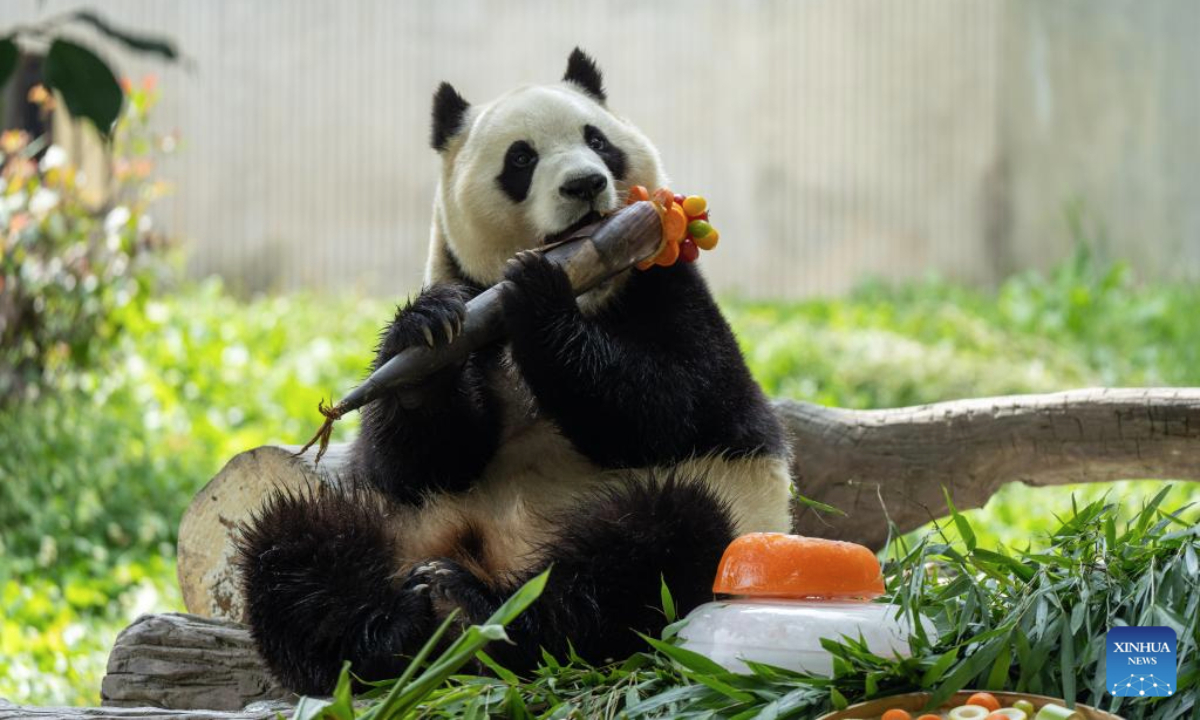
Giant panda Fubao eats bamboo at the Shenshuping giant panda base of Wolong National Nature Reserve in southwest China's Sichuan Province, July 17, 2025. A giant panda birthday season event, hosted by the China Conservation and Research Center for Giant Panda, was held here on Thursday. The much-anticipated giant pandas, including Fubao and Xiao Qiji, met the public and enjoyed delicacies such as carrots, watermelons, etc. (Xinhua/Xue Chen)
As toxic fandom culture has begun to severely disrupt the normal research and conservation work for giant pandas, multiple departments — including the National Forestry and Grassland Administration (NFGA), the Cyberspace Administration of China (CAC), and the panda center — have engaged in various forms of constructive dialogue with fans to collectively protect the species.
When fandom culture gradually extended to the field of giant panda conservation, the verbal abuse, rumor-mongering, and denouncements by some extreme fans have begun to disrupt the normal research and conservation work of relevant institutions, the official WeChat account of the China Conservation and Research Center for Giant Panda (CCRCGP) said on Tuesday.
For instance, on social media, some panda fans spread rumors about giant pandas being beaten in enclosures, threatened by keepers, having batteries implanted in their cheeks, or having their marrow extracted, the CCRCGP said.
These fans questioned scientific decisions such as reintroduction of giant pandas into the wild and international cooperation, with some even doxing keepers and cyberbullying their families.
To address malicious acts, on September 22, 2025, the CAC launched a special campaign explicitly focusing on social media, short-video, and live-streaming platforms to curb such behaviors such as inciting fan groups to disparage, attack, abuse, or organize mass reporting.
Besides, with the rise of new media channels like short videos and livestreams, "panda streamers" have gained popularity in recent years, attracting large numbers of fans who closely monitor the animals' diet, living environment, and daily activities.
Under the prolonged, high-frequency scrutiny of panda fans, disputes over many details of panda care have emerged.
The giant panda Fubao, which returned from South Korea, has faced such issues.
According to the CCRCGP, if Fubao had a good appetite, it was over-interpreted as a sign that a particular keeper was "suitable." If Fubao lost its appetite due to estrus or pseudopregnancy while under another keeper's care, then that keeper was accused of "abusing the animal."
This gradually escalated into cyberbullying against the keepers, with some staff facing online and offline harassment and insults, according to the report.
"Animal conservation is a science, not an emotional carnival," the CCRCGP stated, emphasizing its firm opposition to cyberbullying and the spread of toxic fandom culture.
Additionally, some individuals, under the guise of offering "exclusive updates" or "protecting panda rights," deliberately spread misinterpretations or fabricated rumors to stir conflict within fan communities for profit.
A couple surnamed Bai and Xu, who had previously spread misinformation about the death of the overseas-born giant panda Lele and claimed another overseas giant panda, Yaya was "emaciated," earned over 30,000 yuan ($4,200) through livestreams and raised more than 140,000 yuan from fans, profiting over 170,000 yuan in total, Xinhua News Agency reported, citing public security authorities.
Bai and Xu were later sentenced to one year and six months and one year and two months in prison respectively, for picking quarrels and provoking trouble.
Other relevant departments are also working through various forms and methods to foster positive communication between giant panda conservation institutions and their fans, while strengthening protection efforts.
"As the competent authority for giant panda conservation, we firmly oppose the toxic fandom culture surrounding giant pandas," said the NFGA. "We hope all panda enthusiasts respect science, trust professionals, and express their views and communicate through official and proper channels."
The NFGA also announced plans to establish regular public communication mechanisms and platforms to collaborate with panda fans and bloggers in promotional efforts.
To improve communication between giant panda conservation institutions and panda fans, relevant authorities have since 2024 organized multiple meetings for panda enthusiasts.
During these meetings, experts addressed public concerns, clarified misinformation, and listened to suggestions and feedback.
Authorities also invited online influencers to visit conservation bases, tour panda hospitals and wild-training areas, and engage in face-to-face exchanges with experts and staff, the report said.
"We should respect the natural instincts of the giant panda and care for them in accordance with these instincts,"said a giant panda breeder surnamed Zhang, adding that giant pandas are wild animals, not pets. Rather than seeking to change them, we should adapt to them with respect."
Global Times
RELATED ARTICLES