Carnegie report puts price on US allies as alliances become 'strategic expendables'
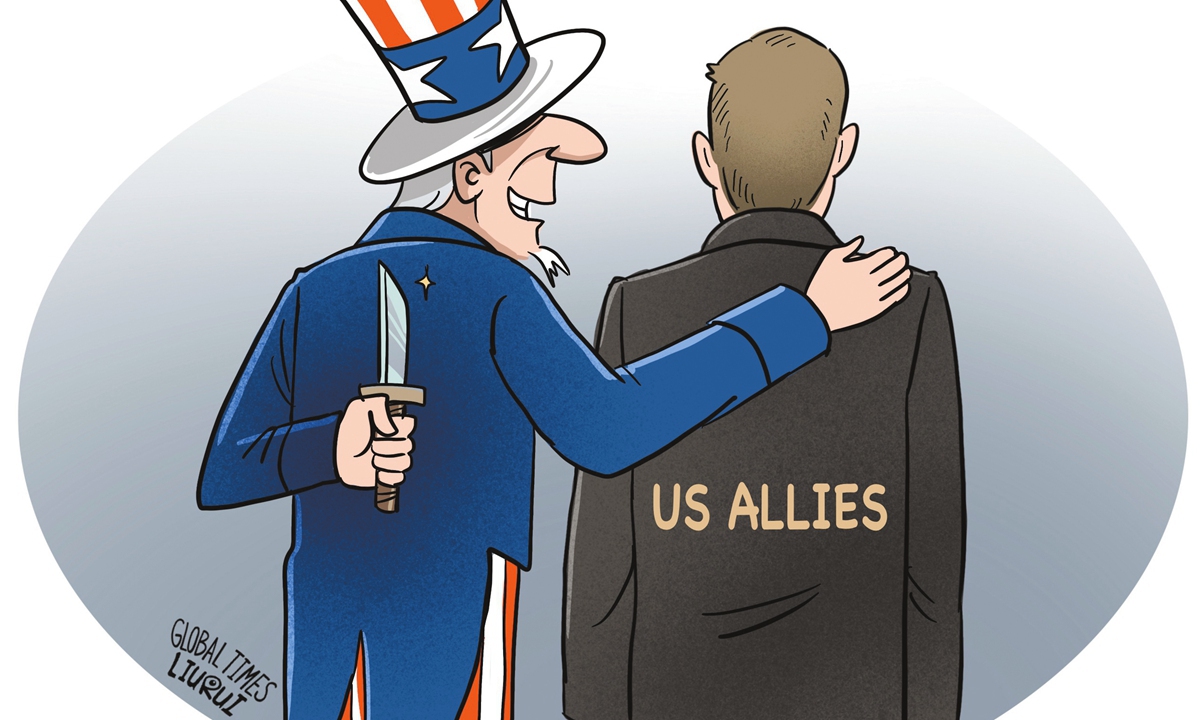
Illustration: Liu Rui/GT
The Carnegie Endowment for International Peace recently released a report entitled "Legacy or Liability? Auditing U.S. Alliances to Compete with China," meticulously assessing the costs and benefits of America's alliances with seven nations - South Korea, Japan, Australia, the Philippines, France, Germany and the UK - across eight core areas of strategic competition with China. This report, steeped in Cold War thinking, reflects outdated concepts and an anachronistic mind-set, lacking strategic foresight. Its underlying premise centers on maximizing the mobilization of US allies to sustain and reinforce the US-manipulated alliance system against China. It fails to understand the world and utterly misreads China.
The report categorizes allies into different levels of priority, explicitly quantifying their strategic value to the US. For instance, it asserts that Japan can further US aims with China across all eight categories, while Australia's contributions remain "at a more modest level." South Korea is deemed a substantial military burden, yet capable of providing robust support in non-military spheres such as chip manufacturing.
The report advocates for periodic reassessment of alliance relationships, urging continuous adjustment and optimization to ensure these partnerships truly "serve the needs of American citizens." In the authors' view, allies can be exploited as unequal partners. This is a typical way the US handles its alliance relations and is not uncommon in history.
The report reflects the consistent arrogance of American elites, who position the US as a "beacon to the world" and a "city upon a hill," towering above the rest of the globe. They believe they can manipulate allies, sow discord globally. They are obsessed with a mind-set of competition and confrontation.
The recommendations in this American think tank report essentially aim to forge an alliance system that is more compliant, combat-ready and cost-effective in serving US unilateral interests, designed to counter what it perceives as its primary challenge - China. Yet reality presents a complex alliance network that is increasingly centrifugal, calculating and riven by internal contradictions, where allies do not blindly obey US orders or risk their own interests for Washington's gains, but instead make choices based on their own strategic calculations.
Strengthening the alliance structure has been a persistent objective of the US elite faction, which regards alliances as the nation's most vital strategic asset. However, the current US administration contends that upgrading this extensive alliance network entails prohibitively high costs for the US itself. From the administration's perspective, allies are viewed as leeches, draining substantial American funds without providing commensurate benefits. Should allies fail to make substantive investments in the US and maximize their own defense spending to purchase American security guarantees, they become burdens.
It could be said that the US' own strategic credibility and policy continuity represent the greatest Achilles' heel within its alliance system. As Henry Kissinger observed, it may be dangerous to be America's enemy, but to be America's friend is fatal. Serving as an American ally carries a high risk of becoming entangled in US policy constraints, ultimately suffering the tragedy of being sacrificed for American interests.
Moreover, the interdependence of globalization makes it difficult for purely antagonistic blocs to sustain long-term vitality, as economic imperatives frequently clash with geopolitical objectives. In the international context where turmoil and transformation are intertwined, the vast majority of nations seek stability in major-power relations, desiring greater space for their own development and prosperity rather than becoming pawns or expendable assets in great-power rivalry.
The authors of the report seem to presume that China would welcome an intensified China-US rivalry with the same enthusiasm they themselves display - as if the entire world revolves solely around this binary contest - and that by properly "leveraging" US allies, other countries would naturally be compelled to take sides. However, the core of China's diplomatic philosophy and practice lies in building a community with a shared future for humanity, emphasizing balanced, stable, healthy and sustainable relations among major powers. Regarding China-US relations, China remains committed to the three principles of mutual respect, peaceful co-existence and win-win cooperation. It is hoped that these American elites will propose wise policies that contribute to the stability of China-US relations and the broader global trajectory.
The author is a professor at the Institute of International Relations at China Foreign Affairs University. opinion@globaltimes.com.cn
RELATED ARTICLES