Spanish FM's China visit reflects Madrid's pragmatic approach to bilateral ties
Frequent high-level China-Europe exchanges serve to expel misunderstanding: analyst
By Published: Oct 14, 2025 10:40 PM

China Spain Photo: VCG
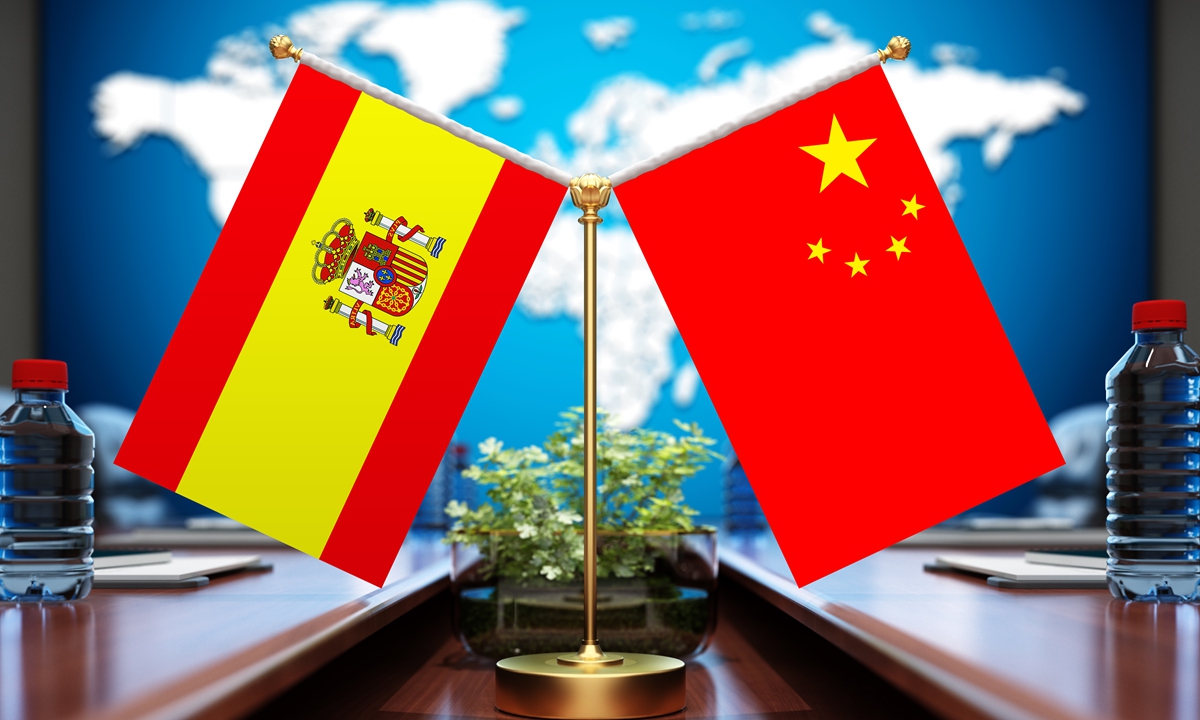
Spain's Minister for Foreign Affairs, European Union and Cooperation José Manuel Albares Bueno began an official visit to China on Tuesday, lasting through Wednesday. Experts say the visit underscores Madrid's commitment to maintaining a pragmatic relationship with China to preserve a balanced international stance.
Albares is visiting at the invitation of Wang Yi, member of the Political Bureau of the Communist Party of China Central Committee and Chinese foreign minister, a Chinese Foreign Ministry spokesperson announced on Monday.
Albares is scheduled to travel on Tuesday to Hangzhou, Zhejiang Province, to review bilateral relations and key international matters, according to a statement published by Spain's Ministry for Foreign Affairs. It said the minister's agenda includes a meeting with Spanish business representatives and the inauguration of the new international campus of the Polytechnic University of Valencia (UPV).
This visit takes place in the context of the 20th anniversary of the Comprehensive Strategic Partnership between Spain and China, which was marked by a visit by Spanish President Pedro Sánchez to China in April, according to the statement.
Amid a complicated international political landscape, Albares' visit to China will help strengthen communication and political trust between the two countries, Jiang Feng, a research fellow at Shanghai International Studies University and president of the Shanghai Association of Regional and Country Studies, told the Global Times.
Jiang noted that the steady development of economic and political cooperation between China and Spain has significantly contributed to Spain's growth in recent years. Moreover, as Spain faces disagreements with some other European countries over security and international policy, maintaining close communication with China has become an important step for Madrid to preserve a balanced international posture.
China and Spain held a trade and investment matching conference on Thursday in Madrid, during which both sides called for stronger bilateral economic and trade cooperation and reaffirmed their support for free trade, according to the website of China's Ministry of Commerce (MOFCOM) on Friday.
Spain's Secretary of State for Trade Maria Amparo López Senovilla said at the event that in recent years, trade and investment cooperation between Spain and China has developed vigorously, reflecting Spanish companies' confidence in China's economic prospects.
Maintaining an active and normalized relationship with China is regarded as one of the broadest consensuses in Spanish society. Spain has no history of direct confrontation with China, and hostility is a marginal element in the bilateral relationship. Moreover, Spain-China economic relations already constitute an important pillar of Spain's foreign trade, with great potential for growth in high value-added sectors, Xulio Rios, director of the Spanish Observatory of Chinese Policy, told the Global Times.
He noted that the Chinese community in Spain is also seen as hardworking and discreet, in contrast to the negative sentiment in some countries against immigration issues.
Spain's attitude toward China is linked to the country's pragmatic foreign policy, Rios noted.
Albares' visit to China is one of the many frequent high-level exchanges that have taken place recently between China and Europe, and even more are scheduled. The Chinese Foreign Ministry spokesperson announced on Tuesday that Diplomatic Adviser to the French President Emmanuel Bonne will be in China from October 15 to 16 and Sweden's Minister for Foreign Affairs Maria Malmer Stenergard will pay an official visit to China from October 16 to 17.
Wang Yi visited Italy and Switzerland from October 7 to 12 to attend the 12th Joint Meeting of the China-Italy Government Committee in Rome and hold the fourth round of China-Switzerland Foreign Ministers' Strategic Dialogue.
From a broader perspective, Europe's policy toward China is still unclear and to some extent is sometimes tinged with negativity, Jiang said. He noted that in such a context, the recent wave of high-level exchanges has helped steer bilateral relations toward greater stability, rationality, and optimism, and expel misunderstanding.
Jiang added that countries like Spain are expected to play a constructive role within the EU in advancing a more stable China-Europe relationship. From the perspectives of strategic development, economic interests, and security interests, deepening ties with China remains an important consideration for Spain, he said.
RELATED ARTICLES