ARTS / CULTURE & LEISURE
China releases first mass-produced barrier-free domestic, world maps
Seeing culture through fingers
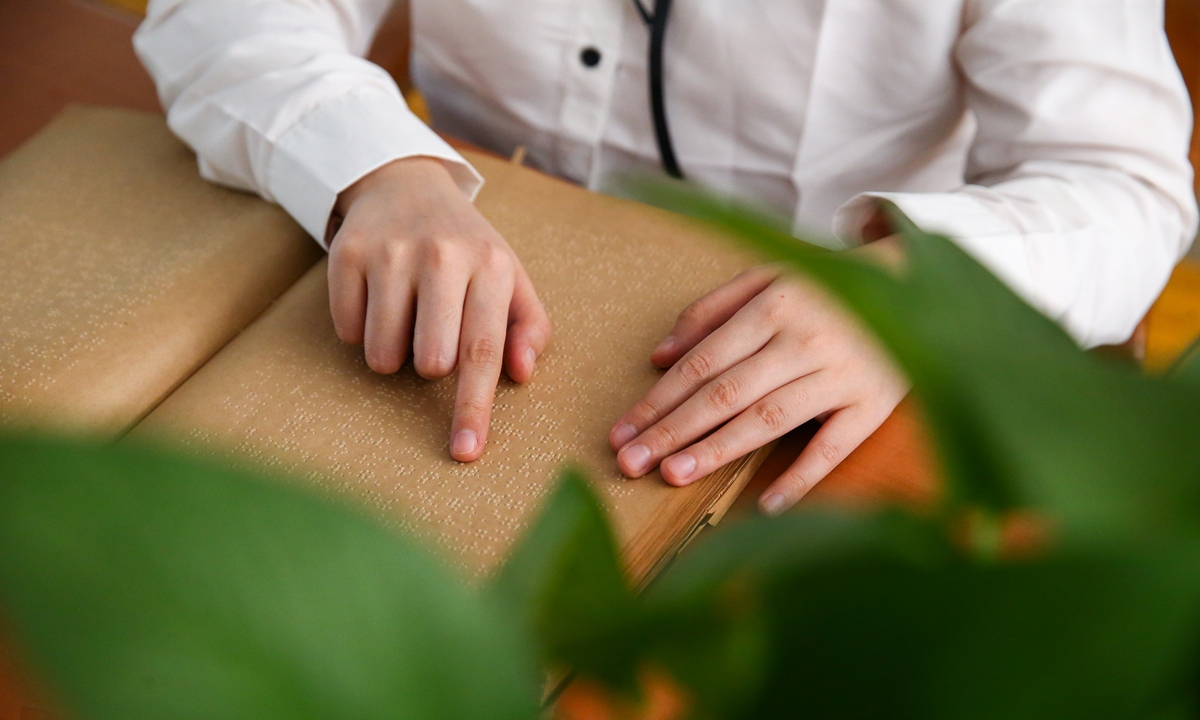
A visually impaired person reads a barrier-free book. Photo: VCG
For 17 million or so visually impaired people in China, the beauty of the nation's cultural relics and landscapes has long been out of reach. But that's beginning to change.
On Monday, ahead of White Cane Safety Day, which falls on October 15 each year, China unveiled a series of accessible cultural publications: China and World Maps, Touch Treasures of the Palace Museum and A Tactile Journey along the River during the Qingming Festival.
These are the nation's first tactile maps in mass publication and heritage touch-books published at the state level, designed especially for people with visual impairments..
"Maps are an important vehicle for national defense education, we can't leave people with visual impairments behind," said Hao Gang, president of Star Map Press.
Hao told the Global Times that the idea for the new tactile map series came from seeing visually impaired children rely only on verbal descriptions to "imagine the maps."
"We wanted them to trace the contours of their own country with their hands, and to understand the meaning of China's territory, airspace, and waters," Hao said.
Existing braille publications, including large-print books, print-and-braille editions, and a few tactile picture books, have rarely covered traditional cultural works such as relics, calligraphy and paintings, said Zhu Bing, director of the China Braille Library, which helped produce the two new tactile books.
"Our goal in producing these tactile books is to let visually impaired readers experience the beauty of traditional Chinese art through touch," Zhu said.
The launch marks a major step in China's ongoing push to make culture more inclusive and accessible.
Mapping inclusion
It took nearly a year to develop the barrier-free China and world maps, the press said, which are the first in the country to be mass-produced using 3D resin printing technology.
The maps feature contours raised to a precise height of 0.5 millimeters. The China map covers all 34 provincial-level regions and key geographic landmarks, while the world map uses different textures to distinguish the seven continents and four oceans.
Printed on thick, durable paper that is water- and moisture-resistant, the maps measure 52 by 73 centimeters, just the right size to lay on a table for tactile exploration. The maps combine braille with various types of raised symbols.
Visually impaired readers can trace lines, dots and textured surfaces to perceive the contours and spatial relationships of regions in China and around the world, enhancing their understanding of geography and improving spatial awareness.
"Visually impaired people cannot form spatial concepts through images in the same way as sighted individuals," said Bao Guohong, a deputy editor-in-chief of China Braille Press.
"As a specialized tool, tactile maps remove barriers to improving spatial awareness and learning geography, playing an important role in daily orientation and navigation."
Looking ahead, Star Map Press plans to add audio commentary to the barrier-free China and world map, enabling a "scan-and-read" feature. Pilot teaching programs will also be launched in schools for the visually impaired to gather feedback and continuously improve the materials, according to Star Map Press.
In collaboration with the China Braille Press, more detailed barrier-free atlases and map collections are also in development.
The initiative seeks to "create an equal, accessible and barrier-free learning environment while contributing to broader efforts to promote reading for all and build a more inclusive society," Hao said.
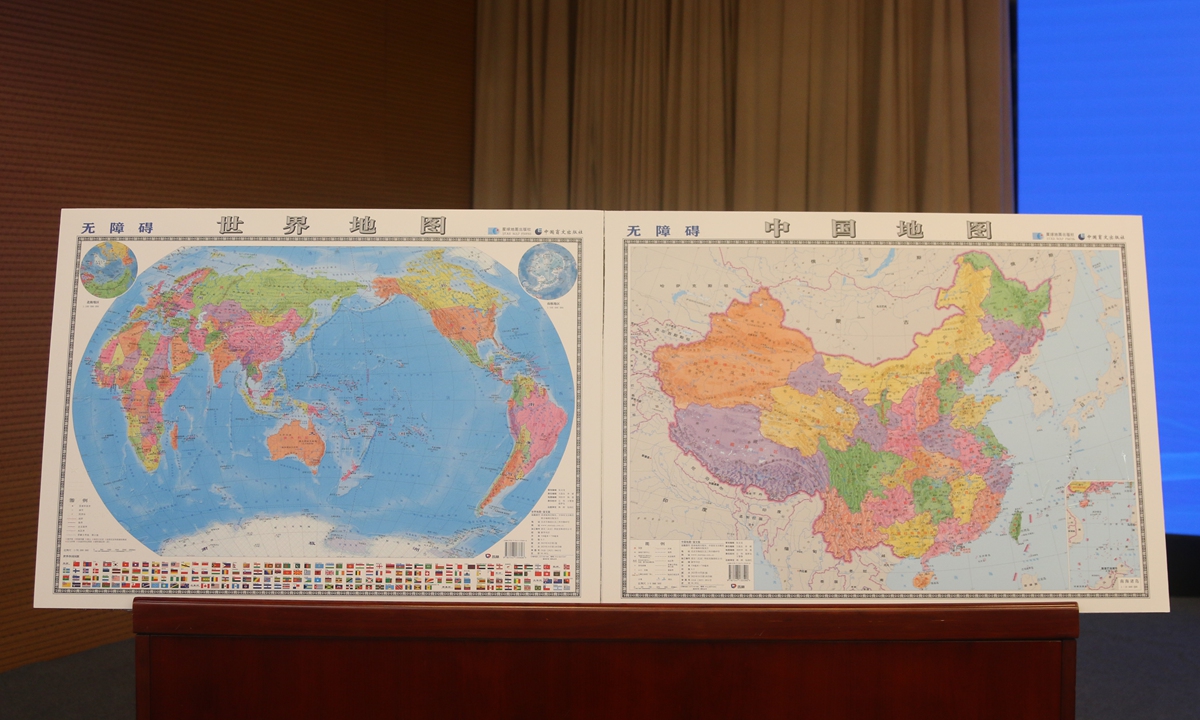
The barrier-free world and China maps Photo: Courtesy of Star Map Press
Broader effortsOn Monday, the two "touch" publications also present over 30 treasured relics from the Palace Museum collections.
"Through embossing techniques, including raised lines, dots and engraved contours, the two books render original appearances in a tactile-friendly way, allowing visually impaired readers to 'feel' the shapes and patterns of artifacts," Zhu said.
The tactile maps and heritage touch-books align with the spirit of the law on building a barrier-free living environment, which took effect in September 2023.
Since the law's implementation, public cultural institutions and publishers have accelerated the production of accessible materials.
Jiang Sheng, 34, a traditional Chinese medicine massage therapist based in Beijing, told the Global Times that prolonged use of braille books can flatten the raised dots, making them harder to read. For this reason, he also relies on mobile apps for accessible reading.
"Our fundamental mission is to meet the diverse, multi-level, cultural and intellectual needs of visually impaired readers," noted Bao.
"The goal of it is to ensure that people with visual disabilities enjoy equal rights to read, participate in cultural life, and share in the achievements of civilization. What we aim to do is remove the obstacles they encounter on their cultural journey," he said.
Work is already underway.
Touch versions of traditional Chinese calligraphy, seal carving, the central axis of Beijing architecture, and more detailed braille map atlases.
In numerous locations, the "Bright Cinema" project brings light to the visually impaired in China, helping them better understand the movies.
RELATED ARTICLES