Hit TV series honoring covert heroes ignites tourism surge to martyr's residence, sparks discussion in Taiwan
Martyrs inspire great cause of national reunification: Taiwan Affairs Office
By and Li Yu Published: Oct 15, 2025 04:47 PM

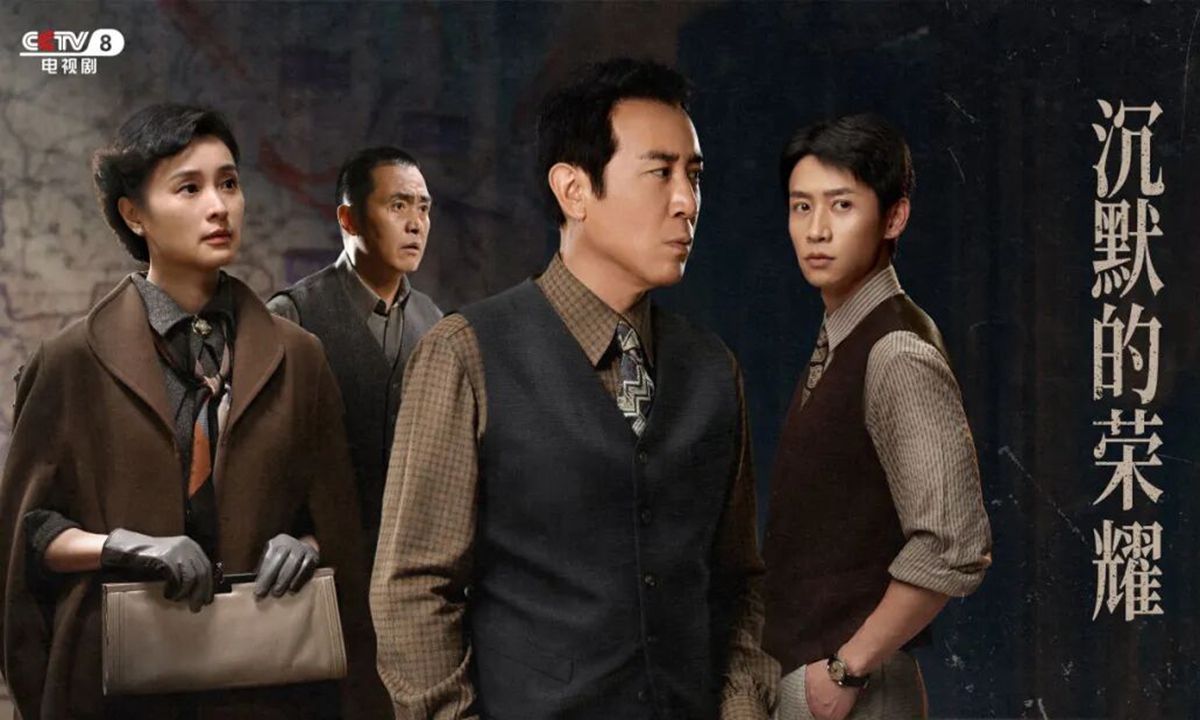
Photo: Poster of the mainland TV series Silent Honor
The mainland TV series Silent Honor, which chronicles the story of Wu Shi and other Communist Party of China (CPC) undercover agents in Taiwan island, has recently become a phenomenon, drawing waves of tourists to Wu's former residence and sparking discussion in Taiwan.
Commenting on the TV series, Chen Binhua, a spokesperson of State Council Taiwan Affairs Office, said on Wednesday that martyrs' faith and determination will undoubtedly inspire compatriots on both sides of the Taiwan Straits to achieve the great cause of national reunification and the rejuvenation of the Chinese nation at an early date.
Chen said the steadfastness, loyalty, struggle and sacrifice of martyrs such as Wu Shi, Zhu Feng, Chen Baocang and Nie Xi will never be forgotten by the people or by history.
A notable line from the hit drama, "Should I depart and never return, so be it — I shall go without looking back," succinctly embodies the fearless spirit of CPC members and revolutionary predecessors, who devoted their lives for the liberation of the people and national reunification, Chen said.
Airing on CCTV-8, the 39-episode TV series marks the first dramatic work to chronicle and commemorate the CPC's espionage work in Taiwan that started in the final months of the Chinese Civil War (1945-1949), with the defeated Chinese Kuomintang Party retreating to Taiwan in 1949 and the founding of People's Republic of China.
In August 1949, Wu was appointed by the KMT authorities as the "deputy chief of staff of defense ministry." In order to obtain more intelligence, Wu went to Taiwan with the KMT. Along with other CPC agents, Wu provided mainland with important information, including troop movements on Kinmen Island and KMT deployments during the Southwest China campaign.
However, a betrayal exposed Wu's identity, leading to his capture and execution in 1950.
The show premiered on September 30, China's Martyrs' Day, as well as the eve of National Day on October 1. Upon its premiere, Silent Honor achieved remarkable results: The peak ratings on the first day reached 3.07 percent, making it the fastest series in 2025 to break 3 percent on CCTV-8. Since then, it has consistently topped ratings charts across multiple platforms, sparking a nationwide frenzy for the show, according to media reports.
The former residency of Wu Shi in Wucuo village, Fuzhou, East China's Fujian Province has recently become a popular tourist destination.
Wu Hang, the grandnephew of Wu Shi, has long been the caretaker of his ancestral home. Recently, the soaring popularity of the Silent Honor has transformed his tranquil routine, as waves of visitors from across the country descend upon the modest residence.
"Over the last weekend, hundreds have come — Beijing, Wuhan, Hong Kong, Xiamen — some making a special pilgrimage, others stopping by during their travels," Wu Hang told the Global Times on Wednesday.
He said more people are remembering and honoring the martyr. "The influx, largely from other provinces, has continued even after the National Day holidays."
"Just yesterday, a frail man in his 90s came with his daughter and granddaughter. When I urged him to take care of himself, he exclaimed with reverence, 'Oh, he [Wu Shi] was a truly extraordinary hero,'" Wu Hang said.
Visitors often remarked that the home of such a remarkable figure remains modest and that Wu deserves a more prominent memorial, Wu Hang told reporter.
Silent Honor has also sparked significant attention in Taiwan. Local media TVBS reported on the TV series, highlighting that "before his execution, Wu Shi wrote the words 'Taiwan Must Return' in blood while in prison." Taiwan's "China Times" noted that, against the backdrop of the current tense cross-Straits situation, the TV series openly commemorates martyrs who devoted their lives to the cause of reunification, carrying a strong "pro-reunification" message.
Zhang Wensheng, a vice dean and associate professor at the Taiwan Research Institute of Xiamen University, told Global Times on Wednesday that Wu Shi was a martyr who gave his life for national reunification in the early days of the People's Republic of China.
Broadcasting his story underscores the mainland's hope for more Taiwan compatriots to recognize the irreversible trend toward reunification and actively contribute to this historic mission, Zhang said.
According to Zhang, the throngs of visitors flocking to Wu Shi's former residence reflect strong public interest with the Taiwan question and a deep yearning for national reunification as cross-Straits relations reach a critical juncture.
Taiwan commentator and scholar Chiu Yi noted in a video post that when Wu Shi and other martyrs arrived in Taiwan, it was during the height of the KMT's "White Terror," a political repression period when conducting covert operations entailed immense personal risk.
"What force compelled Wu Shi to undertake such perilous tasks, to brave death and walk a razor's edge? It was their burning faith in China's complete reunification, their vision of a unified country where the Chinese people could stand tall, free from the threat of imperialist aggression," Chiu said.
RELATED ARTICLES