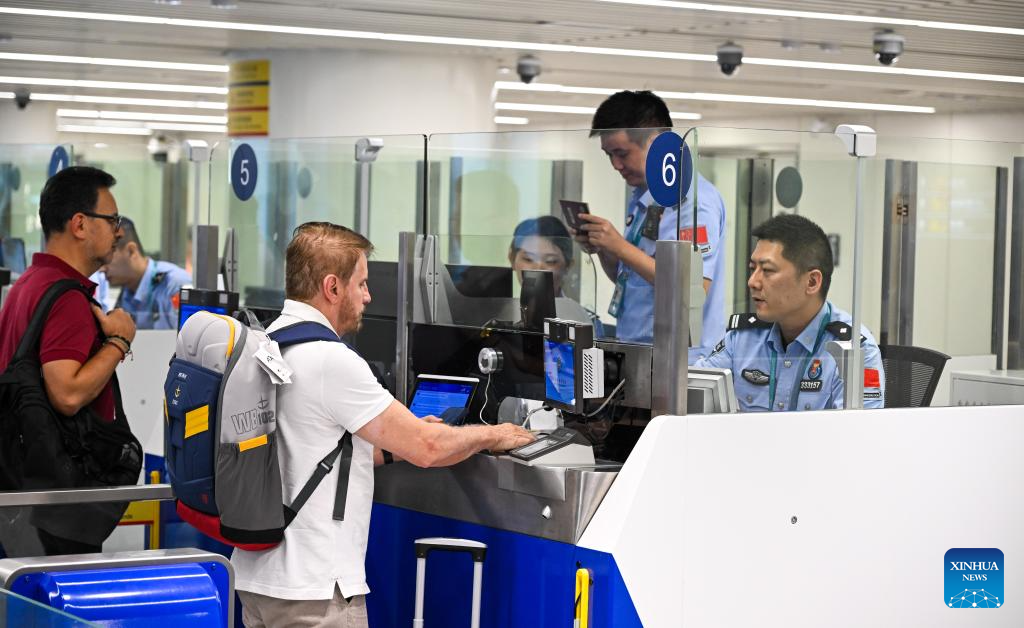
Inbound passengers go through border inspection procedures at Haikou Meilan International Airport in Haikou, south China's Hainan Province, Oct. 15, 2025. Hainan has handled 2 million inbound and outbound trips crossing the border this year as of Oct. 15, with foreign travelers accounting for 53 percent of the total, according to the Haikou General Station of Immigration Inspection. Hainan has long enjoyed favorable visa-free entry policies in China. The majority of foreigners who enter Hainan do so under the visa-free entry policy. (Xinhua/Yang Guanyu)
In the third quarter of 2025, foreign nationals made nearly 7.25 million visits to China under the nation's special visa-free policy, up 48.3 percent year-on-year, a spokesperson of the National Immigration Administration (NIA) said at a press briefing on Thursday.
The figures show that China Travel has been gathering pace, observers said, fueled by factors including the visa-free policy, growing interest among foreign travelers toward Chinese culture and increased international business exchanges. They predicted that the inbound tourism market could explode in the next decade or so, bringing an incremental amount of $1 trillion to $2 trillion.
In the quarter, immigration management authorities in China inspected 20.134 million foreign visitors, up 22.3 percent year-on-year, and foreign nationals entering under the visa-free policy represented 72.2 percent of all inbound foreign visitors, NIA data showed. A total of 584,000 visa documents were issued to foreign nationals during the same period.
The tourism market continued heating up during the eight-day National Day and Mid-Autumn Festival holidays, which ran from October 1 to October 8. A total of 751,000 foreigners visited China during the eight-day holiday, up 19.8 percent year-on-year, while 535,000 entered under visa-free status, an increase of 46.8 percent, according to data released by the NIA.
"Inbound travel demand [from foreign nationals] keeps rising, so we have rolled out more tailored travel services for foreign nationals, such as business vans and Chinese culture tourism itineraries," Gao Lijuan, a guide for English-speaking visitors based in Wuxi, East China's Jiangsu Province, told the Global Times on Thursday.
According to Guo, foreign travelers in particular enjoy local natural scenery as well as cultural and historical sides embodying traditional Chinese heritage, such as Huishan ancient town.
A tour guide surnamed Huang based in Guangzhou, capital of South China's Guangdong Province, told the Global Times that he has seen the diversification of inbound tourists' sources recently. "In addition to traditional source markets in Southeast Asia, the US and Europe, there has been a significant increase in inbound inquiries from Russia, the Middle East, and Central Asia," he said.
In addition to leisure travel, the uptick in tourism is also partly driven by growing business trips. According to a report Trip.com sent to the Global Times, inbound travel consumption involving hotels and flights for overseas visitors arriving in Guangzhou, South China's Guangdong Province, has risen during the 138th Canton Fair. The exhibition runs from Wednesday to November 4 in Guangzhou.
For example, the average per capita hotel spending is up 10 percent compared with the same period last year, while average per capita airfare spending rose by 23 percent, the report showed.
Liang Jianzhang, chairman of Chinese tour operator Trip.com, said in a statement sent to the Global Times on Thursday that thanks to the visa-free policy, "inbound tourism from Southeast Asia has been growing very rapidly, and inbound markets from Belt and Road partner countries are rebounding quickly as well."
Liang also predicted that entering the winter period, Northeast China's ice and snow tourism and similar attractions are expected to become new growth points for inbound tourism.
According to the NIA, tourists from 76 countries are now able to enjoy unilateral or mutual visa-free entry treatment, with transit exemptions expanded to 55 countries. Citizens of 55 countries can visit China in transit visa-free for up to 10 days, before traveling on to a third destination, the Xinhua News Agency reported.
The country's authorities have also rolled out multiple measures to bring convenience to inbound visitors, such as introducing payment facilitation measures and enriching tourism offerings.
Industry insiders said that China's inbound tourism market has abundant growth space.
"China's inbound tourism is poised to enter the world's first tier over the next 10 to 20 years. For example, the US inbound tourism market is in the first-tier rank, accounting for 1 percent to 2 percent of its GDP, which translates to approximately $1 trillion to $2 trillion in market value. China could fully reach this level as well, meaning there is trillion-level room for growth," Liang said.
RELATED ARTICLES