
Illustration: Xia Qing/GT
Two seemingly unrelated events caught my eye recently. In Shanghai, scholars from around the world came together for the second World Conference on China Studies, themed "Historical and Contemporary China: A Global Perspective," with a special focus on connecting historical China to the realities of contemporary China.
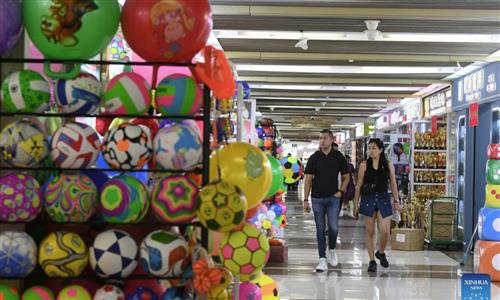
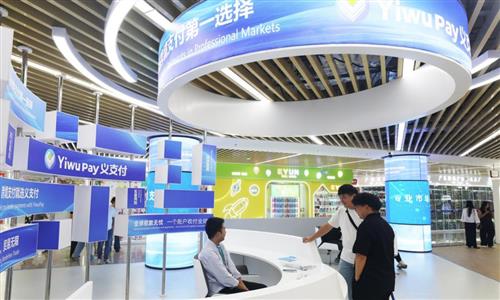
Meanwhile, in Yiwu, a city located approximately 280 kilometers from Shanghai in Zhejiang Province, a brand-new Global Digital Trade Center has just opened, billed as the "sixth-generation market." Here, merchants can reach customers across dozens of countries with nothing more than a smartphone and an app, equipped with real-time translation, design tools and AI-powered navigation that spans every stage, from concept to sale.
While one event is academic and the other commercial, they intersect on a core question: How do we truly understand present-day China and the deep forces powering its transformation?
The conference in Shanghai aims to address this in a scholarly manner. Still, I'd like to offer a practical suggestion to its organizers: hold a future session in Yiwu, or at the very least, invite international scholars to take a serious look at this city firsthand. After all, Yiwu itself is perhaps the most vivid, living window on how ancient China's traditions have morphed into modern strengths.
Why Yiwu? This unassuming central Chinese city has grown from obscurity to the "world capital of small commodities." It now stands at the cutting edge of digital trade. Its backstory reveals as much about China's real sources of resilience as any statistic could.
Yiwu's geography shaped its destiny. More than 40 years ago, Yiwu was an impoverished county in central Zhejiang. Landlocked and lacking resources, it struggled even to feed its people through the 1970s and 1980s, forcing many to seek a living far from their own soil.
Ingenuity became a necessity. Yiwu's peddlers invented a curious barter: swapping homemade brown sugar or simple goods for discarded chicken feathers and household scraps. The saying - one man's trash is another man's treasure - comes to mind as the feathers and fur were transformed into feather dusters or fertilizer.
The margins were slim, but the logic was brilliant: finding value in what others had overlooked, surviving through adaptability and maintaining a keen sense for opportunity.
This "chicken feather for sugar" spirit gave rise to a culture of mobility, resilience and relentless innovation. It took courage to travel and connect scattered markets, stamina to withstand uncertainty and creativity to turn micro-profits into big business.
After China's reforms took root, this spirit exploded in scale. Yiwu transformed from street stalls to gigantic commodity markets, drawing buyers from across the globe.
The new digital trade center is simply the latest leap, channeling the same old instincts -resourcefulness, connectivity and speed - through AI and big data, upgrading the classic "storefront-plus-workshop" model for a hyperconnected world.
Crisis only sharpened these strengths. Pandemic shocks, supply chain snarls and even trade wars could not keep Yiwu's merchants down. They pivoted swiftly to e-commerce and livestreaming, once again adapting faster than most. This is not mere optimism, but the result of habitually turning adversity into advantage.
This brings us back to the World Conference on China Studies. The field of China Studies is evolving, and the Shanghai gathering serves as more than an academic symposium.
Traditional Western Sinology offered great insights into China's historical texts and imperial legacy from the perspective of a distant observer. Today, the challenge - and the theme of this year's conference - is about connection and evolution, bridging textual tradition with urgent realities, and seeing how ideas, habits and cultural genes embolden China.
Observing Yiwu in action reveals how age-old commercial agility gives rise to digital dynamism, how philosophies of harmony inspire sustainable strategies and how Confucian civic thinking transforms local governance.
Through this lens, one can see why China's strengths and its confidence in the face of challenges, such as the trade war launched by Washington, stem not simply from economic policy or size, but from a collective cultural resilience and a talent for practical adaptation.
Yiwu's new marketplace isn't a fortress; it's an invitation. For anyone intent on understanding the China today, Yiwu might just be one of the best classrooms.
The author is a senior editor with the People's Daily and currently a senior fellow with the Chongyang Institute for Financial Studies at the Renmin University of China. dinggang@globaltimes.com.cn. Follow him on X @dinggangchina