ARTS / CULTURE & LEISURE
Not grand nor posh, 'county literature' can also build real human connections
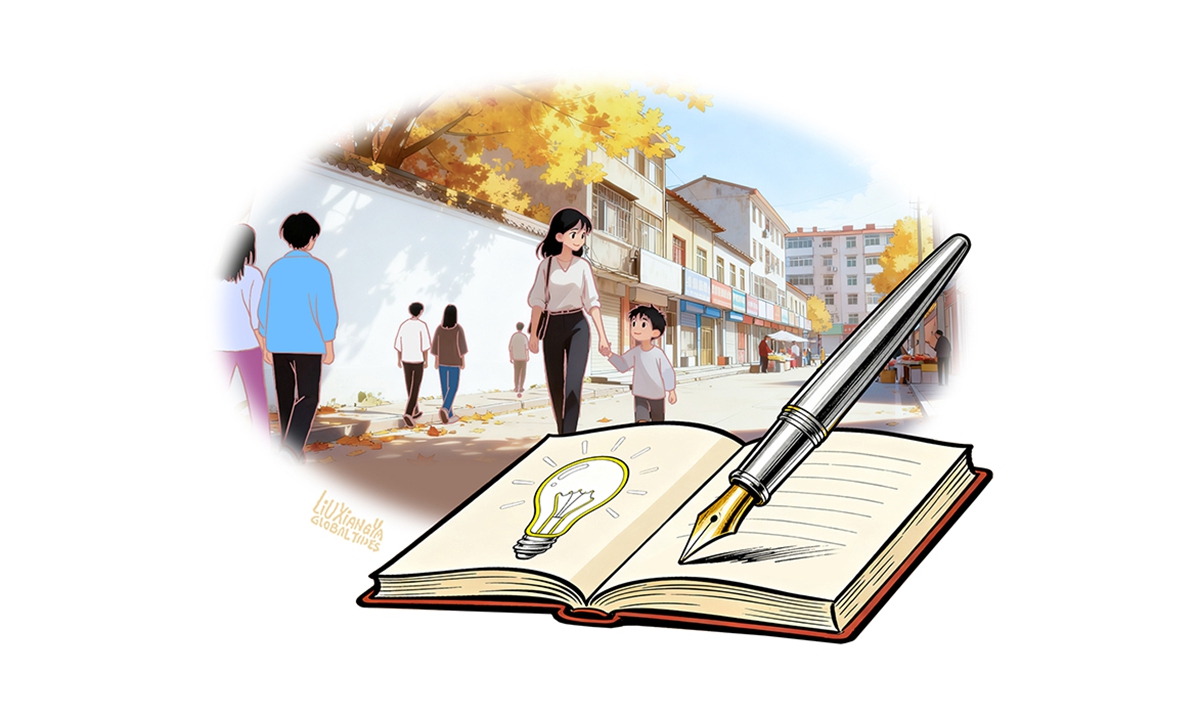
Illustration: Liu Xiangya/GT
Including Alai and Li Juan, several acclaimed contemporary Chinese writers have recently headed to counties across the country to share their literary experiences with local creators. Taking Li, known for her bestselling My Altay, as an example, these writers are no doubt the trend-setters of the current Chinese literary scene. After earning domestic and international fame, broad readership and rich publishing resources, why are these writers still intrigued by off-center literary settings? The growing popularity of "county literature," also known as "small-town literature," holds the answer to this question.
While using the noun "county" to describe "literature" may sound somewhat odd, the emergence of "county literature" is in fact deeply rooted in geographical context.
Unlike "rural" or "urban" settings, the county is like a cultural middle ground, in other words, a hub of both urban and rural narratives. Stories of counties often retain the rustic connection to locality found in rural literature, while also engaging urban subjects such as family, jobs, people-to-people relationships and romance.
Such a fusion makes stories set in counties diverse. At the same time, being influenced by both rural and urban scenes, narratives about county people are also filled with theatrical twists. For instance, born in a county in East China's Jiangxi Province, writer A Yi worked as a police officer before seeking opportunities in big cities. Works like his Betrothed Wife are mirrors of his experiences.
It is exactly the dynamics in county literature's people and stories that makes it stand out from other literary trends. The language of county-level writers might lack polish, and their narrative structure may seem loose, yet it is precisely this raw creativity that allows county literature to deliver a "sense of real human connection."
Unlike classic works' grand themes or the cookie-cutter house-children-marriage plots of urban tales, county literature often depicts how mundane figures' fates can reflect the changes of the times. The ability to reveal what is universal through the mundane is where literary tension truly manifests.
That is to say, "county literature" possesses the essence of literary sensibility. The "county" itself is also the very site of where literary works are incubated. This may explain the reason why many master writers still want to go back to the county level, because that is where they are likely to find more inspiration for their next masterpiece.
What is noteworthy is that when established writers visit these counties, they often engage not by promoting their own accomplishments, but by sharing their creative methods and reflections on local culture. In Xixia county, Central China's Henan Province, for instance, Lu Xun Literature Prize Winner Guan Renshan discussed his approach to character development, offering inspiration to a local writer with disabilities.
Traditionally, the concept of "bringing cultural services - including literature - to the grassroots" was stereotyped as a form of "cultural poverty alleviation," implying a one-way transfer from the giver to the receiver.
Yet Guan's interaction with the local writers in the county reflects a shift in how cultural services at the grassroots are manifested today in China: Established cultural workers are adopting a humbler stance to provide practical, creative support at the grassroots level.
Such a shifted cultural stance illuminates the current relationship between the cultural center and cultural periphery that are both served as important parts of Chinese society. Also, the relationship between literature and the county environment are no longer one of hierarchy but of mutual integration.
On the one hand, such mutual integration can encourage grassroots writers to narrate their own stories with more refined literary techniques. On the other hand, writers without prior grassroots experience can also broaden their creative horizons by experiencing local culture.
The current rise of county literature is also closely tied to China's improvement in grassroots cultural service facilities.
Xiji county, located in Northwest China's Ningxia Hui Autonomous Region, is home to over 1,000 writers residing across its 300 administrative villages. To support local literary creation, the county has established cultural reading rooms in every village, where farmers often read and write after a day's work in the fields.
Meanwhile, more than 20 school-level literary societies have been founded throughout the county, providing a platform for young grassroots creators to develop their skills and exchange ideas.
Through such an agenda, literature appears to have transcended its role as a mere hobby for a handful of villagers. It can become a cornerstone of the county's strategy for future development. Imagine the potential: The local community leverages its literary tradition to boost its cultural tourism, or the integration of literary education into the regional curriculum through the expansion of Xiji county's literary societies.
If a county's unique cultural and geographical soil gives rise to literature creations, then its cultural service facilities are what allow the value of those creations to endure. In this way, "county literature" truly serves the county.
The author is a reporter with the Global Times. life@globaltimes.com.cn
RELATED ARTICLES