Senior official meets with Tsinghua board led by Apple CEO
Meetings underscore China’s openness, two-way engagement with foreign investors: expert
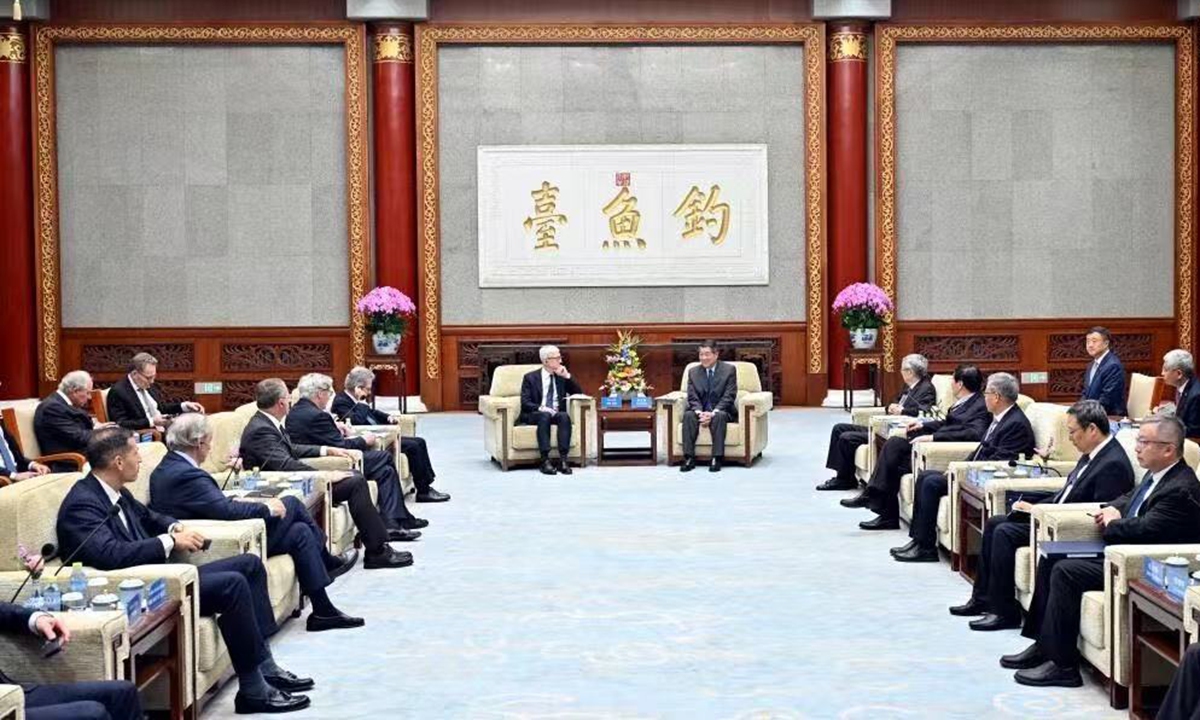
Chinese Vice Premier He Lifeng, also a member of the Political Bureau of the Communist Party of China Central Committee, meets with representatives of the advisory board of the Tsinghua University School of Economics and Management (Tsinghua SEM) at the Diaoyutai State Guesthouse in Beijing, capital of China, Oct. 16, 2025. Photo: MOFCOM
Chinese Vice Premier He Lifeng met with members of the Advisory Board of Tsinghua University School of Economics and Management (Tsinghua SEM), including the board's chairman, Apple CEO Tim Cook in Beijing on Thursday.
During the meeting, He, also a member of the Political Bureau of the Communist Party of China Central Committee, said that China is advancing the establishment of a unified national market, firmly expanding high-standard opening-up, and striving to achieve stable economic growth.
He expressed China's readiness to deepen mutually beneficial cooperation with countries around the world and share the opportunities of high-quality development to achieve win-win results.
He also called on the board members to continue serving as bridges between China and the world and to actively support China's economic development and international exchanges.
The members, including Cook, expressed strong confidence in China's development prospects and said that they would continue to deepen their presence in the Chinese market and further expand investment and cooperation with China.
Also on Thursday, Chinese Minister of Commerce Wang Wentao met with Cook in Beijing. They exchanged views on China-US economic and trade relations and the development of Apple's business in China, according to a release on the ministry's official WeChat account.
During the meeting, Wang expressed hope that the US side would work with China, guided by the important consensus reached between the two heads of state, to seek solutions through dialogue and consultation, and to foster a more stable and predictable environment for cooperation between enterprises of both countries.
The Chinese government will unswervingly advance high-standard opening-up, continuously improve the business environment, and enable foreign-invested enterprises to share in the opportunities of China's development. We welcome Apple to continue deepening its cooperation with China and expanding its investments in the country, Wang said.
Cook said Apple is committed to remaining firmly rooted in China, deepening its local presence, and actively participating in China's pursuit of high-quality development, according to the release.
A sound US-China economic and trade relationship is vital for both nations and conducive to global economic stability and growth. Apple stands ready to contribute positively to fostering win-win cooperation between the two countries, Cook said, according to the release.
Chinese experts said that the meetings underscored China's openness to mutual engagement and two-way commitment with foreign investors operating in the country.
China has remained steadfast in its commitment to market openness, actively supporting and facilitating the operations of foreign enterprises that comply with laws and regulations, Xiang Ligang, director-general of the Beijing-based Information Consumption Alliance, told the Global Times on Thursday.
"For Apple, China is one of its largest markets and a key manufacturing hub for iPhones. Cook has visited China multiple times, seeking to boost iPhone sales in the country as part of his broader market strategy," said Xiang.
In sharp contrast, the US government's trade barriers are undermining global trade, Xiang said.
On October 10, He also welcomed leaders of several multinational companies to invest in China and deepen dialogue and cooperation.
He encouraged multinationals to expand their investment in China, saying the country will continue to expand its high-standard opening-up, during a meeting with the leaders of three multinational companies: Abbott Laboratories from the US, Prudential from Britain, and SK Group from the Republic of Korea, the Xinhua News Agency reported.
During the meeting, He said that China's economy has stable foundations, numerous strengths, remarkable resilience and vast potential, noting that the dominant trend of a long-term, sound Chinese economy and the elements supporting it have not changed, per Xinhua. He encouraged the multinationals to expand their investment in China, deepen cooperation with China and share development opportunities.
The company leaders also voiced confidence in China's economic outlook and pledged to deepen investment and cooperation.
China welcomes international enterprises, as long as they refrain from participating in actions that seek to contain China and operate lawfully within its borders, and the government remains committed to actively supporting and facilitating their business activities, Xiang said.
Xiang emphasized that the Chinese market is one of the largest in the world and holds vast growth potential across both the consumption and raw materials sectors. He said that exploring the Chinese market represents not only an opportunity for Chinese enterprises but also a major chance for many foreign companies, adding that most foreign enterprises should value and seize this opportunity.
Data from the Ministry of Commerce (MOFCOM) showed that amid rising global uncertainties, China's continued commitment to opening-up has continued to attract foreign investors.
From January to August, China saw the establishment of nearly 37,000 new foreign-invested enterprises, up 11.5 percent year-on-year, with actual foreign investment exceeding 580 billion yuan ($81.38 billion), data from the MOFCOM showed.
Notably, both in comparison with other countries and against the nation's own performance over the past decade, this scale of foreign investment remained at a high level, the MOFCOM said.
RELATED ARTICLES