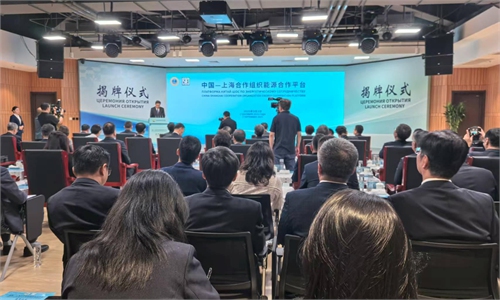
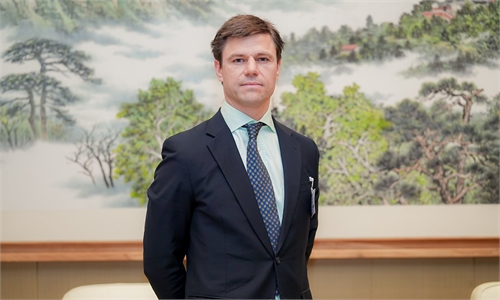
Siddharth Chatterjee, the UN Resident Coordinator in China, speaks at the Global Governance Roundtable for SCO Countries 2025 held in Beijing. Photo: Courtesy of China International Communications Group
There are great opportunities for China's economic growth prospects, as the country has implemented the 14th Five-Year Plan (2021-25) very effectively and is steadily driving toward the 15th Five-Year Plan (2026-30), Siddharth Chatterjee, the UN resident coordinator in China, told the Global Times on Thursday on the sidelines of the Global Governance Roundtable for SCO Countries 2025 held in Beijing.
"China's push to achieve a moderately prosperous society by 2035 remains on track. Meanwhile, the country's goal of striving for carbon peaking by 2030 and carbon neutrality by 2060 is on track, too. Perhaps China will achieve these results ahead of the schedule," Chatterjee said, noting that China is doing well from the prosperity agenda.
In the first half of this year, the world's second-largest economy grew 5.3 percent year-on-year, contributing roughly 30 percent of global growth and serving as a stabilizing anchor amid rising global uncertainty.
China's foreign trade powered ahead with high-quality growth in the first nine months of this year despite increasing external headwinds, according to the General Administration of Customs. Total merchandise trade in yuan-denominated terms rose to 33.61 trillion yuan ($4.73 trillion) from January-September, up 4 percent year-on-year.
China's per capita GDP is progressing and has come out of the challenges of the COVID period, he said. "I'm quite confident and optimistic about China's economic growth, prosperity, and bringing everybody along to progress toward human development," Chatterjee said.
In addition to a positive view of China's economic growth, Chatterjee said at the conference that China has emerged as a key contributor to multilateral cooperation over the past decades.
Through the Global Development Initiative, it has aligned South-South cooperation and the Sustainable Development Goals, supporting projects in poverty reduction, food security, and green transition. Through the Global Security Initiative, it has reaffirmed the centrality of the UN Charter, serving as the largest troop contributor and second-largest financial contributor among Security Council members to UN peacekeeping, and extending support to African Union operations, he said.
Through the Global Civilization Initiative, it has promoted dialogue and mutual understanding, culminating in the UN's recognition of June 10 as the International Day for Dialogue Among Civilizations, according to Chatterjee.
With the aim to work with all countries to build a fairer and more inclusive global governance system and strive for a community with a shared future for humanity, China proposed the Global Governance Initiative (GGI) at the Shanghai Cooperation Organization (SCO) Summit 2025 held in North China's Tianjin on September 1.
The GGI weaves these strands together into a forward-looking framework for reform. It calls for a system in which developing countries have a stronger voice, where technology advances human well-being rather than division, and where global rules evolve through consultation and consensus, he said.
"This vision aligns with the message of UN Secretary-General António Guterres, who welcomed the initiative as one 'anchored in multilateralism and underscoring the importance of safeguarding the international system with the UN at its core'," Chatterjee said.
"At the national level, the UN Country Team in China, which I am privileged to lead, continues to work in close partnership with the government of China to translate global commitments into concrete results. Guided by the UN Sustainable Development Cooperation Framework, our collaboration supports China's journey toward carbon neutrality, inclusive innovation, and enhanced global engagement, including through cooperation with the SCO region and beyond," he said.
The SCO provides an ideal platform to advance this agenda. With its vast and diverse membership spanning Eurasia, South Asia, and the Middle East, the SCO embodies the energy and diversity of the Global South. Its principles of the Shanghai Spirit - mutual trust, mutual benefit, equality, consultation, respect for diversity, and pursuit of shared development - closely align with the essence of multilateralism the world urgently needs, according to Chatterjee.
The roundtable is jointly held by the China International Communications Group, the Secretariat of the SCO, and the China Institute of International Studies.
RELATED ARTICLES