2025 World Intelligent Connected Vehicles Conference opens in Beijing, as Chinese efforts at making smart EVs gain global attention
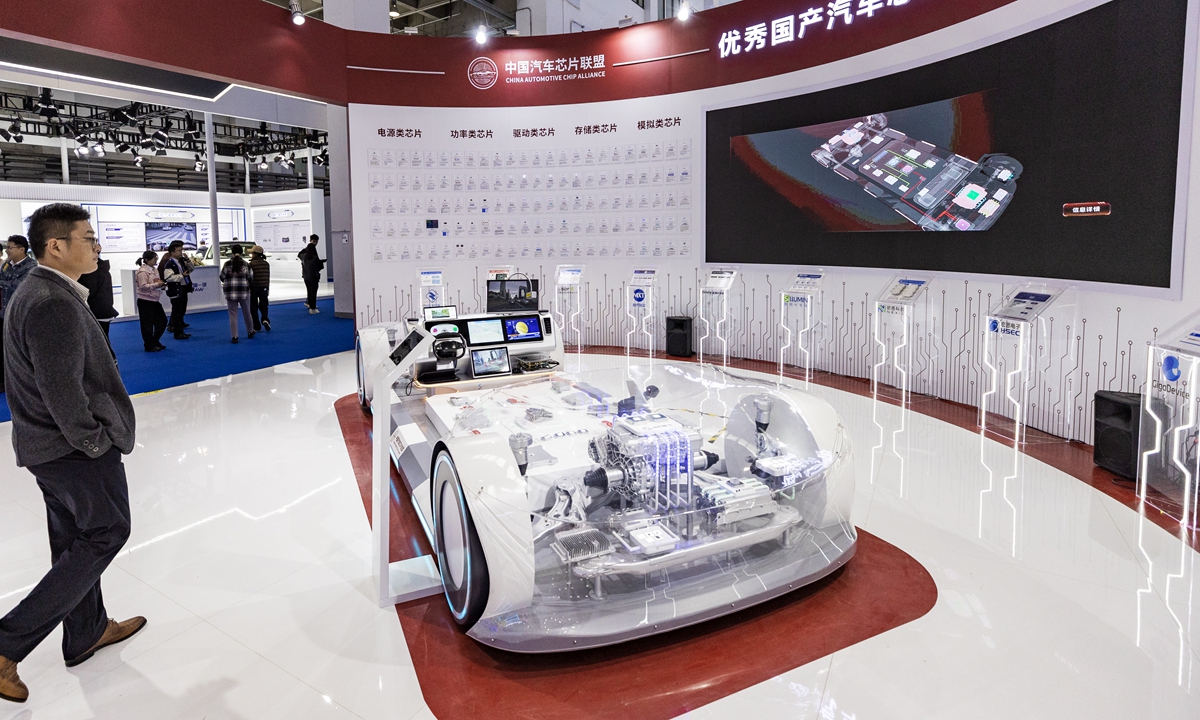
The 2025 World Intelligent Connected Vehicles Conference kicks off in Beijing on October 16, 2025. Photo: VCG
The 2025 World Intelligent Connected Vehicles Conference kicked off in Beijing on Thursday, marking the first time foreign ministerial-level officials have attended the event, according to China Media Group (CMG).
The three-day conference, co-hosted by China's Ministry of Industry and Information Technology (MIIT), the Ministry of Transport, and the Beijing Municipal Government, brings together about 1,000 participants from industry, academia, and research institutions at home and abroad to discuss new trends, developments, and business models in the global intelligent connected vehicle (ICV) sector.
The conference, themed "Pooling wisdom for boundless connectivity," features three plenary sessions and three forums focusing on policies, technology, safety, artificial intelligence (AI), applications, and data in the ICV industry.
Guo Shougang, deputy director-general of the department of equipment industry at the MIIT, said that the conference aims to advance practical international cooperation. For the first time, the conference invited foreign ministerial-level officials to attend and organized events such as "Foreign Diplomatic Missions in China Visit the Automotive Industry." In addition, China-UK and China-Germany bilateral cooperation meetings will be held to promote comprehensive collaboration.
During the conference, a series of events will be announced, including the establishment of national pilot bases for AI vehicle applications, the unveiling of the top 10 vehicle-road collaboration scenarios, and progress in ICV standardization.
According to the MIIT, Minister Li Lecheng met in Beijing on Thursday with South Korean Minister of Land, Infrastructure and Transport Kim Yun-duk, who is attending the conference. The two sides exchanged views on strengthening cooperation in the ICV sector.
At the conference, automakers showcased their latest innovations.
China's autonomous driving company WeRide deployed up to 10 next-generation mass-produced Robotaxi GXRs and several Robobus shuttles to provide autonomous shuttle services for attendees from October 15 to 18, according to a statement the company sent to the Global Times.
WeRide also exhibited four autonomous models — the Robotaxi GXR, Robobus, sanitation truck S6, and sweeper S1 — demonstrating applications in mobility and urban services. The GXR supports 24/7 driverless operation, while the other models focus on short-distance transport and unmanned cleaning.
Another autonomous driving company Pony.ai and BAIC New Energy unveiled the Arcfox Alpha T5 Robotaxi, jointly developed as part of the "Beijing Solution" for China's autonomous driving industry. The vehicle, equipped with Pony.ai's 7th-generation system, began mass production in July and supports all-weather operation, according to a statement Pony.ai sent to the Global Times.
Now licensed for road testing in Beijing and Shenzhen, South China's Guangdong Province, the model is set for large-scale deployment this year. The use of automotive-grade components has helped cut L4-system costs by 70 percent, advancing mass production of autonomous vehicles, the company said.
During the 14th Five-Year Plan (2021-25) period, China's intelligent connected vehicle industry has made notable progress. Nearly 100 technological standards have been introduced, and 20 pilot cities have launched integrated "vehicle-road-cloud" applications, while more than 60 percent of new passenger cars are now equipped with combined driver-assistance systems, according to CMG.
Wu Shuocheng, a veteran auto industry analyst, told the Global Times on Thursday that China's intelligent connected new-energy vehicles now lead the world not only in production and sales, but also in key innovations and applications. The international cooperation sessions, he noted, serve as a platform to showcase these strengths and would help Chinese vehicles expand on the global market.
Guo said that ICVs represent the strategic direction of the auto industry's transformation. During the 14th Five-Year Plan period (2021-2025), China has built a complete industrial system covering smart cockpits, autonomous driving, and cloud-based connectivity, with advances in high-performance auto chips, multimodal sensing, and intelligent chassis control, as well as globally leading progress in human-machine interaction, he said.
RELATED ARTICLES