China cracks major transnational fraud case led by Myanmar-based Xu Faqi, involving illicit gains over $150 million: authority
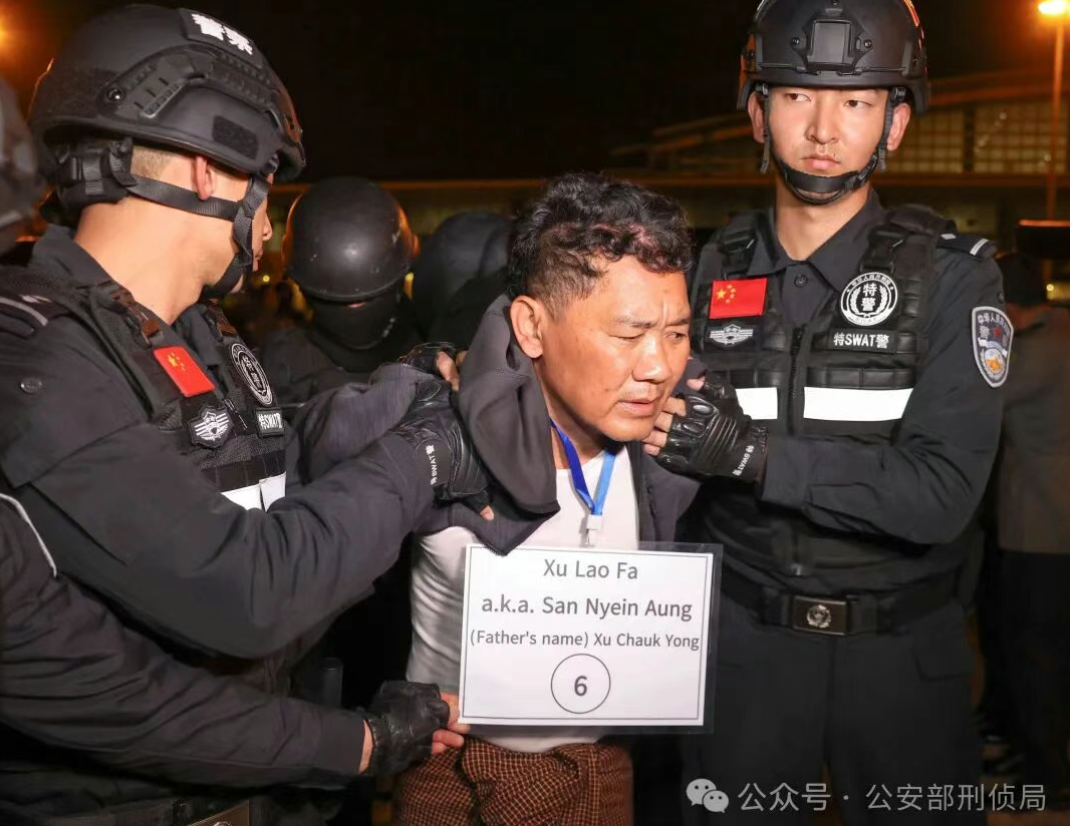
China's Ministry of Public Security announces on October 17, 2025, that authorities have successfully cracked a major transnational criminal case involving the notorious Myanmar-based Kokang gang leader Xu Faqi, also known as Xu Laofa. Photo: China's Ministry of Public Security
China's Ministry of Public Security (MPS) announced on Friday that authorities have successfully cracked a major transnational criminal case involving the notorious Myanmar-based Kokang gang leader Xu Faqi, also known as Xu Laofa, who was recently brought to justice under the China-Myanmar law enforcement cooperation framework.
The criminal organization, with Xu as its principal leader, is suspected of multiple offenses including fraud, intentional injury, illegal detention, and extortion. The group is linked to more than 3,400 fraud cases involving illicit gains exceeding 1.1 billion yuan (about $150 million), according to the MPS.
According to the ministry, the Chongqing Municipal Public Security Bureau was assigned to investigate the case in September 2023 as part of a nationwide operation targeting cross-border criminal networks in northern Myanmar. After months of intensive investigation, Chinese police gathered extensive evidence of Xu's alleged criminal activities, leading to an official public wanted notice issued in December 2023.
On January 30, 2024, Myanmar police arrested Xu Faqi and transferred him to Chinese custody under the China-Myanmar law enforcement and security cooperation mechanism.
To uncover the full scope of Xu's criminal operations, Chinese investigators—risking active conflict in northern Myanmar—worked jointly with Myanmar authorities, collecting substantial material evidence crucial to the case. In China, more than 300 officers from Chongqing police were dispatched across 18 provinces and cities, including Fujian, Guizhou, Gansu, and Yunnan, to gather witness statements and corroborate evidence.
From September 17 to 19, 2025, the Chongqing No.5 Intermediate People's Court held a public first-instance trial of Xu Faqi and his criminal organization.
Since 2019, Xu headed a major criminal syndicate operating in the Kokang region of northern Myanmar, according to the investigation.
Leveraging his local influence, Xu collaborated with telecom fraud groups to establish and rent 14 large-scale scam compounds, including the Tianzi hotel, Dongcheng industrial park, Bao Bao Zhai, and the 311 building. These sites became key bases for large-scale telecom and online fraud targeting Chinese citizens, the investigation revealed.
Authorities said Xu controlled more than 400 armed militiamen who provided armed protection for the scam compounds, allowing the syndicate's financial backers to violently enforce control. Those who disobeyed or failed to meet fraud targets were subjected to brutal punishments, including physical abuse, torture, and even killings.
Within Xu's fraud zones, investigators documented one case of intentional homicide, one case of serious injury, and dozens of cases of illegal detention and extortion.
RELATED ARTICLES