China expresses deep condolences over passing of former Japanese PM
'Murayama Statement' serves as cornerstone for Japan to face up to history: expert
By and Xing Xiaojing Published: Oct 17, 2025 11:36 PM

Chinese Foreign Ministry
China expresses deep condolences over the passing of former Prime Minister Murayama Tomiichi. Our hearts go out to his family, Chinese Foreign Ministry spokesperson Lin Jian said on Friday, calling Murayama an old and dear friend of the Chinese people and long committed to China-Japan friendship.
Japan's former Prime Minister Murayama Tomiichi died at 101 on Friday, multiple Japanese media reported.
Born on March 3, 1924, in Oita City, Oita Prefecture, Murayama became prime minister in 1994.
Murayama was known for, on August 15, 1995, issuing the historic cabinet-endorsed statement, "Murayama Statement," in which he acknowledged that Japan had pursued a misguided national policy and followed the path of war. The statement explicitly recognized that Japan's "colonial rule and aggression, caused tremendous damage and suffering to the people of many countries, particularly to those of Asian nations," and expressed "deep remorse and heartfelt apology." The statement was widely recognized by the international community.
Subsequent prime ministers echoed similar sentiments on the 60th and 70th anniversaries, but their wording gradually weakened. Prime Minister Junichiro Koizumi's 2005 statement retained terms like "colonial rule and aggression," "remorse," and "apology," yet omitted acknowledgement of "erroneous national policy," Xinhua reported.
Murayama was a statesman who left behind an important political legacy in Japan's postwar politics, Xiang Haoyu, a distinguished research fellow at the Department for Asia-Pacific Studies of the China Institute of International Studies, told the Global Times on Friday.
"Murayama Statement" set a benchmark for Japan's historical awareness, and Murayama was regarded as a "conscientious politician" who played a crucial role in advancing the process of historical reconciliation between Japan and its Asian neighbors, Xiang said.
Spirit of 'Murayama Statement'
Lin said that in May 1995, then Prime Minister Murayama visited Lugou Bridge and the Museum of the War of Chinese People's Resistance Against Japanese Aggression during his visit to China, and wrote down the words "face up to history and pray for friendship and ever-lasting peace between Japan and China."
On August 15 of the same year, which marked the 50th anniversary of Japan's announcement of unconditional surrender, then Prime Minister Murayama issued a statement on the historical issues, making a profound reflection on Japan's colonial rule and aggression and expressing apologies to the victim countries of the war. He is a statesman with a strong sense of justice, and his contribution to enhancing China-Japan friendship will be forever remembered, the spokesperson said.
Murayama was first elected to the House of Representatives in 1972 and served as leader of the then Socialist Party, which is now known as the Social Democratic Party, the Japan News reported.
He became prime minister in 1994 in a coalition government formed with the Socialist Party, the Liberal Democratic Party and the New Party Sakigake, according to the Japanese media report.
After leaving office, Murayama continued to devote himself to promoting friendship between China and Japan, Xiang noted.
"He visited China many times, actively supported and advanced people-to-people exchanges between the two countries, and stressed the importance of building a long-term peaceful and friendly relationship between Japan and China," Xiang said, noting that at a time when Japan's political rightward shift and historical revisionism are gaining momentum, Japanese politicians should revisit Murayama's political legacy, uphold pacifism, and foster good relations with Asian neighbors in a spirit of learning from history and looking into the future.
Takakage Fujita, the Secretary-General of the Association for Inheriting and Propagating the Murayama Statement, told the Global Times on Friday that the "Murayama Statement" serves as an important cornerstone for Japan to face up to its history and look toward the future.
The association has just held an emergency executive meeting, during which it decided to honor former Prime Minister Murayama, who fulfilled Japan's postwar historical mission, by more firmly safeguarding, inheriting, and advancing the spirit of the "Murayama Statement." The association also pledged to devote its full efforts to related work in the future.
In an exclusive interview with the Global Times, Fujita revealed the upcoming memorial schedule: a wake is planned for Saturday; a private funeral for family members will be held on Sunday; and farewell ceremonies are scheduled for Monday in both Tokyo and Oita, with a larger number of attendees expected.
Fujita said the "Murayama Statement" holds great historical significance, as it acknowledged Japan's history of colonial rule and aggression and expressed remorse and apology.
However, with Sanae Takaichi being elected as the new president of the Liberal Democratic Party (LDP) and possibly becoming Japan's next prime minister, the country's political landscape is showing signs of shifting toward conservative and right-wing tendencies. "In light of this situation," Fujita stated, "we must more resolutely defend and uphold the 'Murayama Statement,' strengthen related initiatives, and help the Japanese people foster a correct understanding of history."
To reflect on its history
Shortly before his passing, outgoing Prime Minister Shigeru Ishiba delivered a personal statement on October 10 to mark the 80th anniversary of the end of World War II, focusing on "why domestic political systems were unable to brake the momentum toward war." Chinese analysts said even if Ishiba touches upon some sensitive issues, he failed to offer a sincere apology to the people of the victimized countries for the history of aggression.
On the same day of the passing of Murayama, Japanese media reported that on the three-day autumn festival held at Yasukuni Shrine, which enshrines Class-A war criminals from World War II, starting Friday, Japanese Prime Minister Ishiba, in his capacity as "Prime Minister of the Cabinet," sent a ritual offering. Meanwhile, Japanese Ruling LDP head Takaichi also made a monetary offering using her own funds.
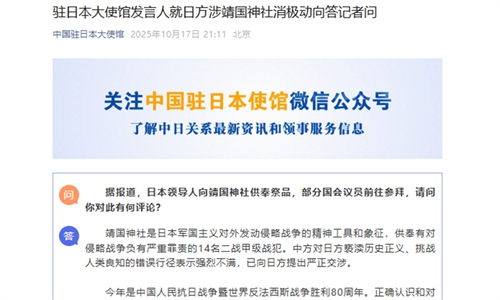
In response, the ministry's spokesperson Lin said on Friday that China is firmly against Japan's latest negative moves related to the Yasukuni Shrine and has lodged serious protests.
We urge Japan to face squarely and reflect on its history of aggression, be prudent on historical issues such as the Yasukuni Shrine, make a clean break with militarism, stick to the path of peaceful development, and earn the trust of its Asian neighbors and the international community through real actions, said spokesperson Lin.
South Korea also expressed deep disappointment and regret Friday following the passive moves of the Japanese side, the Yonhap News Agency reported.
"China's response reflects a balance between history and current affairs, underscoring its principled stance," Chen Yang, visiting research fellow at the Institute of Japan Studies at Liaoning University, told the Global Times on Friday.
Expressing condolences over the passing away of a former Japanese prime minister is a standard diplomatic practice for China. Even when tensions or disagreements exist between China and Japan, Beijing maintains basic diplomatic courtesy and respect, Chen said, emphasizing that as Murayama had long devoted himself to promoting China-Japan friendship, it was natural for the Chinese Foreign Ministry to express condolences upon his passing.
The Yasukuni Shrine involves issues of wartime aggression, war crime responsibility, and moral legitimacy — all long-standing "principled issues in China's Japan policy. By expressing both condolences and criticism, China signals that it seeks to maintain normal diplomatic engagement while firmly upholding its position on key historical matters." Chen said.
RELATED ARTICLES